Get Full Government Meeting Transcripts, Videos, & Alerts Forever!
Get email alerts on the Licensing Roundup topic
No spam. Unsubscribe anytime.
Licenses committee clears dozens of routine renewals, issues provisional holds and conditions on curbside trash and security
Summary
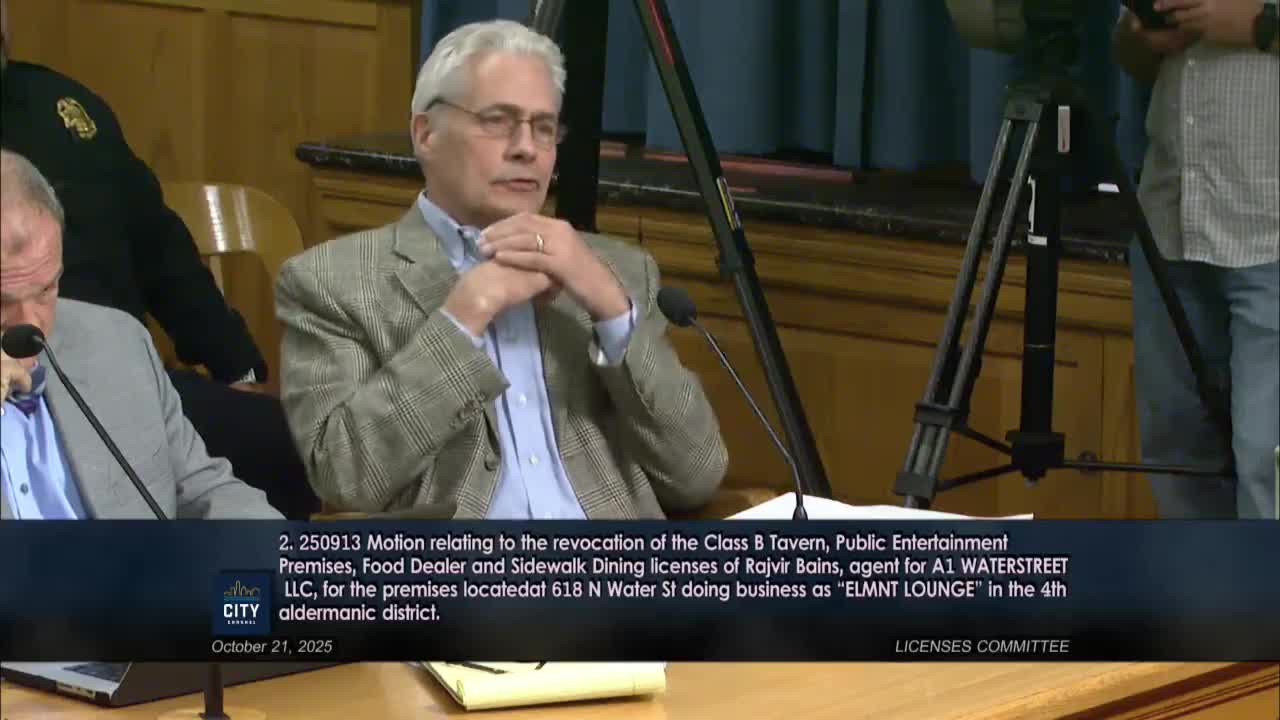
After the Element Lounge revocation hearing, the committee processed many agenda items: several licenses were renewed with warning letters, others were placed on hold pending neighborhood meetings or proof of fixes, and a small number of businesses received suspensions held in abeyance tied to cleanup or training commitments.
The licenses committee processed a wide swath of routine renewals and administrative holds at its Oct. 21 meeting. Most matters were approved by voice vote or on no objection; a handful were held to the call of the chair or renewed subject to warnings or conditions.
Notable administrative outcomes
- Renewals with conditions: multiple food‑dealer and tavern renewals were approved with written warning letters and explicit conditions added to the plan of operation (examples: twice‑daily or thrice‑daily litter pickups; posting of no‑loitering signage; a documented training module for employees on ID checks and de‑escalation; proof of payments of city fees). The committee required some applicants to provide documentation of completed training or cleaning logs as follow‑ups to the Licensing Division.
- Provisional permits and holds: several applicants who had let licenses lapse were issued administrative provisional permits so they could operate while they completed required payments or repairs; other items were simply held to the call of the chair to allow neighborhood meetings or additional paperwork to be filed.
- Small suspensions: in one case the committee approved a 32‑day suspension held in abeyance payable to compliance (applicant agreed to strengthened litter pickup and participation in neighborhood cleanup coordination).
Why it matters: The committee’s actions show a mix of remedial and punitive approaches: most businesses were renewed or provisionally returned to operation, but the committee used warnings, limited suspensions and plan‑of‑operation amendments to press licensees to address litter, security and employee training. The approach reflects the committee’s preference for in‑place remedies where possible, reserving revocation for the most serious public‑safety cases.
What applicants said: Many applicants agreed to add concrete steps to their plan of operation—examples include documented daily clean‑ups, ability to submit receipts showing payment of city fees, increased staff training on ID checks, and willingness to coordinate with aldermanic offices and the police on code‑red deployments.
What’s next: Licensing staff will follow up with requested documentation, including training rosters, completed payment receipts, camera access logs when requested by police, and evidence of no‑loitering signage. Items held to the call of the chair will be re‑noticed when applicants complete the requested steps.