
Staff: state general revenue stable but growth slowing; staff explains millage rules, rollback and timelines
Get AI-powered insights, summaries, and transcripts
Sign Up Free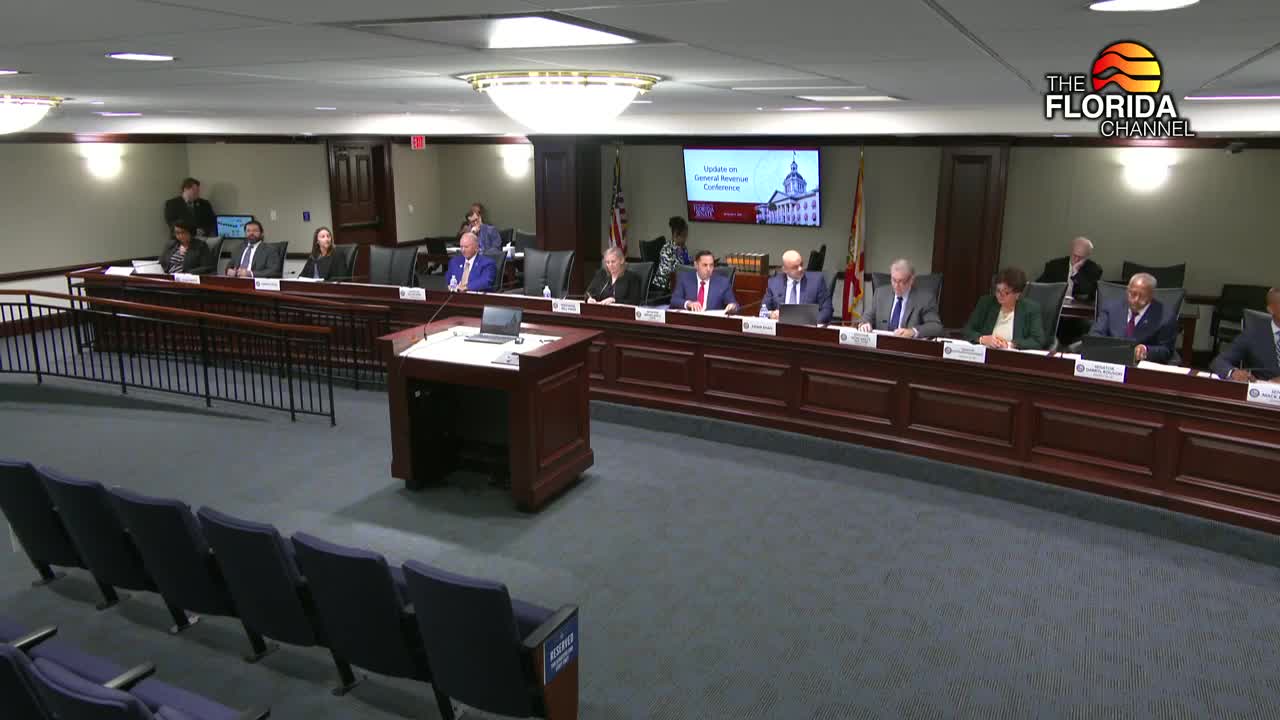
Summary
Azar Khan, the committee staff director, presented the General Revenue conference update and reported trailing-12-month collections roughly $1 billion over estimate while noting growth has moderated and earnings on investments are a recent driver of added revenue.
Azar Khan, the committee staff director, presented the General Revenue (GR) conference update and described recent collection patterns and forecasting inputs. Khan said trailing 12-month collections were "roughly just shy of a billion dollars in these trailing 12 months over the estimate" and averaged "about $80,000,000 a month over the estimate," while the prior-year trailing 12 months were nearly $2 billion over the estimate (about $180 million a month). He cautioned growth has slowed compared with prior years and noted the conference did not build pandemic-related transfers into the baseline going forward.
Khan emphasized that much of the recent incremental GR additions were driven by earnings on investments rather than typical revenue sources such as sales or corporate income taxes: "a bulk of what we added to the general revenue is coming from earnings on investment. It's not our usual driver for the forecast." He said the new forecast cycle begins in December with a January update.
Khan then provided an extended explanation of ad valorem millages. For school districts he listed five separate millages: required local effort (RLE, nonvoted), discretionary local effort (DLE, nonvoted), voted district operating millages (two-, four-year options), a nonvoted capital outlay millage (1.5 mills), and voted debt-service millages. He noted school millages combined cannot exceed 10 mills except by referendum and said the RLE for fiscal year 25-26 was "just a hair over 3 mils" while the DLE was about "0.748 mils."
Khan explained the rollback rate with a numeric example: if taxable value on a property rises from $100,000 to $115,000, a taxing authority can lower its rate from 10 mills to about 8.6957 mills and collect the same total revenue. He reviewed the TRIM timeline (taxable-value certification July 1; TRIM notices mailed August 24; tentative and final hearings in August/September) and voting thresholds for millage adoption (majority to levy last year's rate or maximum; two-thirds to exceed maximum up to 110%; higher thresholds or referendum required to go beyond that).
On long-term trends, Khan showed that aggregate statewide millage rates have declined over 25 years while taxes levied have increased because of rising taxable values. He said millage variance is greater across counties for non-school millages than for school millages.
During the Q&A, Senator Gates asked whether backfilling homestead-related ad valorem taxes with a higher sales tax was feasible; Mr. Conn and Khan provided a ballpark calculation that a full backfill could translate to approximately a 2.8 percentage-point increase in the sales tax before accounting for behavioral effects. Senator Russon asked about a negative adjustment in the corporate income tax forecast; Khan attributed it to changes in national profit expectations and monthly collection patterns and offered to follow up with details.
Lisette Kelly of the Department of Revenue confirmed DOR collects TRIM uploads and has jurisdiction-level adopted millage, rollback-rate, and maximum-millage calculations available and offered to provide those files to the committee. The committee took no fiscal actions at the meeting; staff will distribute additional data and analysis to members.