Get Full Government Meeting Transcripts, Videos, & Alerts Forever!
Get email alerts on the Muslim Commission topic
No spam. Unsubscribe anytime.
Supporters and critics debate proposed Massachusetts Muslim commission at committee hearing
Summary
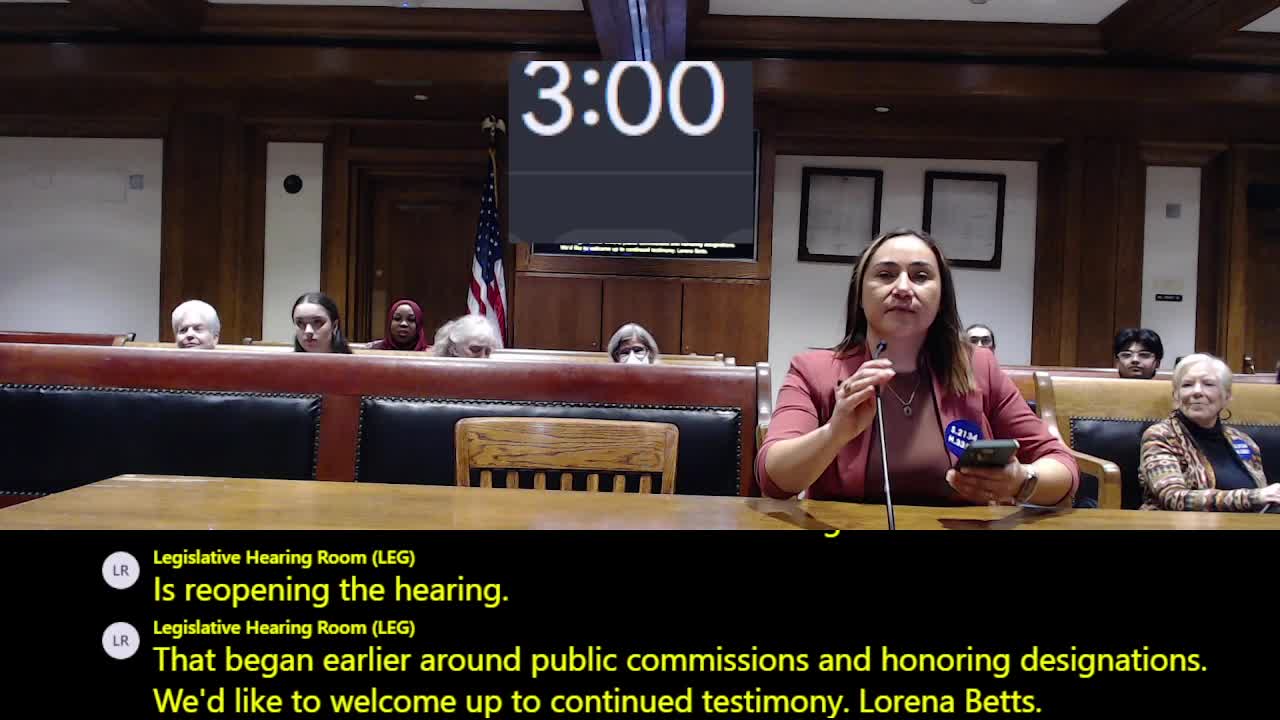
The Joint Committee on State Administration and Regulatory Oversight reopened testimony on legislation to create a Massachusetts Muslim commission, with supporters urging a favorable report and one witness warning the measure could centralize authority over who is recognized as a Muslim.
The Joint Committee on State Administration and Regulatory Oversight reopened testimony on legislation to create a Massachusetts Muslim commission, with supporters urging a favorable report and one witness warning the measure could centralize authority over who is recognized as a Muslim.
Loretta Betts, president of the Peacemakers Network, told the committee that the commission would "identify and recommend qualified Muslim residents for appointments in government" and assess how state programs affect Muslim communities. "It will also promote opportunities that allow the state to benefit from the skills, talents, and cultural heritage of Muslim Americans," Betts said at the hearing.
Susan Eskewitz of Jewish Voice for Peace said Jewish and Muslim communities share experiences of hate and discrimination and that backing the bill strengthens civic ties. "We support this bill because uniting in this effort with our Muslim friends and neighbors strengthens the civic and social fabric here in our state," Eskewitz said.
A young speaker described childhood harassment and urged the committee to address Islamophobia in schools, citing CAIR Massachusetts data that a portion of students who were taught about Islam reported biased or factually incorrect curriculum. "A Muslim commission would allow lawmakers to address Islamophobia in education," the witness said.
Not all testimony was uniformly supportive. Akmal Desfahani, who served in multiple levels of government, said the bill as drafted risks allowing "those with only a superficial or political connection to Islam" to occupy positions of authority and could enable an appointed body to claim it speaks for all Muslims in the Commonwealth. "What begins as an inclusion could become a co-optation," Desfahani testified.
Mark Stern, representing the National Lawyers Guild Massachusetts chapter, described increased discrimination and said the Guild supports the commission because its goals align with protecting civil rights and liberties. He added that lawyers in his field have seen more discrimination and retaliation reported by Muslim clients in recent years.
The hearing record in the transcript contains no committee vote on S.2134 or H.3351. After public testimony concluded, the chair entertained and approved a motion to close the hearing; no further committee action on the bills was recorded.
Advocates framed the measure as a structural step toward inclusion and improved policy oversight; critics cautioned about definitions of community representation and the risk of concentrating authority in a single, state-recognized body. The committee did not issue a recommendation during the session recorded in the transcript.