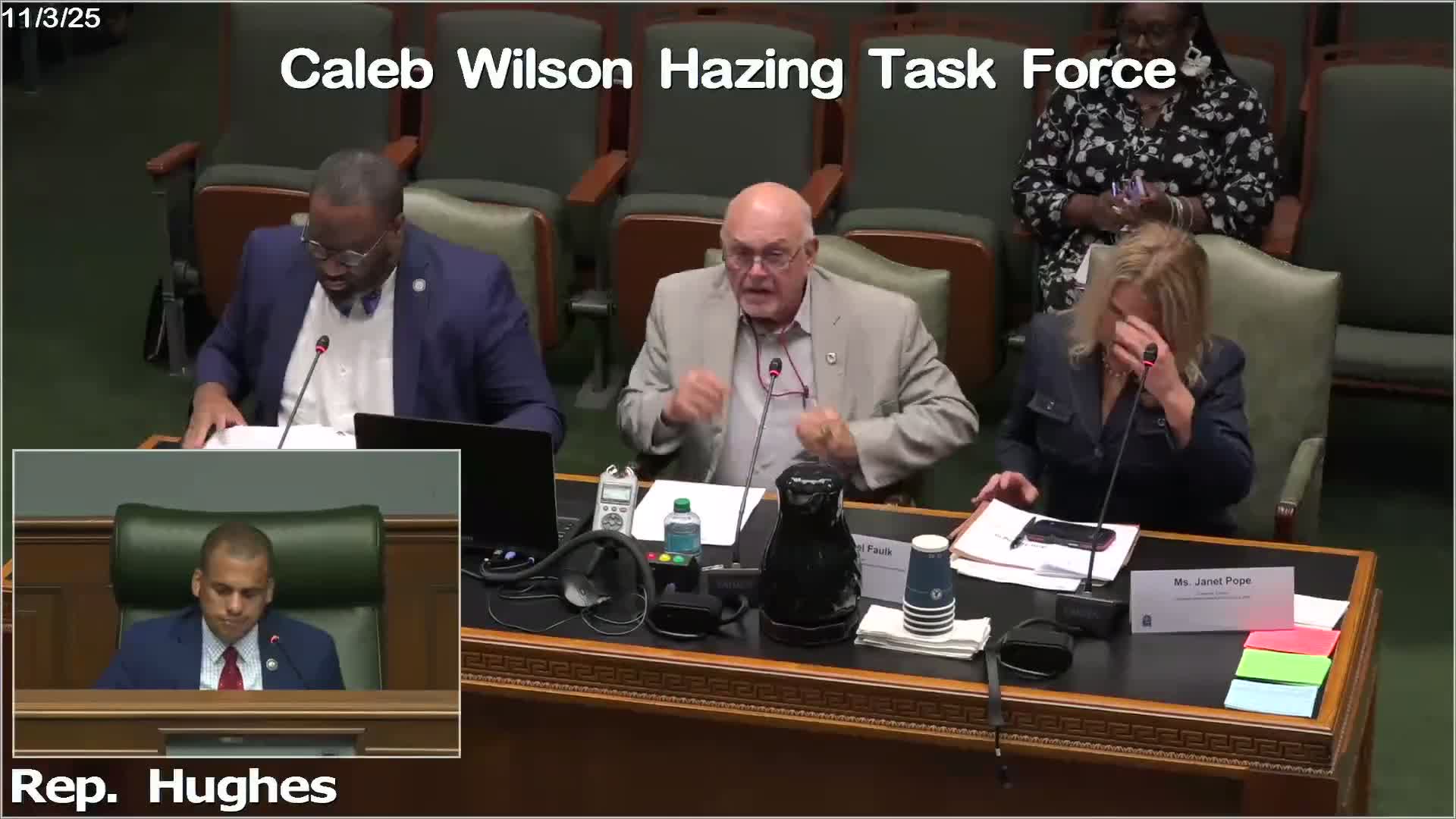
K–12 officials tell task force Louisiana law requires student codes of conduct; districts urged to expand hazing education

Caleb Wilson Hazing Prevention Task Force · November 3, 2025

Get AI-powered insights, summaries, and transcripts

Subscribe
AI-Generated Content: All content on this page was generated by AI to highlight key points from the meeting. For complete details and context, we recommend watching the full video. so we can fix them.

Summary

At the Nov. 3 meeting of the Caleb Wilson Hazing Prevention Task Force, Tavares Walker, executive director of the Louisiana State Board of Elementary and Secondary Education (BESE), told legislators ‘‘every school in Louisiana must adopt a student code of conduct that includes prohibitions against bullying and that prohibition must align with state law that's found in title 17, section 4 16, 13, 14, 15 and 16.’’

At the Nov. 3 meeting of the Caleb Wilson Hazing Prevention Task Force, Tavares Walker, executive director of the Louisiana State Board of Elementary and Secondary Education (BESE), told legislators ‘‘every school in Louisiana must adopt a student code of conduct that includes prohibitions against bullying and that prohibition must align with state law that's found in title 17, section 4 16, 13, 14, 15 and 16.’’

Walker and other K–12 leaders described a framework of BESE bulletins and rules — identified in materials provided to the task force as Bulletin 741 (Louisiana Handbook for School Administrators), Bulletin 741 nonpublic section 13.11 for nonpublic schools, and Bulletin 126 for charter schools — that guide local policies, investigations and parent notification.

‘‘You will find that school systems have very leeway in terms of what they must do. Where the school system do have leeway is in the prescribed professional development and curriculum around this topic,’’ Walker said, summarizing BESE’s view that the law sets reporting, investigation and notification requirements but allows local variation in prevention programs.

Janet Pope, executive director of the Louisiana School Boards Association, told the task force that Louisiana statutes distinguish bullying and hazing and that mandatory training requirements already exist for teachers and board members. ‘‘Bullying is intended to keep a person out of a group, where hazing is intended to allow the person into the group,’’ Pope said, adding that school boards and superintendents must ensure policies are current and that curriculum and in‑service training address both behaviors.

Members pressed panelists on how districts should educate students about hazing specifically, an issue several lawmakers said is not always obvious to young people. Representative Jason Hughes, who chairs the task force, raised the point that a student seeking to join band or athletics may not recognize hazing when it happens and urged early, age‑appropriate education. Michael Faulk, executive director of the Louisiana Association of School Superintendents, said the superintendent ‘‘is the leader of the school system’’ and should place hazing prevention on agendas for administrators and activity sponsors.

Panelists also described reporting and operational practices. Walker told members that, under BESE rules, an investigation and parent notification must occur ‘‘very quickly, as in within 24 hours of a reported incident,’’ and that local systems must annually report incidents to the Department of Education; LDOE’s most recent report, Walker said, showed 96 reported bullying incidents for the 2024–25 school year. Janet Pope noted the Louisiana Center for Safe Schools (created by LRS 29 7 26.5 0.1 in the governor’s office) maintains an anonymous reporting app and resources for schools.

Members queried whether current statutes cover charter and nonpublic schools for hazing. Panelists said that some statutory provisions were written to apply to public schools and charters can be treated differently under certain sections; any statutory extension of hazing requirements to charter or nonpublic schools would require legislative change.

Why it matters: K–12 leaders told the task force the state’s legal framework already requires codes of conduct and reporting, but several lawmakers and panelists urged clearer, earlier education on hazing and stronger local accountability — specifically asking superintendents and school boards to put prevention on annual agendas and to ensure that sponsors of extracurricular activities receive training and oversight.

Authorities cited in discussion included Title 17 (sections referenced during the meeting), the BESE bulletins named above and a statutory reference to the Louisiana Center for Safe Schools. The task force asked K–12 stakeholders for written examples of practical, nonstatutory steps districts can take without new legislation, and for clarification on statutory coverage for charter and nonpublic schools.

Ending note: Task force members said they will press for more concrete, implementable steps from K–12 leaders between now and the January meeting and asked for model curriculum or templates that districts can deploy quickly.