Mass. police chiefs urge consistent use of IHRA definition in training, cite civil-rights officers and HEART unit
Loading...
Summary
Chiefs from municipal departments told the Special Commission on Combating Antisemitism that Massachusetts already has statutory tools to standardize hate- and bias-crime training and that the state's training apparatus can be adapted quickly to new threats.
Chiefs from municipal departments told the Special Commission on Combating Antisemitism that Massachusetts already has statutory tools to standardize hate- and bias-crime training and that the state's training apparatus can be adapted quickly to new threats.
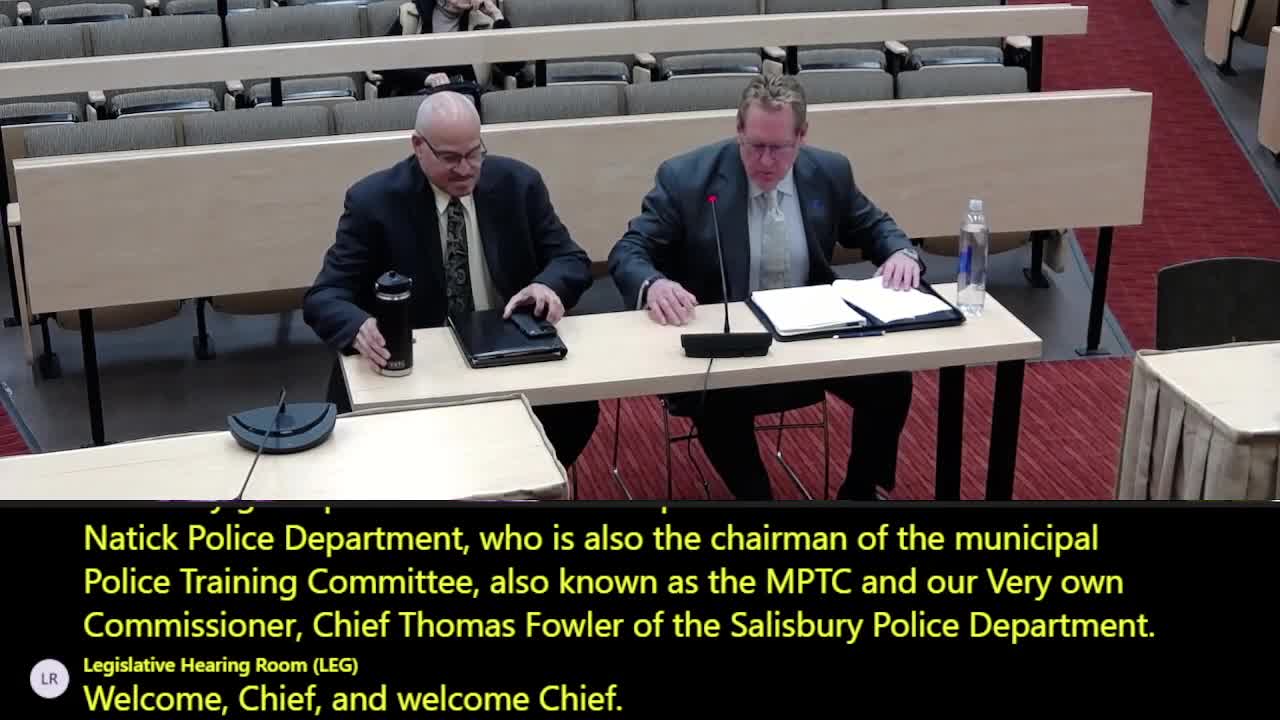
"We get our authority from master law chapter 41 section 96 b," said Chief James Hicks of the Natick Police Department, chair of the Municipal Police Training Committee (MPTC), explaining the committee's statutory mandate to set and enforce training standards for municipal, campus and other local police officers. "We have the flexibility to move in directions where we see fit."
Hicks and Chief Thomas Fowler of the Salisbury Police Department described a two-tier approach: civil-rights officers designated in each local department who receive annual specialized training, and a small State Police unit known as HEART that supports investigation, victim services and statewide curriculum development. "Those members of the HEART unit are who we come and bring in to develop our curriculum," Hicks said, adding that their reach is amplified through civil-rights officers in every community.
Why it matters: Speakers framed the issue as one of consistent identification and reporting. Several commissioners and chiefs said officers sometimes struggle to recognize antisemitism in practice; a uniform, commonly cited reference could help less familiar officers make that call. Hicks recommended that the commission "make a recommendation to incorporate the International Holocaust Remembrance Alliance, IHRA, definition of antisemitism into future police, hate, and bias crime curriculum as a consistent reference."
Practical points speakers highlighted included: MPTC membership (a 15-member panel), a training year that runs July through June, expanded POST standards since police reform, and the use of hybrid and virtual training to reach smaller departments. Hicks described the committee's ability to add topics into the curriculum rapidly when incidents arise, and to distribute new guidance statewide.
On data and reporting, chiefs noted that civil-rights officers are responsible for reporting bias-motivated crimes to a statewide website that permits cross-referencing of incidents. "Civil rights officers in the HEART unit investigate and report all hate crimes," Fowler said, while acknowledging testimony that officers sometimes cannot readily identify antisemitism.
On controversial enforcement tools, the chiefs cautioned that masking statutes often require an underlying crime. "My understanding is that there is a section within the criminal statute committing a crime while masked," Hicks said, adding that the masked-offense provision typically requires proof an underlying crime occurred. Chiefs urged clear communication between federal and local law enforcement when federal officers operate locally and suggested visible identifiers on agents to prevent public confusion.
What the commission can consider: Chiefs recommended adopting IHRA as a training reference and securing funding to embed it consistently. They also described HEART's curriculum role and recommended expanding training distribution and continuing annual in-service instruction for designated civil-rights officers.
Ending: Commissioners thanked the chiefs for the overview and pressed for follow-up on HEART's capacity and the mechanics of ensuring civil-rights officers receive consistent annual training across roughly 350'380 departments in the Commonwealth.