Get Full Government Meeting Transcripts, Videos, & Alerts Forever!
Get email alerts on the Behavioral Health Capacity topic
No spam. Unsubscribe anytime.
Oregon task force narrows recommendations on residential behavioral health capacity, data reporting and administrative barriers
Summary
The Legislative Behavioral Health Task Force met Oct. 20 to review draft recommendations and to decide how to align planned residential behavioral health investments with local planning and statewide reporting obligations.
The Legislative Behavioral Health Task Force met Oct. 20 to review draft recommendations and to decide how to align planned residential behavioral health investments with local planning and statewide reporting obligations, Co-chair Senator Lieber said as the meeting opened.
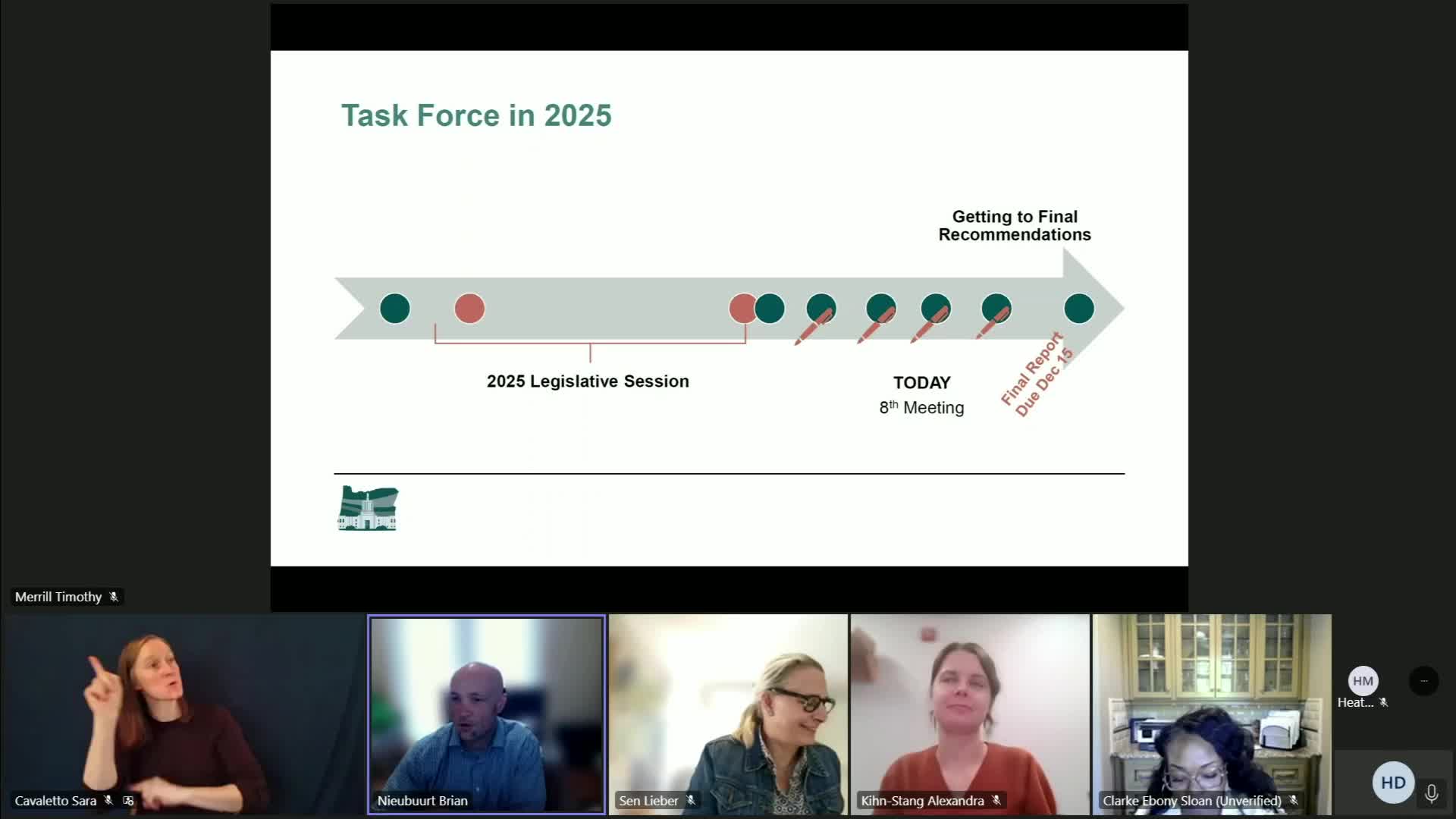
Brian, LPRO staff, told the panel that “we are in our eighth meeting today with the final report due on December 15,” and summarized the task force charge under House Bill 4002, which asked the group to produce recommendations on collaboration and funding alignment, equitable outcomes in publicly supported treatment, system cost efficiencies and broader access to opioid use disorder medications.
The draft recommendations discussed would: direct the Oregon Health Authority to incorporate consolidated CHIP/local-plan information into rulemaking and decision making for the residential behavioral health capacity program established under recent legislation; ask the team doing the HB2215 investigation of residential flexibilities to evaluate administrative barriers that prevent timely placement of people into the appropriate level of care; and request that OHA use consolidated CHIP/local-plan information to inform grant or other appropriations outside the CCO global budget or CFAA.
Why it matters: Members said the guidance matters for how the state allocates roughly $65 million in residential capacity investments and for whether forensic and court‑ordered patients can access new beds. Judge Nan Waller and others warned that current administrative rules — including priority for people stepping out of the state hospital and routine screening requirements — make it difficult for people coming through the criminal justice or mental health court systems to be placed into secure residential treatment facilities (SRTFs). As Judge Waller put it, some high‑need people “won’t go through screenings,” which can block placement even when the hospital has identified the right level of care.
What the meeting covered most closely
- Residential capacity criteria and forensic referrals: Staff explained that HB2059 prioritization criteria emphasize projects aligned to the PCG residential-plus study, shovel‑ready projects, cost‑per‑bed, and the ability to accept civil commitment, aid‑and‑assist and GEI forensic populations. Multiple members asked that guidance and administrative rules not unintentionally bar referral pathways for forensic populations and requested that HB2215 work examine alternatives or flexibilities for screening and referral so people identified as needing a higher level of care can be moved there more quickly.
- Administrative burdens and screening: Members debated the tradeoffs of screening: program staff and residential providers said pre‑admission screening helps protect program safety and match patients to appropriate services, while judges, court staff and criminal justice partners said screening requirements and a priority structure that privileges discharges from the Oregon State Hospital can effectively exclude some forensic referrals. The task force did not adopt a final policy change in the meeting; instead, several members supported asking the HB2215 evaluation to explicitly study whether and how to minimize administrative barriers to timely placement.
- Data, reporting and OHA infrastructure: Task force members emphasized the need for better use of consolidated CHIP/local‑plan reporting. Several members, including local program leaders and county mental health representatives, urged OHA modernization and possible public financial dashboards to make visible how federal, state and other funds flow to behavioral health services by region and program type. Members cautioned against adding reporting requirements until OHA has the IT and administrative capacity to absorb and use the data effectively.
- Federal and budget context: Staff flagged two events that should shape recommendations: amendments to the county financial assistance agreements (CFAA) that are expected to roll out in 2026, and federal HR1 changes to Medicaid eligibility and financing (including provider tax and state‑directed payment limits). Staff and members noted that HR1 and the scheduled expiration of some ACA tax credits could reduce Medicaid resources and complicate efforts to operationalize newly built capacity.
What the task force asked staff to do next
Members asked staff to revise the draft recommendations to (1) refer to the consolidated local plan (which includes CHIP materials) rather than CHIP alone when describing sources of planning data to inform HB2059 decisions; (2) include a specific request to HB2215 investigators to evaluate administrative barriers and possible flexibilities related to screening and placement for residential care; and (3) propose how OHA can use consolidated CHIP/local plan information to inform grant appropriations while minimizing new reporting burdens. Staff committed to circulate updated draft recommendations to members in the coming weeks and to post a fuller draft report ahead of the next task force meeting.
Context and limits: The task force repeatedly emphasized that the group is not adopting final rules at this meeting. Several members urged caution because CFAA changes are under negotiation and HR1 effects are still being assessed by the Health Authority. The meeting recorded no final votes or formal actions; members agreed on wording to send back to staff for revision and scheduled a drafting timeline.
Next steps: Staff said they will circulate updated draft recommendations to members in the coming week and aim to post a fuller draft report before the Dec. 3 meeting; the statutory report deadline remains Dec. 15.