Treasurer, health and advocacy groups urge committee to back baby bonds to narrow wealth gap
Loading...
Summary
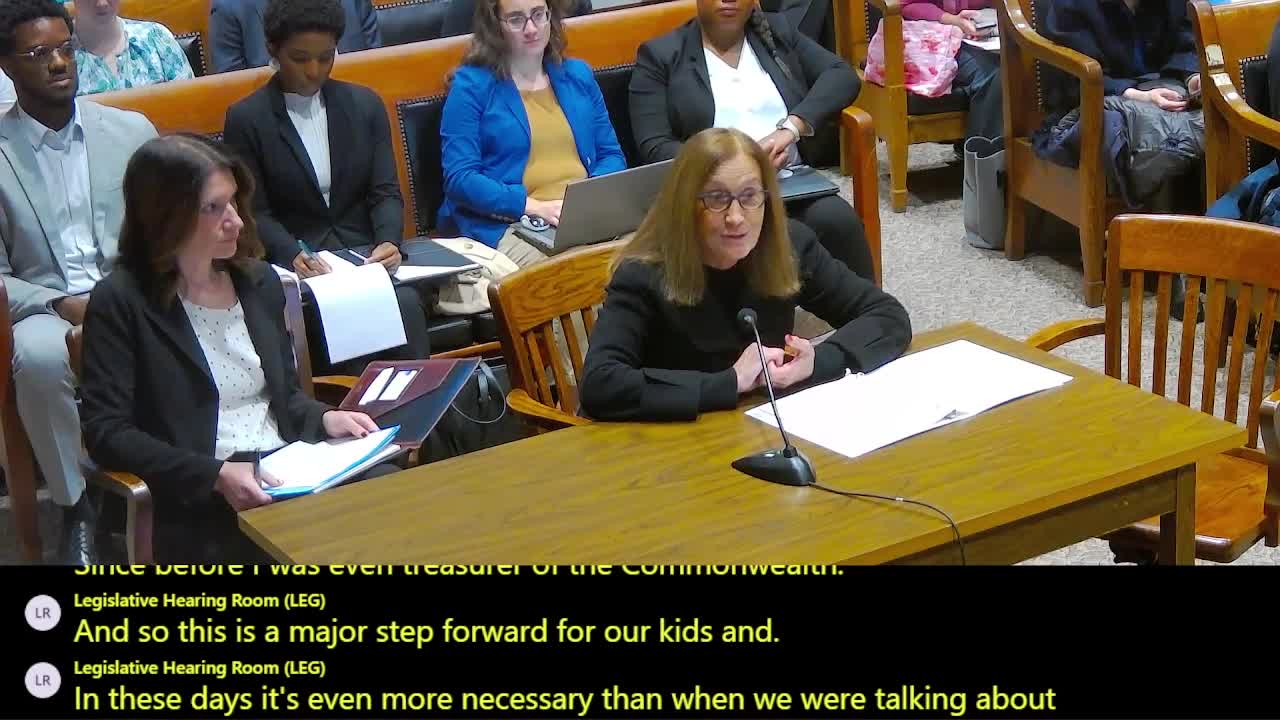
Treasurer Goldberg and a coalition of health, research and anti‑poverty groups urged the Joint Committee on Financial Services to report House 48 favorably, describing baby bonds as a targeted way to help children from low‑income families build assets for education, homeownership or business capital.
Treasurer Goldberg told the Joint Committee on Financial Services that House 48, an act to establish a Massachusetts baby bonds program, would create seed investments at birth for children born into families below 200% of the federal poverty level.
"Baby bonds are a powerful tool to help address these challenges by providing children whose families are below the 200% federal poverty rate with a seed investment at birth," the treasurer said, describing a program that would grow funds until children reached adulthood and could use them for education, homeownership or business capital.
Speakers from health and policy organizations expanded that case. David Radcliffe of the Institute on Race, Power, and Political Economy framed the proposal as a corrective to structural concentration of wealth in Massachusetts, noting that wealth is increasingly inherited rather than earned. Dr. Rachel Sager of Boston Medical Center and colleagues from Children's Healthwatch and Boston Children's Hospital linked the policy to health outcomes, saying childhood poverty is associated with worse physical and developmental outcomes and that asset supports can produce long‑term benefits.
Adam Jones of MassBudget offered fiscal context: modeling suggests that targeted actions to reduce racial disparities in housing, wages and wealth could meaningfully increase state revenue over time, and a modest baby bond seed could grow substantially over 18–35 years. Advocates pointed to Connecticut's recently implemented program and to a wave of state and local pilot activity nationwide as evidence of political momentum.
Supporters asked the committee to consider program design elements discussed at the state's baby bonds task force: automatic enrollment for eligible newborns, an independent trust or public fiduciary to manage accounts, outreach and financial counseling and limits on eligible uses tied to wealth‑building activities. Witnesses repeatedly emphasized that baby bonds are intended to be complementary to — not a substitute for — broader anti‑poverty programs and that implementation should include counseling and age‑appropriate financial education.
Committee members thanked witnesses and said the proposal would be considered alongside related anti‑poverty and savings legislation. The hearing record includes technical questions about eligibility definitions, administrative costs, and whether program benefits would be accessed between ages 18 and 35, which proponents indicated are standard design choices that can be set in implementing legislation.
Supporters requested a favorable report; no final action was taken at the hearing.