Clinicians, advocates press for higher pay, billing carve‑out to expand psychiatric collaborative care
Loading...
Summary
Representatives and clinicians urged the committee to boost reimbursement and remove billing barriers for psychiatric collaborative care, asking that codes be reimbursed at no less than Medicare rates and be billable outside MassHealth primary‑care subcaps so practices can sustain staffing.
Representatives, clinicians and provider groups told the joint committee that psychiatric collaborative care — a team‑based model that pairs a primary‑care clinician with a behavioral‑health care manager and a consulting psychiatrist — consistently improves mental‑health outcomes and reduces downstream costs. Supporters asked the committee to require payment at no less than Medicare rates and to allow use of collaborative‑care CPT codes (including the 99492/99493/99494 series) outside of MassHealth’s primary‑care subcapitated payments so practices can sustain staffing.
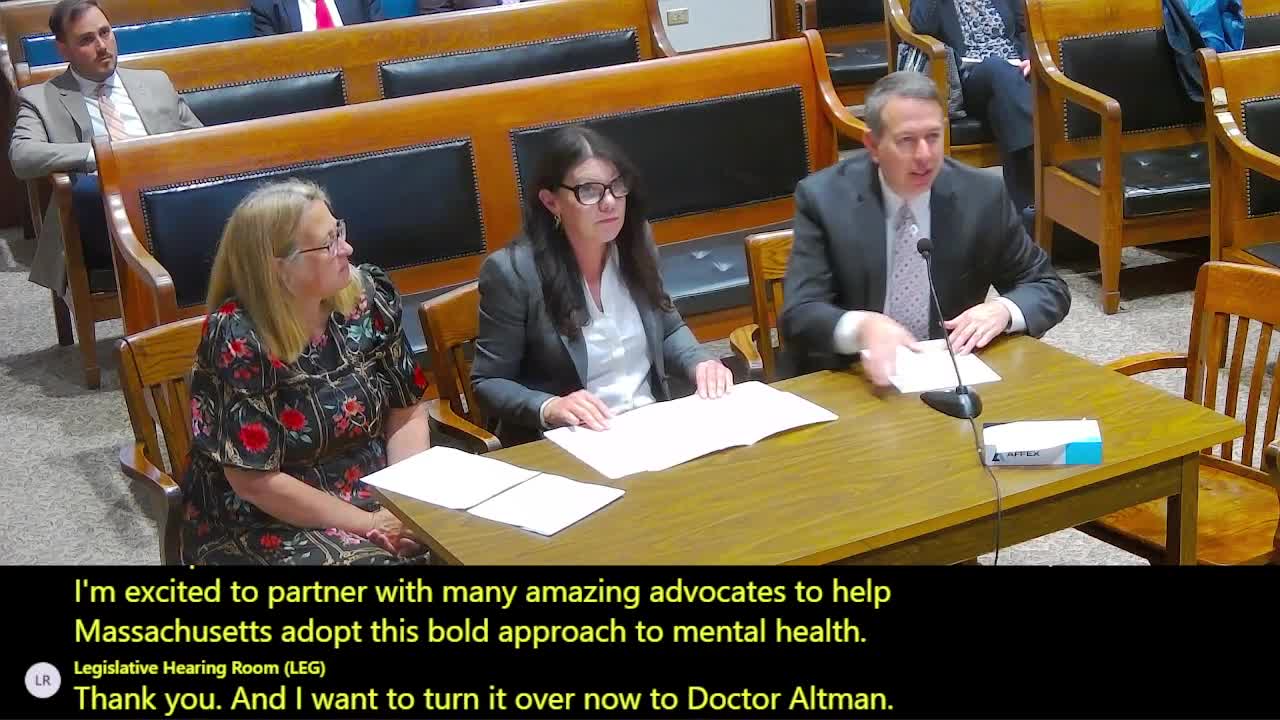
Dr. Wayne Altman described a common workflow: “Patient comes to us in crisis needing mental health care... I instead walked them down the hall to meet Cassie, our care manager, who helps them navigate all of this quickly and effectively. And then Cassie and me and a psychiatrist, if needed, continue to collaborate on behalf of the patient.” Altman urged reimbursement at “the floor of 100% of Medicare levels” and a fee‑for‑service carve‑out from MassHealth ACO subcaps, arguing that without a carve‑out practices “pay for the staffing of collaborative care without any revenue to support that.”
Dr. Verna Little summarized evidence and adoption: her organization has provided collaborative care to more than 11,000 patients and reported that roughly half reduced symptoms by 50% in 90 days; she cited state examples (New York, North Carolina) that reimburse at or above Medicare levels and show increased adoption, reduced specialty referrals, fewer emergency visits, and positive return on investment. “We know that it works,” she told the committee.
Community providers and implementation partners — including Helios Behavioral Health, the Brookline Center and Accelerate the Future — described real‑world results and workforce benefits. Jessica Lyons (Helios) said more than 60% of enrolled patients in supported clinics show symptom improvement within ~60 days. Ross Lord described a career‑ladder impact, saying his organization’s model has enabled bachelor’s‑level staff to earn higher wages while serving Medicaid patients.
Multiple witnesses urged removal of patient cost sharing for collaborative‑care visits, recommended permitting the 99494 add‑on code to be used as CMS intended, and asked the committee to craft explicit billing language so FQHCs and CCBHCs can adopt the codes without administrative uncertainty. Donna Mosch (Massachusetts Association for Mental Health) noted that Chapter 177 (2022) specified codes but not reimbursement levels, leaving implementation incomplete.
No formal vote occurred at the hearing. Sponsors asked for favorable reports on H.2220 and S.1390 and offered written materials and state comparisons for the committee record.
Provenance: - topicintro: first supportive testimony for H.2220 at 00:09:40 where Rep. LaNatra introduced the bills and Dr. Altman began his remarks. - topfinish: last in‑person panel comments supporting the carve‑out at about 00:58:40.