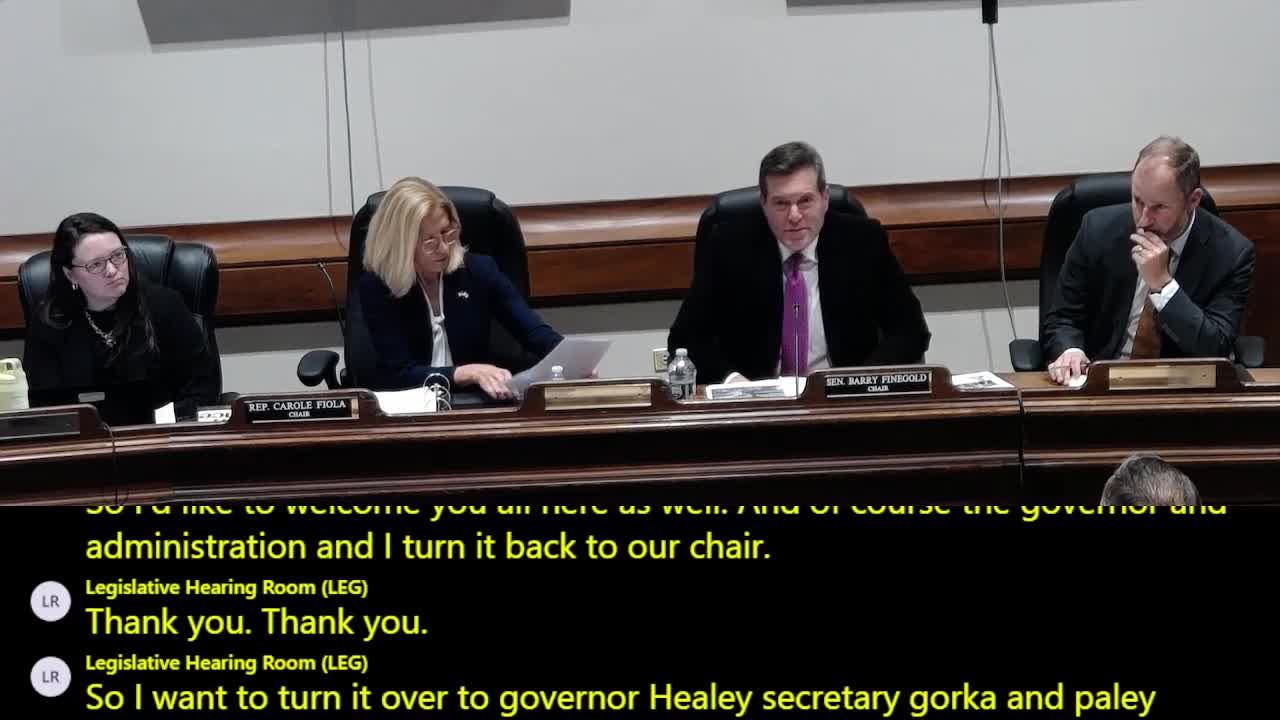
Massachusetts Hearing on DRIVE Act Focuses on $400M Plan to Protect Research Jobs and Innovation
Loading...
Summary
Governor Healey urged the Legislature to pass the DRIVE Act, a $400 million package to bolster Massachusetts research and innovation after a wave of federal grant cancellations and proposed cuts threatened jobs, graduate training and clinical trials.
Governor Healey urged the Joint Committee on Economic Development and Emerging Technologies to back the DRIVE Act, saying it is "essential to our state's economic future starting now" and describing the bill as a $400 million state response to recent disruptions in federal research funding.
The administration's proposal would dedicate $200 million as bridge funding for Massachusetts public higher‑education institutions and $200 million to a broader research funding pool and a research catalyst fund to attract private and philanthropic matches. The bill would rely on Fair Share revenues and interest on the Commonwealth's stabilization fund rather than a new tax, and it includes a review structure to select and monitor awards.
Why it matters: Massachusetts’ life sciences and R&D ecosystem supports hundreds of thousands of jobs, university programs and clinical trials, speakers told the committee. "Research is economic infrastructure here," Governor Healey said, warning that federal actions had already produced cancellations and furloughs. She cited the University of Massachusetts system as having "100 suspensions or cancellations of federal grants that total $35,000,000," and said UMass Amherst had 34 cancellations totaling about $17,500,000 and that UMass Chan had taken personnel actions including layoffs and furloughs.
What the bill would do: The administration described three main elements — bridge funding to preserve researchers and training pipelines at public higher education campuses; a research funding pool to support hospitals, universities and independent institutions; and a research catalyst fund, to be run through MassDevelopment, to receive philanthropic and private matches. Healey said the structure aims to "leverage every dollar" so state investment will be matched by private and institutional funding.
Selection and oversight: Lawmakers pressed the administration on details: how recipients will be chosen, whether the money would effectively reach communities outside Boston and Cambridge, and what happens when the one‑time funds are exhausted. Administration witnesses described a merit‑based, study‑section style review and a research review board that could recommend approaches including limited equity stakes or revolving mechanisms where appropriate. The administration said it would report back to the Legislature with allocation details.
University and medical‑center testimony: Senior leaders from the UMass system, Boston University, MIT, Northeastern and private and public research hospitals described immediate harms: canceled awards, stop‑work notices, paused admissions for graduate students, and layoffs of staff and postdocs. UMass leaders emphasized both the economic returns of research and the long‑term clinical impacts; one provost explained how an academic discovery moves through licensing and private investment to become clinical treatment.
Research fields and programs affected: Witnesses described impacts spanning fields and programs: biomedical and cancer research, neuroscience and gene therapy work, climate adaptation (including a paused $7.5M agreement affecting NECAASC), clean energy and offshore wind research and workforce programs, fisheries and marine science, and social‑science and AI projects. Program directors also warned that federal terminations had already disrupted TRIO/Student Support Services, ANAPISI grants for Asian American and Native Pacific Islander‑serving programs, SNAP‑Ed nutrition education and other discretionary grants that deliver education and community services.
Economic and workforce testimony: Business groups, trade unions and the state labor federation all testified in support of the bill, arguing that research funding sustains not only lab jobs but construction, food service, and other local jobs. Labor and building‑trades representatives stressed that public investment supports local, union jobs when campuses build labs or facilities.
Community and patient voices: Patients and students described how academic discovery produced therapies and trials that had changed lives. A survivor who received CAR‑T therapy at a Massachusetts medical center described the treatment as life‑saving and credited the state’s research ecosystem for enabling the work that led to his care.
Concerns and unanswered questions: Legislators repeatedly asked for clarity on priorities (for example, whether the fund should emphasize the life sciences, the blue economy, climate research, or student support programs), on the distribution between public and private institutions, and on whether wealthy private institutions with large endowments should be expected to contribute more. Multiple university leaders said many endowed gifts are restricted for specified uses and cannot be repurposed to replace canceled federal grants.
Next steps: Committee members requested follow‑up materials, including lists of private licensees and specific commitments from private partners and more detail on the review and selection process. No formal action or vote occurred during the hearing; committee members said they would continue deliberations and follow up with the administration and stakeholders.
Why it matters to residents: Proponents framed the DRIVE Act as a short‑term, targeted intervention to preserve the research workforce, keep start‑ups and clinical trials in Massachusetts, and protect the downstream jobs and tax revenues that flow from the state’s research base. Opponents and skeptical members urged additional guardrails and transparency before one‑time funds are committed.