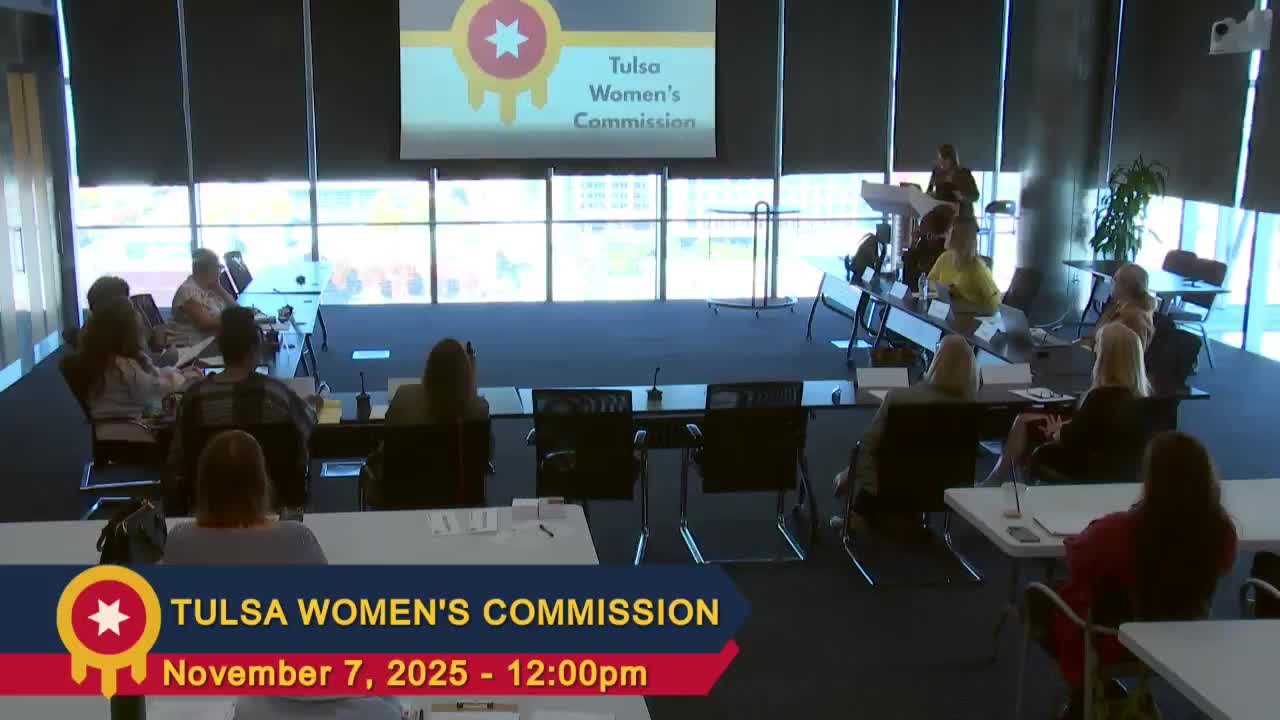
Tulsa Women’s Commission hears final inquiry presentation urging focus on safety, pick-one strategy
Loading...
Summary
Dr. Meg Myers Morgan, a professor at the University of Oklahoma, told the Tulsa Women’s Commission on Nov. 10 that “women’s empowerment cannot exist if we first don't eliminate racism,” and framed empowerment around safety, health, education, work and public representation.
Dr. Meg Myers Morgan, a professor at the University of Oklahoma, told the Tulsa Women’s Commission on Nov. 10 that “women’s empowerment cannot exist if we first don't eliminate racism,” and framed empowerment around safety, health, education, work and public representation.
Morgan's presentation, the final installment of a year-long inquiry, emphasized that baseline personal safety — in housing, in public and at work — is a prerequisite for other forms of empowerment. She cited national research and disparities discussed earlier in the inquiry: “36 percent of women in the U.S. have experienced intimate partner violence,” and “black women are significantly more likely to die in childbirth than white women,” points she used to illustrate how disproportionate risk undermines opportunity.
The commission’s discussion brought those themes to local priorities. Commissioners connected workplace inclusion and pay equity to childcare availability, noted the financial impacts of gendered markets (often called the “pink tax”) and discussed cultural and generational constraints that limit some women’s options. Marcia Bruno Todd, executive director of Leadership Tulsa, noted a local example of community leadership: “Her name is Amelia Wynn and she's gonna be honored tomorrow at OCCJ’s banquet for Camp Anytown Leadership Leadership Award,” illustrating the commission’s focus on youth leadership and local pipelines.
Commission leadership asked staff to synthesize the inquiry’s qualitative and quantitative findings into a concise decision packet for the body, with the goal of selecting one area for concentrated action at the commission’s January meeting (the commission will not meet in December). Commissioners suggested that a focused, achievable campaign — for example, convening forums, targeting outreach, or a single program pilot — will both produce measurable results and sustain volunteer engagement.
During Q&A and discussion, commissioners raised culturally specific barriers (immigrant family expectations, caregiving norms and stigma), the disproportionate burden of unpaid domestic labor, and the need for safe, accessible childcare to keep women in the workforce. Kate Neary, vice chair and CEO of Community Health Connection, emphasized the value of translating the inquiry’s materials into public-facing tools and forums to reach affected residents.
The commission took no legislative action at this meeting on the topics Morgan raised; instead, members endorsed the plan to condense findings into a short packet and return in January to choose a focused area for 2025 work.
The commission also used the meeting to note related community efforts and next steps, including a Carter Center initiative (announced during this session) and an upcoming presentation on financial empowerment services.