Get Full Government Meeting Transcripts, Videos, & Alerts Forever!
Get email alerts on the Research And Financial Aid topic
No spam. Unsubscribe anytime.
System office files EDRF and scholarship reports; officials highlight follow-on grant activity and retention effects of scholarships
Summary
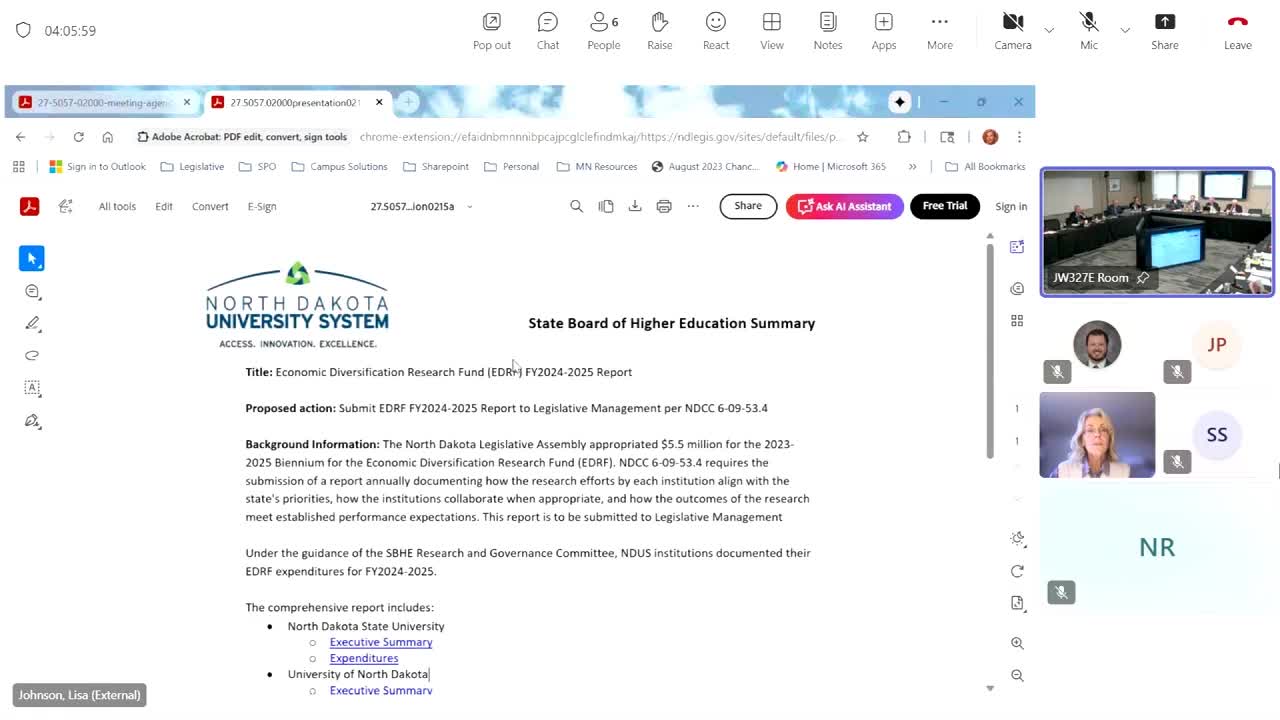
System staff filed the FY24'25 Economic Diversification Research Fund report and the annual academic/CTE scholarship report, describing project expenditures, follow-on grant activity and retention benefits associated with scholarship recipients.
System staff presented two required reports to the Legislative Management Higher Education Committee: the FY24'25 final report on the Economic Diversification Research Fund (EDRF) awards and the annual account of legacy academic/CTE scholarships (and the newer North Dakota Scholarship framework).
EDRF report Lisa Johnson (system office) remotely submitted the EDRF report, which provides project lists, expenditures spreadsheets and narrative summaries from award recipients including NDSU and UND. Johnson said institutions had to move quickly because awards arrived late in the biennium; recipients spread funds across research, experiential learning, faculty development and infrastructure investments. System staff and university representatives noted a number of follow-on grant proposals are in development that could leverage EDRF-backed work into larger federal awards.
UND and NDSU representatives told the committee the EDRF awards supported dozens of projects and early-stage commercialization activities and may enable larger proposals (for example, multi-institution National Science Foundation or federal defense submissions) this year.
Scholarship and retention report System staff also summarized the legacy academic/CTE scholarship program (legacy awards that continue to be paid through 2030) and the North Dakota Scholarship that replaced it for new applicants. Staff outlined eligibility mechanics (award amounts, enrollment benchmarks and GPA requirements) and showed multi-year retention tracking: students who received academic or CTE scholarships were retained in North Dakota at higher rates than non-recipients through multi-year follow-up.
Brenda Zastepal (system office) said the scholarship program covers multiple delivery modes (semester, quarter, clock hours and apprenticeships) and described an updated payment rule that moves from strict per-term credit thresholds to a cumulative-progress approach so students with dual credit or summer terms are not penalized.
Why it matters The EDRF report documents early-stage investments intended to catalyze commercialization and research partnerships; universities described follow-on proposals that could leverage state seed funding into larger federal awards. Scholarship reporting shows public investments in student aid are associated with higher in-state retention of recipients, which matters for workforce planning.
Follow-up Staff said they will return with additional outcomes and grant award results as follow-on proposals are decided and emphasized the potential for EDRF awards to be leveraged in future federal grant competitions.