Get Full Government Meeting Transcripts, Videos, & Alerts Forever!
Get email alerts on the Education Ai topic
No spam. Unsubscribe anytime.
Valley City State outlines new AI institute, expands teacher pipeline and dual-credit partnerships
Summary
Valley City State University told lawmakers it has launched an AI Institute for Teaching and Learning, is embedding AI across its curriculum and is expanding dual-credit, para-to-teacher and apprenticeship programs aimed at strengthening the teacher pipeline for rural North Dakota.
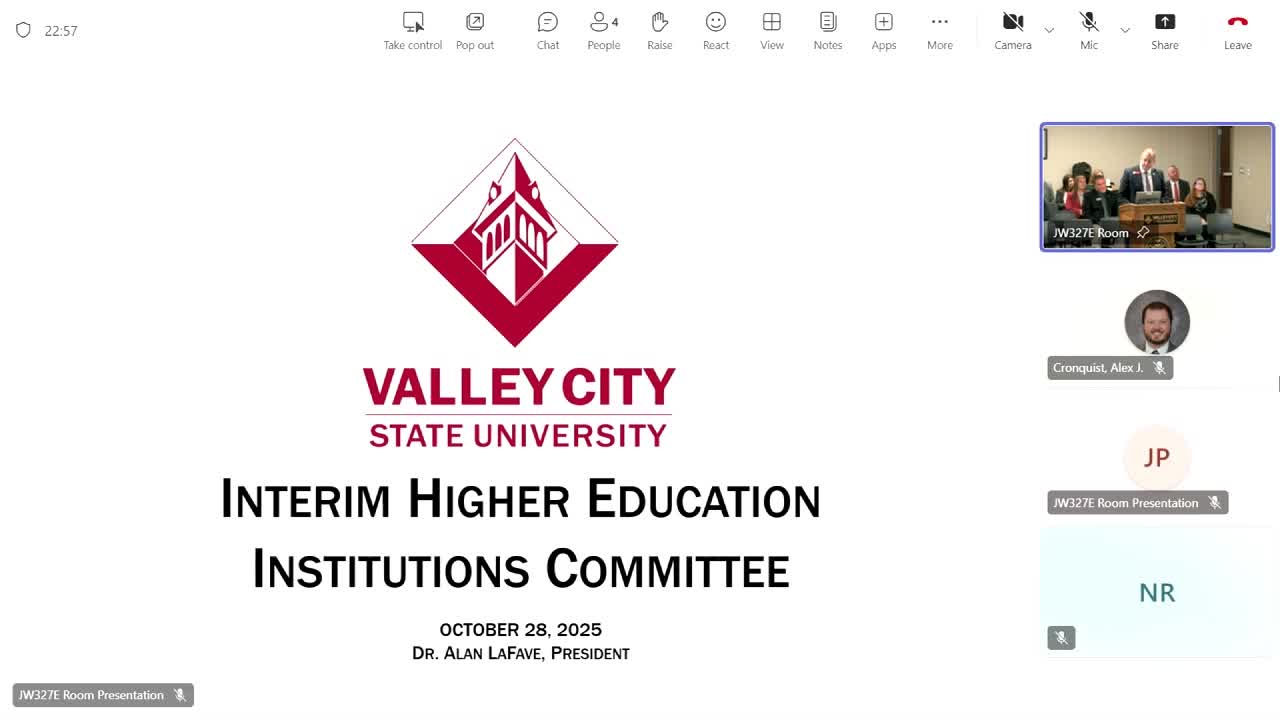
Valley City State University leaders told the Legislative Management Higher Education Committee on the VCSU campus that the university has launched an AI Institute for Teaching and Learning, is pursuing new AI-related certificates and faculty supports, and is continuing to expand dual-credit and teacher-pipeline programs that its leaders say are critical to rural schools.
President Lefebvre welcomed the committee to VCSU's newly renovated McCarthy Hall and introduced university staff and local partners before Vice President for Academic Affairs Larry Brooks described the AI Institute, which Brooks said received state workforce-innovation support. "AI is gonna revolutionize and change everything that we do in the world," Brooks said, arguing the institute will prepare teachers and students for new workplace expectations.
The institute, Brooks said, has six pillars that include K'12 teacher training, AI across the curriculum, personalized learning and "ubiquitous access." He told the committee VCSU will host a two-day mid-November workshop with regional universities to develop standardized curriculum for K'12 teachers and will pay faculty stipends for departmental "AI champions" who will embed AI content across courses. Brooks also said the university has filed program notices to the system office for graduate and undergraduate certificates in AI in education.
Assistant Professor Harmony Richmond demonstrated a classroom use case for pre-service elementary teachers, showing how students use ChatGPT to create a song that teaches second-graders to count coins and then use Suno to generate audio. "We're always looking for ways to make learning both effective and engaging as educators," Richmond said, and she added that instructors must review AI outputs for accuracy and age appropriateness before classroom use: "We do know that when we grab something from AI, we have to review it for accuracy."
Committee members pressed on two recurring concerns: cost and accuracy. Senator Davidson asked whether adoption would impose rising paywall costs for students. Richmond replied that faculty emphasize prompt engineering and platform-agnostic skills and that instructors will adapt tools if a given service becomes paid. On accuracy, Richmond and other presenters cautioned that AI can make arithmetic or procedural errors and must be checked before classroom use.
Enrollment, program and workforce ties VCSU leaders presented multiple enrollment and workforce figures to illustrate the university's role in producing teachers and other regional workforce skills. The university identified elementary and secondary education as its largest undergraduate majors, reporting roughly 341 elementary and 172 secondary education enrollees and saying 513 students were pursuing undergraduate teaching degrees. Brooks and President Lefebvre pointed to a retention increase to about 77 percent from first to second year as a driver of recent enrollment growth.
VCSU described several programs intended to strengthen the teacher pipeline: a para-to-teacher cohort with 46 participants (supported by the state Department of Public Instruction), a registered apprenticeship program with 27 of 41 available seats filled, and scholarship programs and articulation agreements with two-year institutions and out-of-state partners such as the College of DuPage.
Dual-credit and cost savings President Lefebvre provided dual-credit pricing and estimated student savings: in-person dual-credit tuition at VCSU was listed at $89.43 per credit hour, online dual-credit at $153.96, and regular in-state tuition and fees at $302.31 per credit. The presentation noted a per-course savings example of up to $638 for a three-credit course and said North Dakota students saved more than $1 million in tuition costs from VCSU dual-credit offerings in 2024'25.
Local partnerships and community impacts Valley City Public Schools Superintendent Josh Johnson described deep ties between the university and local K'12 schools, saying the district benefits from a strong pipeline of VCSU-trained teachers. Johnson said the partnership includes extended placements, required substitute-teacher days for education majors and a dual-credit certificate program that produced dozens of graduates: "Valley City High School now offers up to 50 dual-credit courses," Johnson said, and he reported hundreds of dual-credit credits earned by local students.
Jennifer Feis, executive director of the Valley City Barnes County Development Corporation, described local economic-development support for VCSU and told the committee the development corporation has contributed more than $2.1 million in cash support to the university over time to underwrite initiatives including business incubator space, workforce training and capital projects.
Fundraising and scholarships Corey Anderson, executive director of the VCSU Foundation, described substantial private fundraising and scholarship growth tied to state matching programs. He said the foundation's net assets and endowed funds have risen substantially in recent years and credited the North Dakota Challenge Grant program for enabling sustained scholarship support.
Votes at a glance - Motion: Approve minutes from the August meeting. Moved by Senator Eberly; seconded by Senator Woboma. Committee approved by voice vote (motion carries).
Why it matters VCSU's presentation combined curricular innovation (an AI institute and AI across the curriculum) with continued emphasis on teacher preparation, dual credit and local workforce partnerships. For rural districts that rely on nearby teacher-preparation programs, VCSU described multiple, tangible programs intended to supply teachers, reduce family tuition costs through dual credit, and provide partnerships for local economic development.
What remains unresolved Committee members asked for continued clarity about long-term sustainability of the AI institute beyond initial WEIF support, the projected costs to students if commercial AI tools become paywalled, and effect-size estimates for recruitment attributable to dual-credit funding changes. University leaders said they plan to seek additional grant and fee-for-service revenue and will adapt tool choices if costs rise.