Get Full Government Meeting Transcripts, Videos, & Alerts Forever!
Get email alerts on the Bonuses topic
No spam. Unsubscribe anytime.
State agencies used recruitment, retention and performance bonuses to fill hard‑to‑staff roles, HRMS reports
Summary
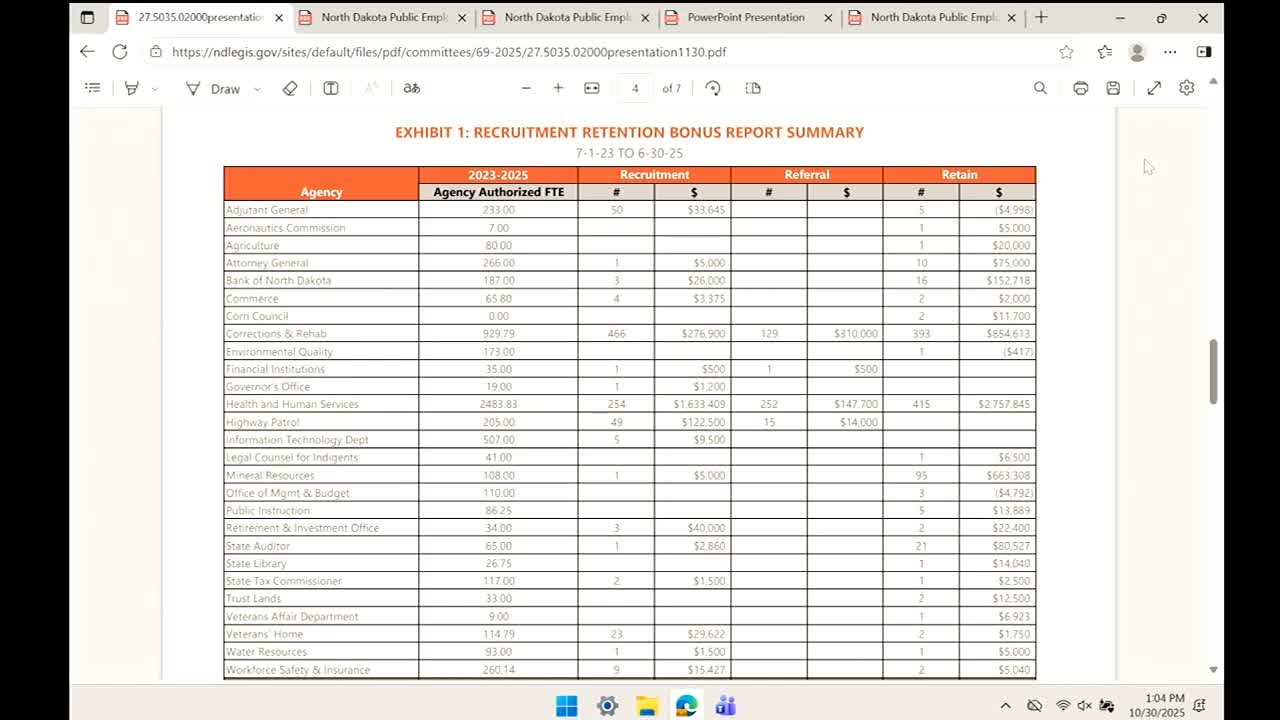
HRMS reported that recruitment, referral and retention bonuses were deployed across state agencies to fill hard‑to‑staff jobs; retention bonuses totaled about $4.7 million and recruitment bonuses about $2.2 million in the most recent reporting period.
HRMS told the Employee Benefits Program Committee on Oct. 7 that recruitment, referral and retention bonuses remain a widely used tool to address hard‑to‑fill positions, and the division provided its statutorily required biennial summary.
Lynn Hart (Total Rewards Manager) said recruitment bonuses were paid by 17 agencies in the most recent reporting period, totaling about $2.2 million. Referral bonuses (paid to staff who recommend new hires) were used by four agencies ($472,000), and retention bonuses totaled about $4.7 million across 23 agencies after accounting for repayments when recipients left before the agreed retention period ended.
Agencies cited corrections, rehabilitation, health and human services and public safety as common areas of use. Health and Human Services said it uses recruitment bonuses for direct care staff and medical professionals; corrections uses bonuses for corrections officers and related staffing. Agencies said referral bonuses are effective because word‑of‑mouth remains a primary recruitment channel for certain job types.
Performance bonuses are limited by statute to $1,500 per employee per fiscal year. Several agencies told the committee they value the program but said the $1,500 cap limits its impact for some hard‑to‑fill roles. HRMS staff said bonus awards are funded from agency salary appropriations rather than a separate bonus appropriation; negative (repayment) entries reflect prorated clawbacks when an employee leaves before a required retention period ends.
HRMS presented the data as part of its broader total‑rewards and compensation review and will provide detailed agency‑level reports on request. Committee members asked whether agencies may draw from salary savings when a position remains vacant to fund bonuses; staff said internal agency practices vary and the salary line is the usual source for awarded bonuses.