Get Full Government Meeting Transcripts, Videos, & Alerts Forever!
Get email alerts on the Organ Donation Transplant topic
No spam. Unsubscribe anytime.
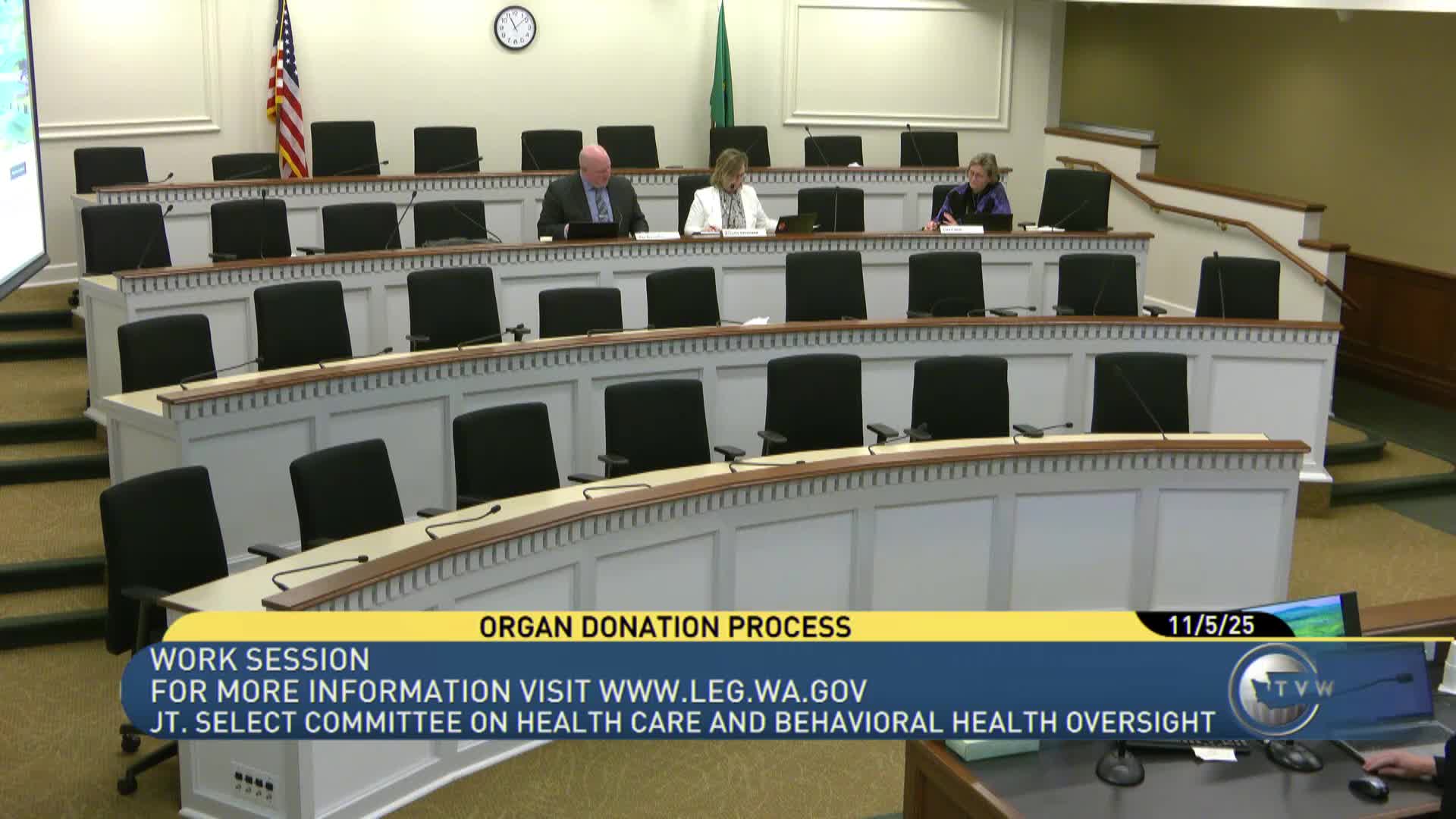
Organ donation, licensed organ transport and transplant centers: Washington officials and OPO describe system and challenges
Summary
Department of Health and organ‑procurement and transplant center leaders briefed lawmakers on Washington’s organ‑donation process, statutory transport standards and transplant center capacity, noting transport, geographic and workforce challenges across a large service area.
Dawn Felt, EMS program manager at the Washington State Department of Health, told the committee that the 2023 organ‑transport law allows licensed organ transport services to use emergency lights and sirens, HOV lanes and traffic preemption devices for time‑critical organ delivery. Felt described driver qualifications in statute and rule: drivers must be at least 24 years old, have at least five years’ experience driving under emergency conditions (e.g., as a firefighter, police officer or EMS provider), pass background checks, complete a defensive driving course and meet licensing requirements. Insurance minimums set by the statute include $5,000,000 in general liability and $5,000,000 in automotive liability plus an umbrella policy. Since the law and the corresponding WAC went into effect, the department has licensed one company (the Nationwide Oregon Recovery Transport Alliance) with 11 vehicles and has received no public complaints about the program.
Ashley Lind, director of external affairs at Life Center Northwest (the organ procurement organization that serves Washington, Alaska, Montana and northern Idaho), described the donation process and scale. Life Center is one of 55 U.S. OPOs; the group emphasized that deceased donation is rare because it requires a specific clinical pathway (ventilator‑dependence in hospital and death declared by physician). "Less than 1 percent of people die in a way that will allow them to become an organ donor," Lind said. She noted there are currently nearly 1,500 patients waiting for transplants in Washington and that one donor can save as many as eight lives through organ donation.
Lind summarized Washington’s legal history under the Uniform Anatomical Gift Act (UAGA) and state RCW updates that strengthened donor intent and created the statewide donor registry linked to driver records. She explained OPOs’ regulatory oversight by the U.S. Department of Health and Human Services and CMS and described Life Center’s family aftercare and outreach work across a large geographic footprint that includes remote communities and weather‑dependent transport challenges.
Representatives of the University of Washington Medical Center — Tina Block (transplant service line director) and Dr. John Demarakis (director of heart transplantation) — described UW Medicine’s multispecialty transplant programs (kidney, liver, heart, lung and pancreas), living‑donor programs, multidisciplinary selection processes, and outreach clinics (including regular clinics in Anchorage). They explained that selection and evaluation can take months for elective candidates but must be expedited for critically ill patients, and they reviewed a complex combined liver‑heart transplant case with a positive outcome that illustrated innovation and the need for timely transport and organ preservation technology.
Committee members asked about air transport, palliative care in rural settings and how mental‑health conditions are considered in recipient selection. Officials said air transport and aircraft coordination are typically handled by transplant logistics partners or OPOs and that psychiatric evaluations inform but do not automatically disqualify candidates; transplant teams evaluate each case and consider capacity to adhere to lifelong post‑transplant care.
No changes to state law or rule were made during the session; the briefing identified statutory citations (RCW and WAC) that govern driver standards and organ‑donation regulation and highlighted operational and funding needs for transport and transplant logistics.