Get Full Government Meeting Transcripts, Videos, & Alerts Forever!
Get email alerts on the Cares Programs topic
No spam. Unsubscribe anytime.
State audit finds 52 local CARES programs but warns of funding, coordination and measurement gaps
Summary
The state auditor—s office told the Joint Legislative Audit and Review Committee that 52 fire-agency-led CARES programs operate across Washington but many areas still lack services and the programs face significant funding and coordination problems.
The state auditor—s office told the Joint Legislative Audit and Review Committee that 52 fire-agency-led CARES programs operate across Washington but many areas still lack services and the programs face significant funding and coordination problems.
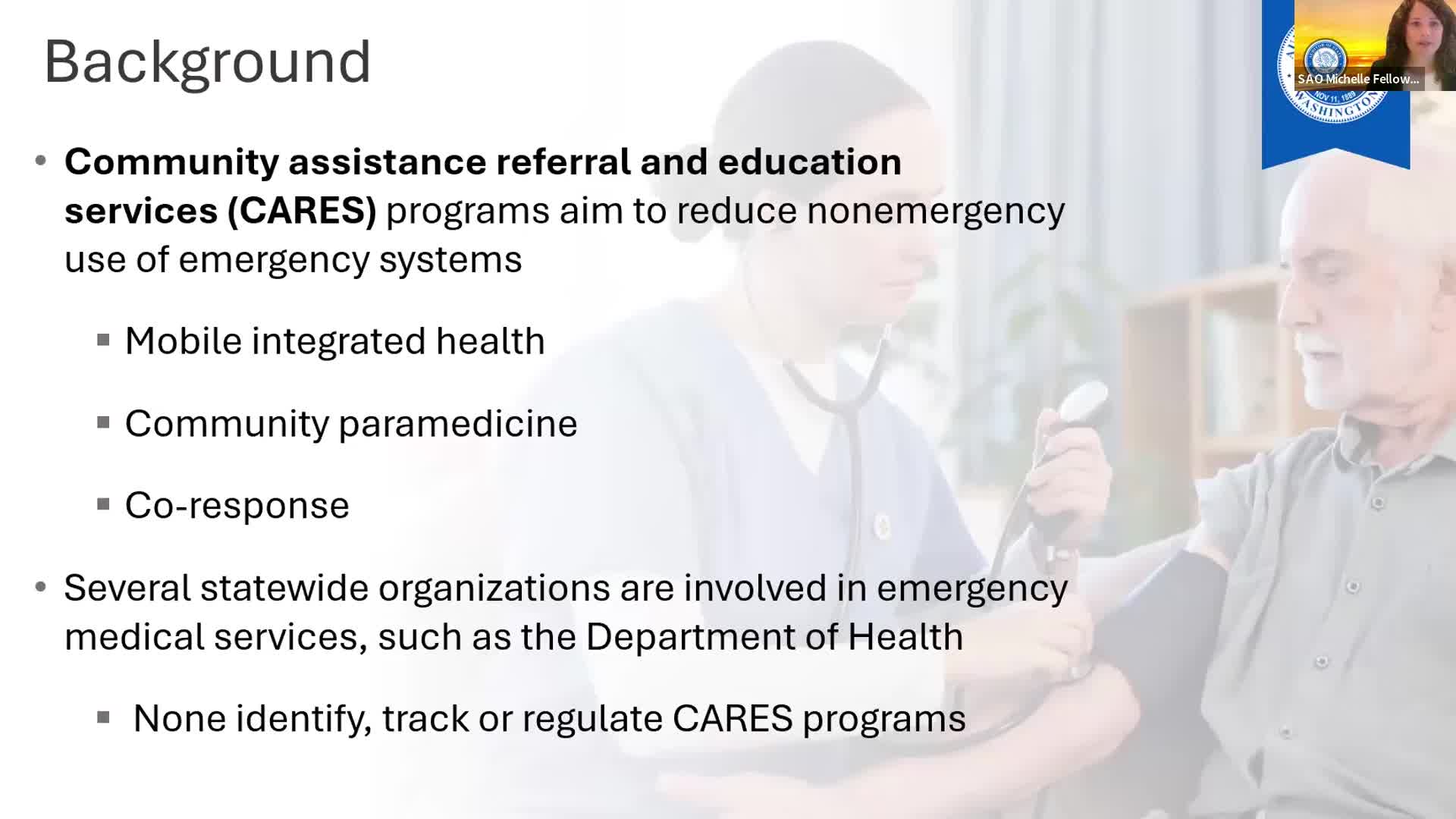
Auditors Michelle Fellowes, performance auditor, and Laurie R. Garretson, who led the audit, told JLARC that CARES programs——mobile integrated health, community paramedicine and co-response models——aim to reduce nonemergency 911 calls and avoidable emergency department visits while connecting residents to social and primary-care resources. "When it's for a true medical emergency, fire agencies' EMTs and paramedics can respond to provide life saving care. But when it's not, the EMTs and paramedics' specialized skills aren't put to good use," Fellows said during the presentation.
The audit found substantial geographic variation: two-thirds of counties lead at least one program, King County led 11 programs, Pierce and Snohomish counties led several, and some counties—including Stevens and Yakima—had no program. Services commonly included outreach to frequent 911 callers (reported by 98% of surveyed programs), in-home fall assessments, case management and overdose response. Staffing models varied by community and included social workers, paramedics, nurses and students.
Funding was the most frequently cited barrier. Auditors reported that three-quarters of programs receive dedicated local government revenue, and more than half receive grants, but 72% of existing programs reported a moderate to high risk of insufficient funding in the next three to five years. Fire-agency witnesses at the hearing echoed that point: Nicole Picknell, fire captain and community paramedic program manager for South County Fire, said, "85% of my program is ran on grants" and described year-to-year ACH contracts and single-year grants that leave sustainability uncertain.
The audit also documented measurement and regulatory gaps. State law (2013) requires CARES programs to track reductions in avoidable ER visits and repeated 911 use; auditors found nearly all programs collect data but only about half track both required measures. Auditors cited causes including lack of awareness of the legal requirement, limited analytic capacity, and software limitations. They also noted regional variance in allowable community paramedic services because Washington lacks statewide expectations, which creates differences in what paramedics can do across county lines.
Auditors quantified financial incentives that could motivate broader health system participation: they estimated an ambulance transport and ER visit can cost a private insurer about $1,200 to $1,800, whereas a home visit by a home health nurse costs roughly $320. Direct Medicaid "treat-and-refer" reimbursement was reported as occurring in about 10% of agencies surveyed; auditors said some fire chiefs stopped seeking that $115 reimbursement because the administrative effort outweighs the payment.
To address these issues, the audit recommended the Legislature consider requiring private insurers to develop ways to reimburse CARES services and convene a statewide CARES work group to draft guidance, standardize measurements for different program types, consider recognizing community paramedics as a distinct provider category, and evaluate whether the Department of Health—s role should be expanded. The auditors also made recommendations to stakeholder organizations including the Washington State Association of Fire Chiefs and the Washington State Hospital Association.
Fire-agency representatives who testified in person and online supported the findings and urged stable funding and improved data-sharing with hospitals. Mike Jackson, assistant chief with Clark/Cowlitz Fire Rescue, said his program partners with hospitals and the area agency on aging but relies on "siloed" grant funding that is not guaranteed year to year. Witnesses highlighted operational impacts such as multi-hour ED wait times and jail diversions.
The auditors concluded CARES programs can improve patient outcomes and lower system costs but recommended statewide coordination, clearer measurement, and new funding pathways to sustain and expand effective programs.