Get AI Briefings, Transcripts & Alerts on Local & National Government Meetings — Forever.
Washington lawmakers hear plans to integrate 911 and 988, expand co‑response and mobile crisis teams
Summary
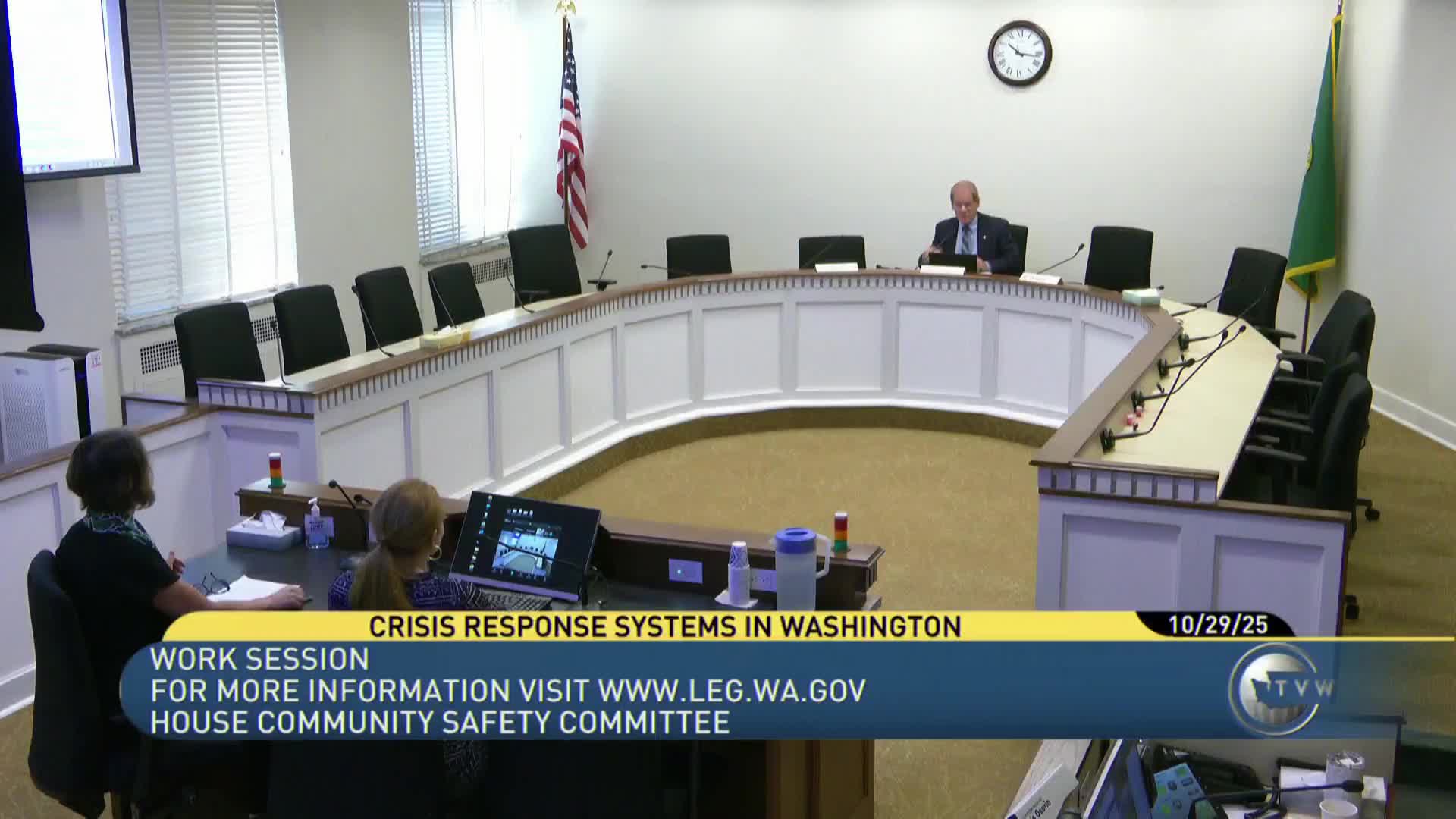
A Washington State House Community Safety Committee work session on Oct. 29 heard extensive testimony on how to get people in behavioral‑health crisis the right response at the right time, whether that response is a 9‑1‑1 co‑responder, a 9‑8‑8 mobile rapid response team, or in‑person follow up by a community provider.
A Washington State House Community Safety Committee work session on Oct. 29 heard extensive testimony on how to get people in behavioral‑health crisis the right response at the right time, whether that response is a 9‑1‑1 co‑responder, a 9‑8‑8 mobile rapid response team, or in‑person follow up by a community provider.
The session brought dispatchers, city and county officials, nonprofit providers and researchers to the same table to describe models that are already operating in Washington and elsewhere and to press for coordinated funding, training and data systems.
"Washington is the first state to have done that," said Brooke Bittner, executive director of the Regional Crisis Response Agency and board president of the Co‑Responder Outreach Alliance, referring to the legislative framework that defines co‑response teams under last session's House Bill 1811. Bittner told the committee the state now has more than 60 co‑response programs and needs sustained support for the 9‑1‑1 side of the ecosystem as 9‑8‑8 services mature.
Why it matters: witnesses described a continuum of options — telephone‑based crisis lines, mobile clinical teams, co‑responder units embedded with fire or police, crisis receiving centers and short‑term respite — that can reduce unnecessary emergency‑room transports and criminal‑justice involvement when coordinated well. Katie Myers, representing Washington APCO/NENA, told lawmakers that telecommunicators are first responders and urged evidence‑based 9‑1‑1 triage protocols before nonpolice responses are dispatched.
Dispatch pilots and warm transfers: several Washington examples illustrated different integration strategies. ValleyCom in South King County began a pilot embedding Crisis Connections clinicians in the comm center; after moving to a warm‑transfer model and expanding 988 staffing, ValleyCom reported transferring 2,165 calls from March–July 2024 and said 98% of those were stabilized by 988/211 resources and did not require a field dispatch.
Whatcom County dispatchers said colocation of a "community connector" in the 9‑1‑1 center allows joint triage on the same CAD screen, producing faster, better‑informed decisions about whether an unarmed alternative response team or law enforcement should go. "Having people in the same room that are working from the exact same screen… has played paid dividends," said Justin Rasmussen, deputy director of Whatcom County 9‑1‑1.
National and local models: Denver's STAR program is dispatched through 9‑1‑1 as one of four response options; Tristan Sanders (Denver Public Health) said STAR has about 16 units, a roughly $6.5 million annual budget and has answered about 50,000 calls since 2020. Albuquerque's Community Safety Department (ACS) operates multiple behavioral‑health teams dispatched through 9‑1‑1 and, according to ACS director Jody Esquivel, handles about 3,500 calls per month; Chief Harold Medina said ACS reduced use of force and freed officers to handle other crimes.
Training, certification and funding: multiple witnesses urged the Legislature to fund workforce development, including a crisis responder certificate program created last session but funded below the level proponents say is required. Dr. Jennifer Stuber (University of Washington) asked that the certificate program and co‑response funding be tied to 988 account resources and that the Department of Health be directed to include behavioral‑health training requirements for fire and EMS in county OTEP plans.
First‑responder wellness and staffing: witnesses said co‑response growth is increasing demand on first responders and dispatchers, with repeated exposure to traumatic calls. "We have to take care of the people that are doing this work," Kim Hendrickson, Poulsbo director of housing, health and human services, told the committee, urging legislative attention to wellness programs.
Outlook: presenters urged the committee to support policies that (1) invest in embedded triage capacity at 9‑1‑1 and warm transfers to 9‑8‑8, (2) braid funding sources to sustain mobile and follow‑up services, (3) expand training and a statewide certificate for crisis responders, and (4) protect telecommunicators and responders with peer support and interoperability tools. Lawmakers signaled interest in drafting measures in the short session to improve integration and implementation guidance for co‑response and mobile crisis teams.
Sources: testimony included practitioners and program directors from Whatcom County 9‑1‑1, ValleyCom (South King County), Denver STAR, Albuquerque ACS, DESC (Seattle), Frontier Behavioral Health (Spokane), North Mason Regional Fire Authority and university researchers who described the emerging evidence base.