Get Full Government Meeting Transcripts, Videos, & Alerts Forever!
Get email alerts on the Grants Active Transportation Transit topic
No spam. Unsubscribe anytime.
WSDOT and transit association outline grant options, cite capacity, funding and procurement constraints
Summary
WSDOT’s active‑transportation director and the Washington State Transit Association discussed options for structuring active‑transportation and transit safety grants, advising runway time for new programs and flagging costs for operator barriers, facility needs, and uncertainties about sales‑tax treatment and federal procurement rules.
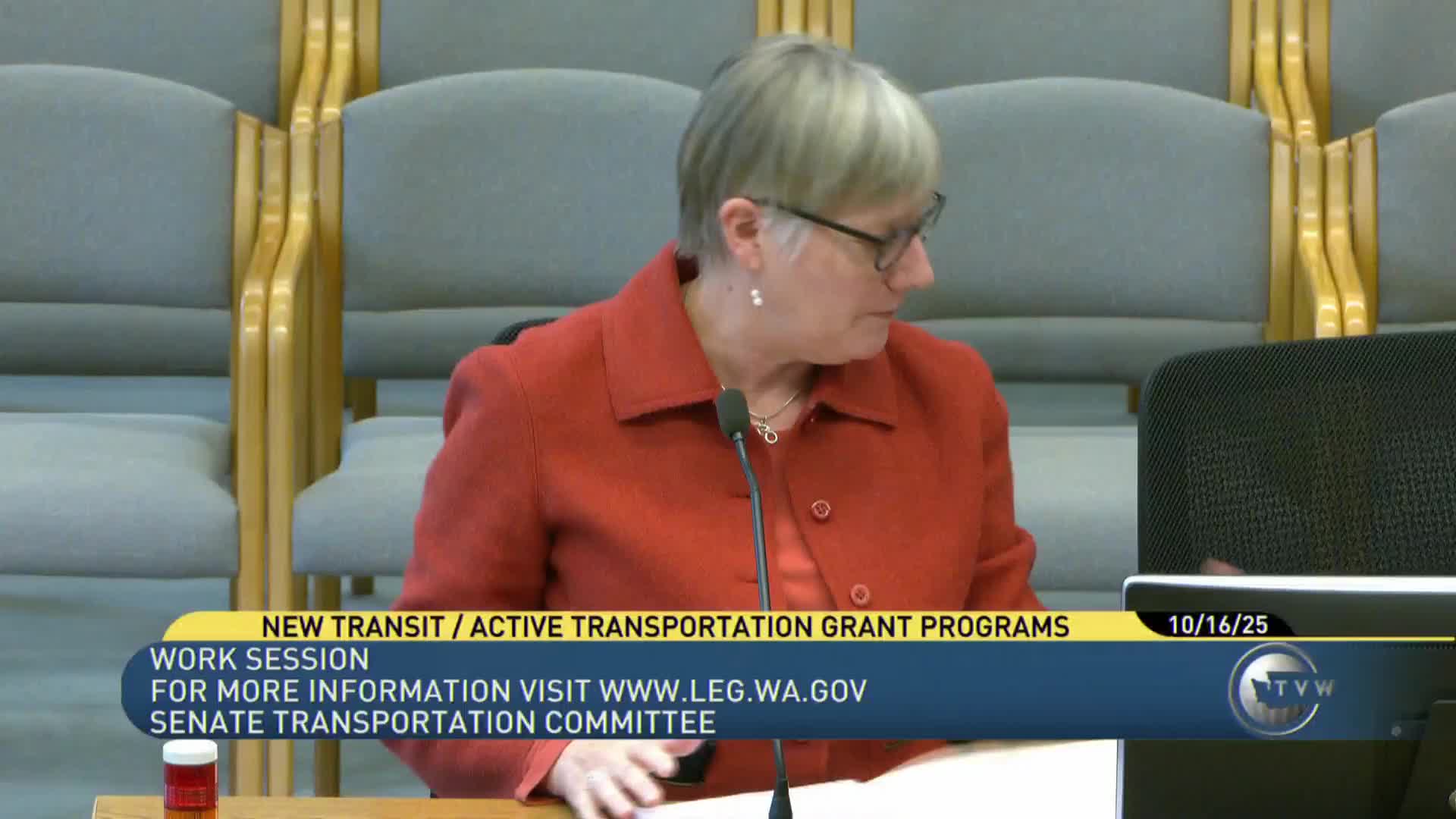
Barb Chamberlin, director of the Active Transportation Division at the Washington State Department of Transportation, and Justin Layton, executive director of the Washington State Transit Association, presented a joint work session to the Senate Transportation Committee on Oct. 16 on potential designs for active‑transportation grant programs and transit safety/security investments.
Chamberlin said grant programs require ‘runway’ — time and administrative capacity — for applicants and WSDOT to plan, evaluate and deliver awards. She described two sequencing models: a projects‑first/funding‑after cadence used by longstanding programs (e.g., Safe Routes to School, Ped‑Bike) and a funding‑first/projects‑after approach used for new program lines (e.g., recent add‑ons). She recommended allowing time for local applicants to prepare active‑transportation plans and noted programs that include assistance for applicants (planning, consultant support) can broaden participation.
Chamberlin walked through the proposed Senior Transportation Emphasis Program (STEP) and a regional‑trails/cycle‑highways concept, noting that regional trail connectors are currently eligible under existing programs but often score lower because project scoring favors in‑town safety investments that serve larger populations. She said a standalone trail or cycle‑highway program could be designed, but that it would need criteria, collaboration requirements and staff capacity to administer awards.
Layton framed transit needs around the state’s 32 public transit systems and a funding mix heavily reliant on local sales tax. He said many state competitive capital grants are oversubscribed and listed unmet projects in the prioritized bus‑and‑bus‑facility queue (examples included garage and facility needs for small rural operators). He also proposed elements for a transit safety and security grant program: funding for operator barriers, facility lighting and siting, shelters, behavioral‑health partnerships, and non‑uniformed ambassadors.
“Operator barriers alone, because most of our buses were never made with them, is anywhere from a $20 million to $30 million endeavor alone just to convert the vehicles that are on the street now,” Layton said, estimating statewide retrofit costs. He also warned that federal procurement changes increasingly push agencies to procure standard vehicle models with less customization, which complicates adding retrofit features.
Layton flagged policy and cost uncertainties under recently enacted legislation (SB 5814) regarding whether interlocal agreements or certain services are subject to state sales tax; the Department of Revenue is still evaluating the question. He also described workforce and delivery challenges: persistent operator and mechanic shortages, a potential short‑term pause in reissuing non‑domicile CDL certifications, reductions in FTA regional staffing that slow grant processing, and longer vehicle manufacturing and delivery timelines.
Committee members asked about definitions (what constitutes a regional trail) and whether trail funding is for recreational versus transportation uses; Chamberlin answered that program design should focus on connecting population centers and destinations and that e‑bike adoption could expand transportation use of trails.
Both WSDOT and the transit‑association presenters asked the committee to consider multi‑year grants, technical‑assistance lines for smaller applicants, and modest runway funding to build applicant capacity if the legislature creates new program lines.
Sources: Testimony by Barb Chamberlin (WSDOT), Justin Layton (Washington State Transit Association); committee Q&A.