Get Full Government Meeting Transcripts, Videos, & Alerts Forever!
Get email alerts on the Budget Revenue topic
No spam. Unsubscribe anytime.
Committee told 2025–27 transportation plan balanced but fuel use decline and revenue restrictions cloud outlook
Summary
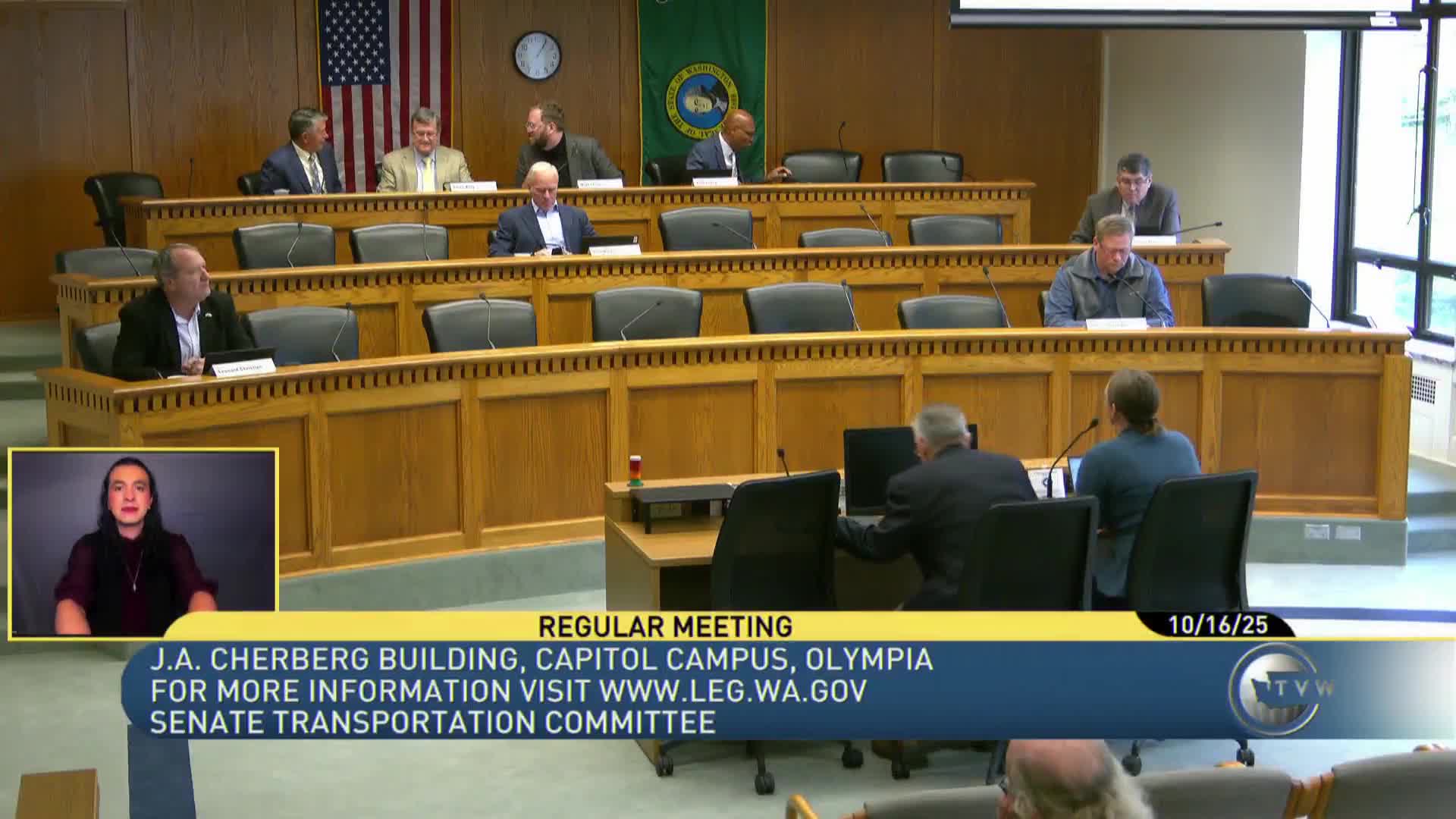
The Washington Senate Transportation Committee heard a budget and revenue briefing on Oct. 16 from committee budget coordinator Haley Gamble and staff forecaster Brian (first name only), who said the adopted 2025–27 transportation spending plan is balanced but faces medium‑term uncertainty due to lower motor‑fuel consumption and shifting revenue sources.
The Washington Senate Transportation Committee heard a budget and revenue briefing on Oct. 16 from committee budget coordinator Haley Gamble and staff forecaster Brian (first name only), who said the adopted 2025–27 transportation spending plan is balanced but faces medium‑term uncertainty due to lower motor‑fuel consumption and shifting revenue sources.
Gamble, the committee’s budget coordinator, told senators the adopted 2025–27 expenditures total $15.5 billion and that the Washington State Department of Transportation accounts for the largest share — about $11.9 billion. She said program-level decisions preserved highway preservation funding at $900 million for 2025–27 and added targeted amounts for culverts ($125 million in the current biennium and $1 billion over the planned delivery timeframe) and local preservation (a $50 million addition in the current biennium).
“The pie chart shows how that’s broken out by transportation agency,” Gamble said, listing the State Patrol, Department of Licensing, the Transportation Improvement Board and others as smaller shares. She explained that roughly 70% of the budget is limited to highway purposes by constitutional and statutory restrictions.
Brian, who led the revenue forecast sections, described how the current forecast builds in new revenues enacted in 2025 — including provisions of the 2025 revenue package and transfers authorized in SB 5802 — and the Climate Commitment Act receipts. He said the 2025 package includes a 6‑cent increase in the fuel tax indexed to 2% annual growth, higher diesel surcharges, increases to vehicle weight fees, rental‑car taxes and driver’s‑license fees, and a 0.1% state sales‑tax transfer to transportation beginning in 2027–29.
At the same time, Brian said the September forecast assumes motor‑fuel gallonage will decline by about 1% annually compared with the June forecast’s 0.3% decline. “The impact on your revenues, about $816 million over the 10‑year period, is largely associated with that slightly more pessimistic view of fuel consumption,” he said. That reduction in motor‑fuel receipts is partially offset in the forecast by new 2025 revenues and Climate Commitment Act money.
On the Climate Commitment Act (CCA), Brian said Ecology’s June 2025 projection raised near‑term auction revenue expectations relative to a December 2024 projection, but he cautioned that the statute’s allowance caps and allocations to non‑state entities mean CCA receipts decline over the long term. He added that two recent auctions were higher than the June estimate and could produce roughly $400–$500 million in additional short‑term receipts depending on forthcoming auctions.
Gamble summarized agency supplemental requests for the 2026 session at about $687 million total, characterizing most capital items as reappropriations of underspent 2023–25 funds or timing adjustments rather than new project costs. On the operating side she said agencies requested about $96 million total (roughly 1.5% of operating programs), including carryforwards and IT items. Separately, Gamble noted an addendum from WSDOT that listed larger potential needs — for example, maintenance and operations asks of $67 million and a long‑term preservation request that the department described as up to $8 billion over 10 years — which would require additional funding or bond authority to support.
Senators pressed staff about the distribution of money across fund types and regions. Senator Gaynor asked for a breakdown by dedicated (eighteenth‑amendment) funds versus non‑eighteenth funds; staff said they could prepare a fund‑by‑fund mapping and try to correlate identified needs to the funds that can legally be used. Gaynor also asked whether gas‑tax revenues can be reported by region; staff said regional sales and consumption data are limited, though they will pursue ways to shed light on regional patterns.
What’s next: staff will incorporate November’s revenue forecast into updated charts, and the governor’s December budget proposal will use that forecast. The committee will resume consideration of these topics in January when the legislature convenes.
Sources: Committee presentation by Haley Gamble (budget coordinator) and forecast remarks by Brian; slides and charts shown to the committee.