Get email alerts on the Earthquake Insurance topic
No spam. Unsubscribe anytime.
Experts say Washington has large gaps in commercial earthquake coverage; parametric and captive options recommended
Summary
Chair Wallen opened the Oct. 21 Consumer Protection & Business Committee work session; Office of the Insurance Commissioner staff and private consultants warned lawmakers that earthquake coverage is expensive for most homeowners, uncommon for commercial properties and that lenders could face material exposure absent better inventory and risk transfer strategies.
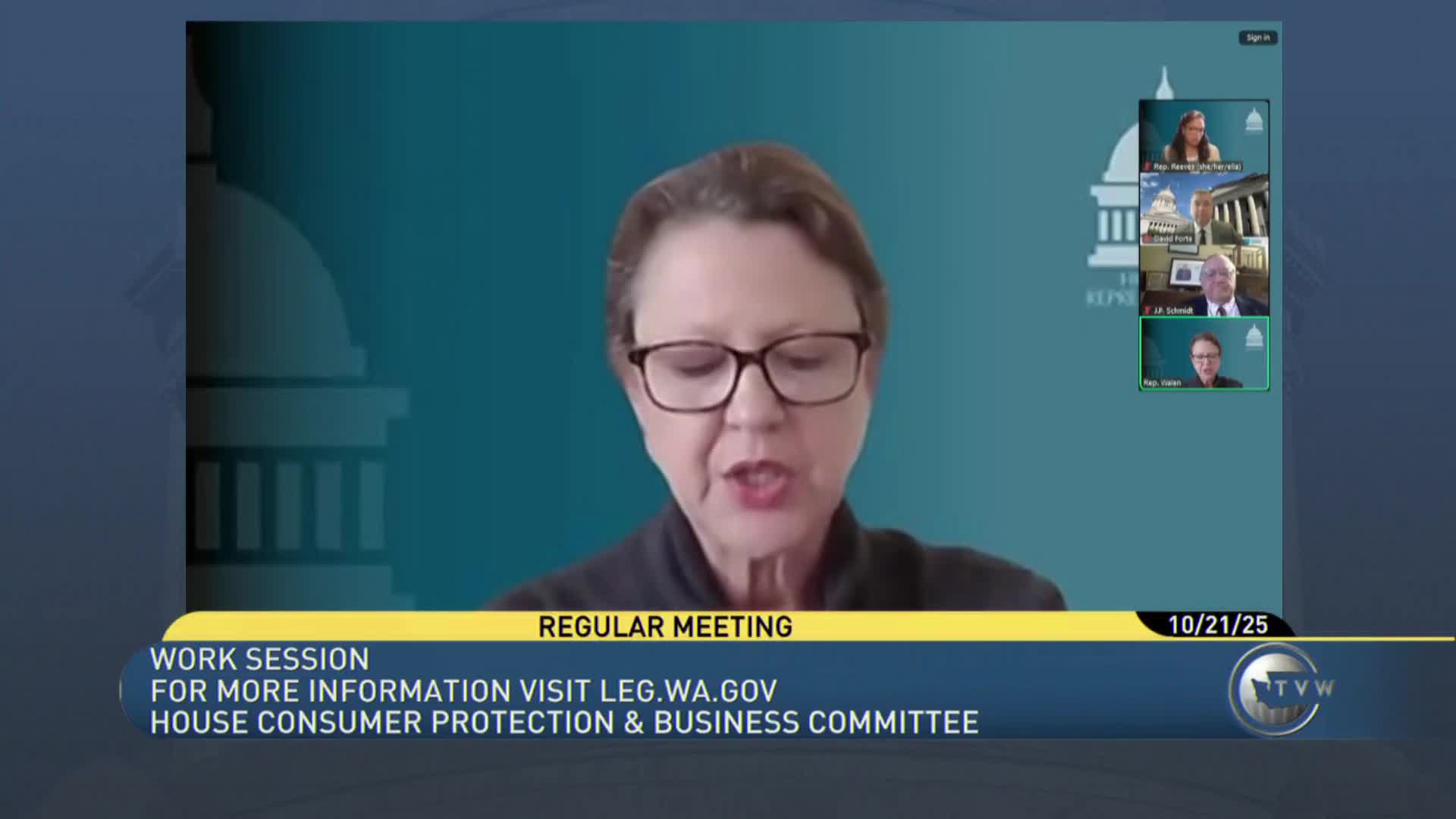
Chair Wallen opened the Oct. 21 work session with two agenda items, starting with a briefing by the Office of the Insurance Commissioner on earthquake insurance for Washington residents and businesses.
David Ford, senior policy adviser for property and casualty at the OIC, told the committee that "insurance is best designed when there are many people pool together sharing the risk and very few of us have damaging events," and he explained why earthquake coverage is typically excluded from standard property policies. He said residential earthquake endorsements often carry very high deductibles — "up to 25% of the policy limit" — and that such endorsements can cost "about 50% of what an annual homeowners premium cost would be." (David Ford, 00:02:00). The OIC also distinguished admitted carriers from surplus‑line (non‑admitted) carriers, noting surplus lines serve as a safety net for risks the admitted market will not cover and that surplus lines place about 14% of Washington's insurance market, largely in commercial lines (David Ford, 00:03:37).
Lauren Burns, senior policy analyst for property and casualty at the OIC, summarized admitted‑market earthquake policy counts for filing years 2021–2023 and said the admitted market held roughly 231,000 earthquake policies in 2021 and about 226,000 in 2023, with the largest concentrations in the Puget Sound and Vancouver areas (Lauren Burns, 00:05:06). Burns emphasized that surplus‑line reporting shows far smaller policy counts for earthquake coverage.
Private‑sector consultants Jeff Bridal (BCE Consulting LLC) and JP Schmidt (Aberis Global) focused the committee on commercial collateral exposure. They summarized geologic risks tied to the Cascadia Subduction Zone and local faults and urged the legislature to consider better inventory and underwriting information for commercial properties: construction dates, soil composition and slope, retrofit status, and the potential for pollution remediation costs after structural failure (Jeff Bridal, 00:26:42; 00:23:50). Bridal told the committee their research estimated roughly 600,000 commercial properties statewide (about 300,000 west of the Cascades) and suggested that only about "5%" of commercial buildings have earthquake protection, leaving a large coverage gap (Jeff Bridal, 00:28:18).
As possible responses, presenters described alternatives to the traditional retail market. David Ford and JP Schmidt explained parametric insurance as a trigger‑and‑payout model that uses third‑party indices (for example, a USGS monitoring threshold) to make fast payments without claims adjustment; Ford said of parametrics: "there's no adjustment of the claim. It's a trigger and it's a payout" (David Ford, 00:08:39). Schmidt and Bridal recommended that lenders and large property owners evaluate captive insurance and parametric structures as tools to provide financial backstops and to transfer peak exposures into global reinsurance markets (JP Schmidt, 00:33:43; Jeff Bridal, 00:33:43).
Members questioned whether the concern was primarily for private consumers, commercial owners, or financial institutions. Schmidt and Bridal said their focus was commercial exposure and lender risk but that shocks to lenders could have downstream effects on consumer access to credit. Megan Mannigan of the Washington Bankers Association reiterated that earthquake insurance premiums are high and that banks have participated in FEMA‑led planning exercises and maintain disaster recovery plans; she cautioned that adding insurance requirements would raise mortgage costs and affordability concerns (Megan Mannigan, 00:50:25).
No formal motions or votes were taken. Committee members asked staff to follow up with materials, and presenters recommended targeted risk assessments (property‑level surveys), lender portfolio reviews, and exploration of alternative risk transfers such as captives and parametric contracts to reduce systemic exposure.
Ending: The committee received the presentations for information and moved on to the WSIPP cannabis research briefing. No ordinance or regulatory change was adopted at the meeting.
AI generated
The text on this page is AI generated. Summaries, highlights, analysis, and video transcripts are all produced from the original source material.
AI can make mistakes, so if you spot one, and we will fix it for everyone.
Note: the source content is unaltered by us. Any content source we link to, be it a video, an audio recording, or a document, is presented exactly as its publisher released it. That publisher is usually a government body, sometimes an individual official or another organisation.