Get Full Government Meeting Transcripts, Videos, & Alerts Forever!
Get email alerts on the Tribal Data Sovereignty topic
No spam. Unsubscribe anytime.
Tribal leaders press for protected access to health data, citing sovereignty and COVID‑era gaps
Summary
Vicky Lowe of the American Indian Health Commission told committee members that tribes have inherent authority over their data, described a state tribal data‑sharing agreement, and said Department of Health stopped collecting tribal affiliation because of Public Records Act concerns.
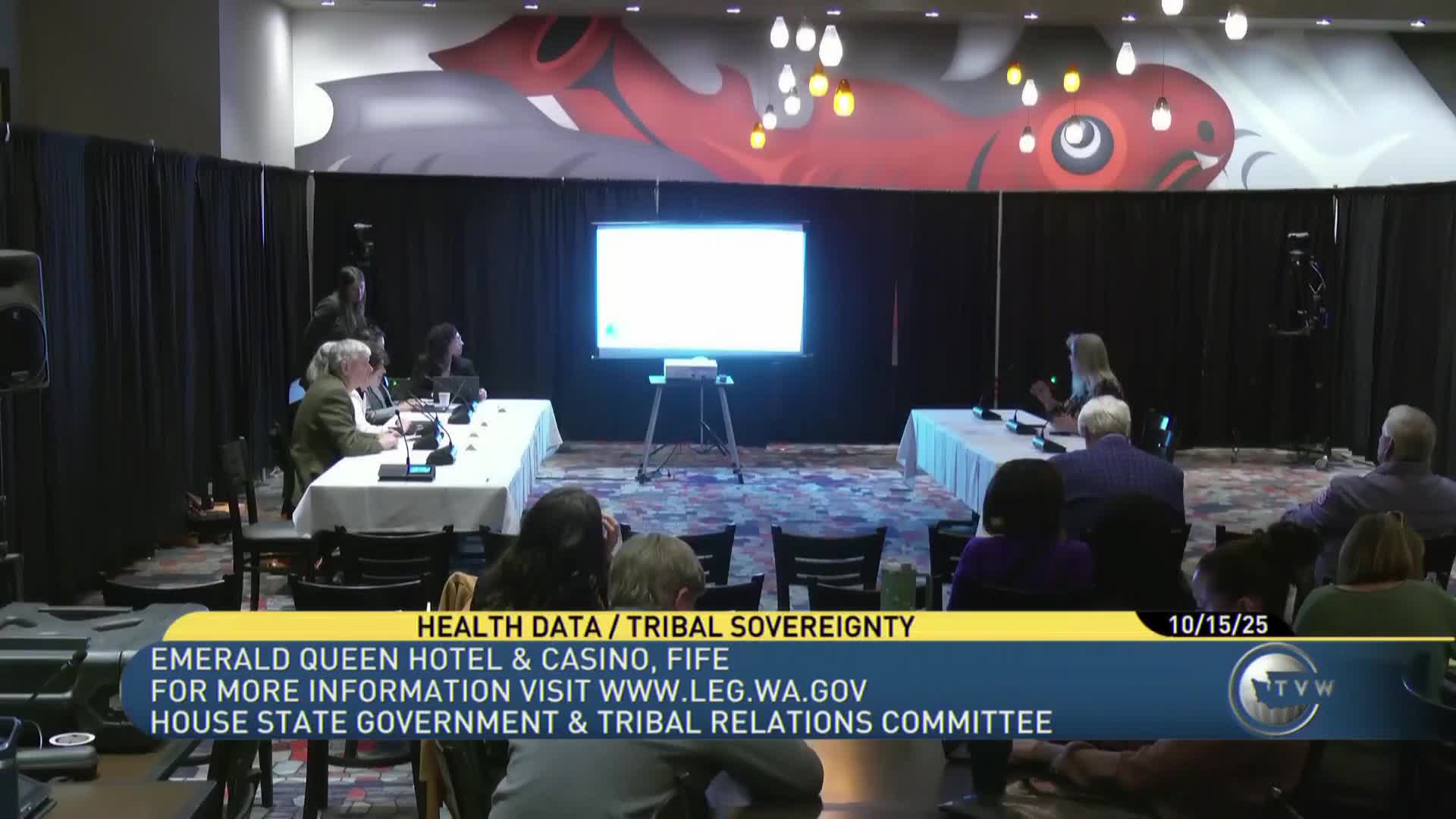
Vicky Lowe, executive director of the American Indian Health Commission, told the House State Government and Tribal Relations Committee at a Puyallup Reservation field hearing that tribes must control access to health data that link individuals to tribal affiliation to protect communities and to inform tribal public‑health work.
"Tribes have the inherent authority to manage their data," Lowe said, describing principles developed by the governor's Indian Health Advisory Council and a tribal data‑sharing agreement negotiated with the Washington Department of Health. She said the American Indian Health Commission represents 29 tribes and two urban Indian health programs in Washington.
Lowe reviewed legal foundations: tribal sovereignty is inherent and predates federal and state authority; the federal trust responsibility and treaty obligations create a government‑to‑government relationship and inform public‑health responsibilities. She cited the Indian Health Care Improvement Act, which codified certain federal obligations for tribal health services.
Lowe described concrete problems uncovered during the COVID‑19 pandemic: tribes lacked direct access to Department of Health case reports, forcing tribal staff to rely on local health jurisdictions for contact tracing. "All of the positive COVID tests were put into the Department of Health's disease reporting system, and none of the tribal staff had access to them," she said. Tribal staff and local jurisdictions spent time exchanging information by fax and manual entry, she said.
The presentation said the Department of Health suspended collection of tribal affiliation in some surveys and reporting because of concerns that tribal identifiers would be exposed under public records requests. Lowe said tribes want RCWs, agreements or technical safeguards that would let DOH collect tribal affiliation while protecting tribal privacy and ensuring tribes can access and interpret their own data. She cited RCW 43.71B (Washington Indian Health Improvement Act) as recognizing tribes as public‑health authorities in the state.
Lowe described an eight‑point tribal data‑sovereignty checklist produced by the governor's advisory council that emphasizes ownership, informed consent, equitable access, privacy and security, consultation and that tribal sovereignty should limit third‑party access to tribal data. "If third parties are accessing tribal data through the state system, we strongly hold that they should be talking to the tribes," she said.
Committee members asked clarifying questions about the definition of tribal data and whether vaccination mandates were used by tribal authorities during COVID; Lowe said tribes, as sovereign nations, decide public‑health measures for their communities. The committee thanked Lowe for the briefing and staff said they would keep the materials on committee files for legislative planning and follow up.
The presentation did not propose a bill at the hearing but aimed to inform members before the next legislative session and identified DOH‑agency coordination and statutory or technical fixes to permit protected collection and use of tribal affiliation data as next steps.