Get Full Government Meeting Transcripts, Videos, & Alerts Forever!
Get email alerts on the Sports Betting topic
No spam. Unsubscribe anytime.
Tribal casinos outline sports‑betting operations, urge permission to allow bets on Washington college teams
Summary
Emerald Queen Casinos and the Washington State Gambling Commission briefed the House committee on how tribal sportsbooks operate, compliance with financial‑crime rules, limits on mobile betting to tribal premises, and a tribal request to allow wagering on Washington collegiate teams, which state law currently prohibits.
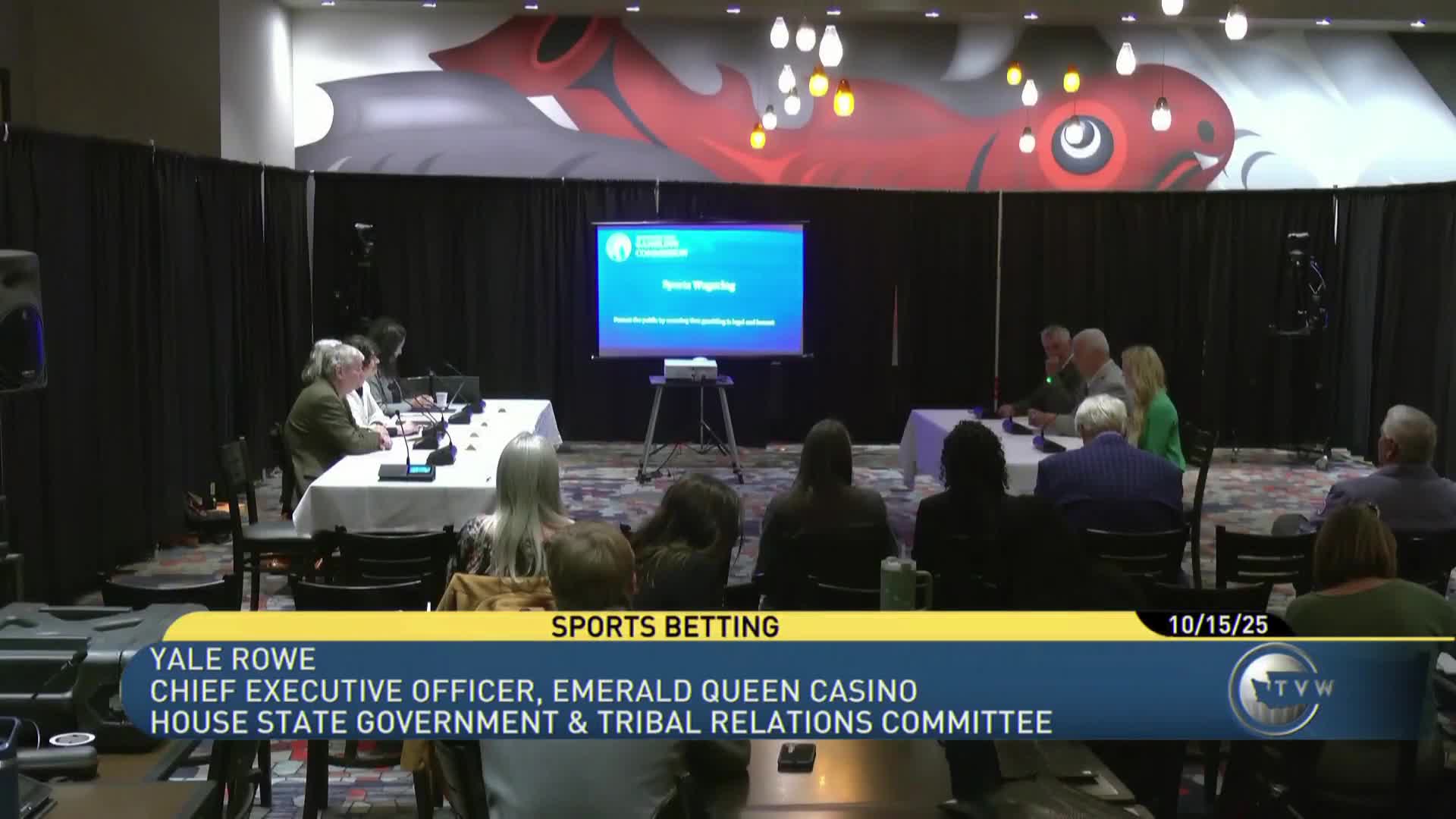
Emerald Queen Casinos executives and a Washington State Gambling Commission official told the House State Government and Tribal Relations Committee at a field hearing on the Puyallup Reservation that tribal sportsbooks use data‑driven oddsmaking, geofencing for on‑site mobile wagers, and federal anti‑money‑laundering safeguards.
"Sports betting is the practice of placing wagers on sports events, guessing outcomes like winners or scores," John Strauss, chief gaming officer for Emerald Queen Casinos, said in his overview. He said oddsmakers set and balance lines to attract wagers on both sides and noted that major operators active in Washington include DraftKings, Caesars, BetMGM and FanDuel.
The commission heard details of how mobile wagering works in Washington: mobile bets are permitted only on tribal premises and are enforced through geofencing or geoframing technology that disables wagering once a patron leaves the allowed area. "Mobile sports betting on a mobile device has become a popular method," Strauss said, adding that other states allow statewide mobile betting, but Washington currently does not.
Strauss described the federal compliance regime for sportsbooks, saying operators follow Financial Crimes Enforcement Network requirements, including know‑your‑customer checks, anti‑money‑laundering monitoring, and currency transaction reports for cash transactions over $10,000. "Protections include know your customer, KYC, verification, anti money laundering, currency transaction reports for cash transactions over 10,000 in a day," he said.
Committee members asked about cyber workarounds to geofencing. Representative Chase asked whether VPNs could defeat geofencing; Strauss said the industry uses third‑party geolocation vendors such as GeoComply and declined to discuss technical details. "We pay 3 different services, GeoComply being 1 of them, which locks them in," he said.
Speakers also emphasized economic and regulatory rationales. Yale Rowe, chief executive officer of Emerald Queen Casinos, said having a sportsbook attracts visitors and supports tribal economic growth. "We believe through our contacts throughout the state that we have the number 1 sports book in Washington," he said. Strauss estimated sportsbooks generate about 2 to 3 percent of a casino's revenue.
A notable policy request from the tribe was permission to accept wagers on Washington collegiate teams such as Washington State University, Gonzaga and the University of Washington. The presenters said the prohibition stems from compact negotiations and concerns about contest integrity, though they argued the regulated tribal environment reduces collusion risk. "We'd like to see that. There's a view that when it's not allowed, it goes into the unregulated market," Strauss said. Tricia Gullian of the Washington State Gambling Commission confirmed the prohibition and noted the state's regulatory role and the compact amendments that legalized sports wagering in 2020 (House Bill 2638).
Panelists also warned of an emerging threat from prediction markets that claim Commodity Futures Trading Commission authority. Gullian said Washington's attorney general joined a multi‑state amicus brief arguing such products are illegal wagering; Strauss said tribes view those markets as a competitive threat.
The committee closed the sports‑betting segment after members raised technical and statutory questions and thanked tribe hosts for the site visit.