Get Full Government Meeting Transcripts, Videos, & Alerts Forever!
Get email alerts on the Special Education topic
No spam. Unsubscribe anytime.
State auditors: no clear underidentification but Washington districts face funding, data and staffing challenges in special education
Summary
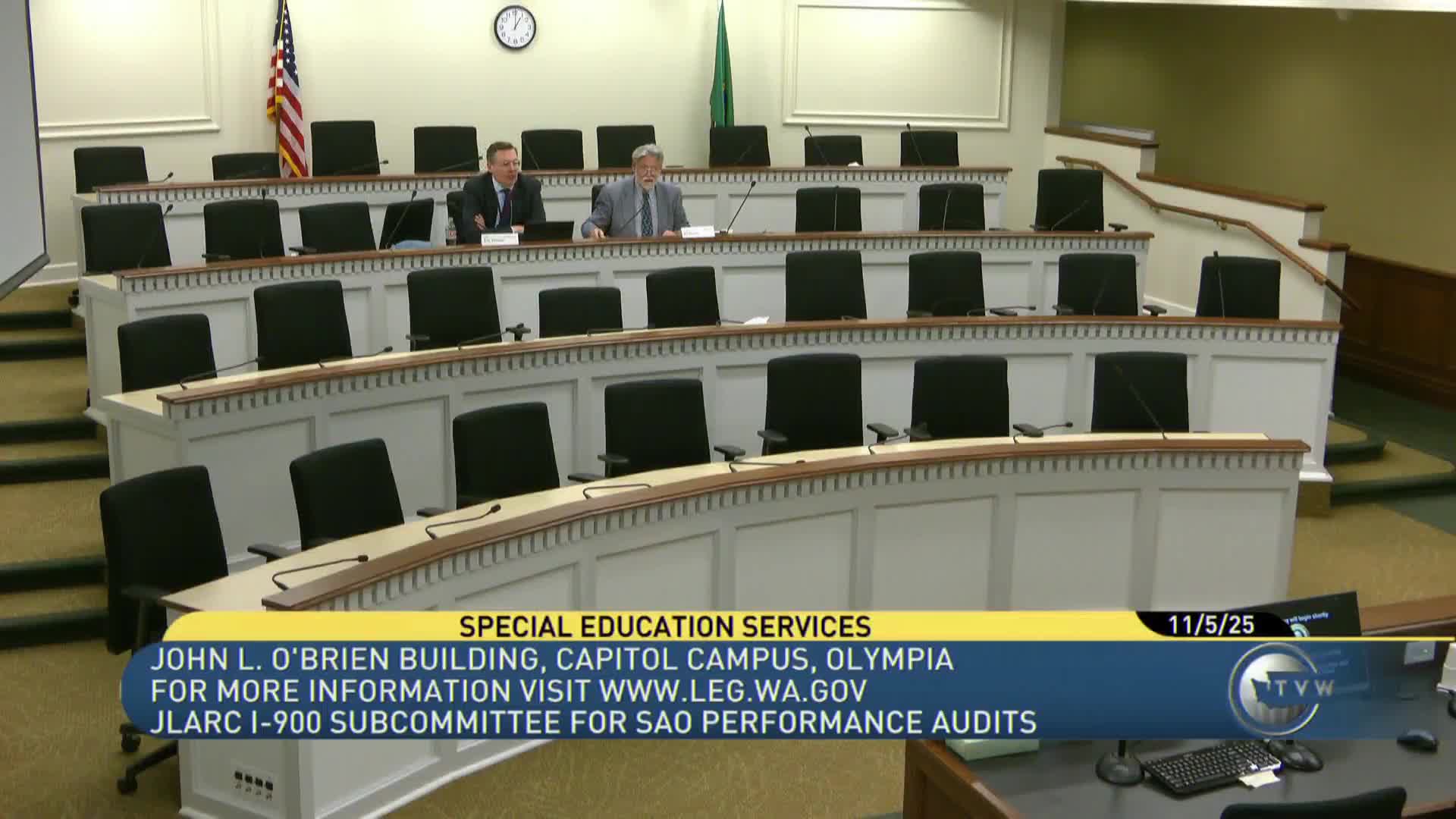
The Washington State Auditor's Office told a JLARC Initiative 900 subcommittee on Nov. 10 that its performance audit found little evidence that any particular population in Washington is being systematically underidentified for special education, but it also documented persistent funding gaps, inconsistent documentation and reporting across districts, and workforce shortages that constrain services.
The Washington State Auditor's Office told a JLARC Initiative 900 subcommittee on Nov. 10 that its performance audit found little evidence that any particular population in Washington is being systematically underidentified for special education, but it also documented persistent funding gaps, inconsistent documentation and reporting across districts, and workforce shortages that constrain services.
"We are here today to discuss the results of our performance audit comparing student needs to district funding for special education," Emily Simber, lead auditor on the project, said as she opened the presentation. Auditors conducted the work under authority granted by Initiative 900 and at the request of House Bill 2180, Simber said.
The audit addressed two primary questions: whether any populations appear to be underevaluated or underserved by Washington school districts, and whether districts receive sufficient funding to evaluate students and provide services consistent with need. To estimate prevalence where a definitive baseline does not exist, auditors used two statistical models (a national model and a state model) that applied demographic risk variables — including foster care share, percentage of English language learners and the share of private school students living in a district — to estimate expected rates and compare them to actual identification rates.
The models showed Washington districts clustered near national trends but slightly below the national trend line when holding demographic characteristics equal. "Washington school districts lie a little bit below average, but towards the middle in terms of their percentage of students in special education," auditor Corey Crowley Hall said. Auditors concluded that, given the models and the data available, they found little evidence that any specific demographic group was being underidentified for special education in the state.
Auditors emphasized the limits of the method. "The true rate of these disabilities in society is not known because we don't have any kind of universal screening for them in our society," Crowley Hall said during questions from lawmakers. He and the audit team acknowledged that models provide the best available baseline but cannot definitively rule out underidentification if medical or public-health screening is incomplete.
The audit identified several operational challenges that complicate identifying and serving students. Districts sometimes use different definitions, track data inconsistently, and do not uniformly capture whether an initial referral was for special education or for another service. Auditors reviewed records in 11 districts and found that while most followed required processes, documentation gaps made monitoring compliance difficult. Auditors noted that OSPI required districts to report counts of special-education evaluations and initial referral dates but did not track referrals that did not result in evaluations.
Auditors also highlighted two variables associated with lower identification rates: the percentage of private school students residing in a district and the share of English language learners. The report said both groups can be harder for districts to identify because private students are less visible to district staff and ELL students present additional language and cultural assessment challenges.
On funding, auditors reported that districts collectively had to cover approximately $500,000,000 in special-education expenses not paid for by state or federal funding during the review period. Washington's prior special-education funding formula also included an enrollment cap (16% in 2024-25) that limited the state funding districts could receive; the Legislature removed that cap and altered the safety-net process during the most recent session, changes that took effect in the current school year and were therefore not analyzable in the audit.
Auditors made several recommendations aimed at improving statewide understanding of need and supporting uniform practice. Principal recommendations include that the Office of Superintendent of Public Instruction (OSPI) clarify what constitutes an official referral for special-education evaluation; require school districts to report referral data even when the referral did not lead to an evaluation; work with districts in developing the new statewide special-education data system; provide training to promote uniform use; and consider mandating the system so the state has a consistent statewide data source.
Dr. Sue Ann Booby, the auditors'special education consultant, told the panel that medical diagnoses do not map directly to IDEA eligibility categories and that some students may receive 504 plans rather than IEPs, complicating comparisons between medical prevalence studies and special-education identification. "A medical diagnosis ... is different than an educational service area as defined by IDEA," she said.
Representative Sharon Pollet, who authored the legislation requesting the study, pressed auditors during questions about whether the work examined prevalence of specific disabilities in vulnerable populations. "I am disappointed," Pollet said, asking why the audit did not use peer-reviewed prevalence research to compare medical prevalence by race and ethnicity to identification rates. Auditors reiterated the limitations of available prevalence data and the difficulty of concluding underidentification in the absence of universal screening.
OSPI staff in attendance — Misha Chernisky, Jennifer Story and Cassie Martin — said the agency concurred with the audit results and appreciated the work. The auditors and OSPI committed to further work on the statewide system and implementation of the recommendations.
The JLARC subcommittee took no formal votes at the hearing. The auditor's report and related materials include detailed methodology exhibits, model outputs, and a set of follow-up recommendations intended to improve data quality and funding transparency across districts.