State veterans agency seeks match dollars for Tri‑Cities cemetery, urges funding for Spokane home replacement amid service cuts
Loading...
Summary
The Washington State Department of Veterans Affairs told the legislative joint committee it needs state matching funds to access federal grants for a new Tri‑Cities veterans cemetery and seeks state support to complete a Spokane Veterans Home replacement that would add private rooms and memory‑care capacity.
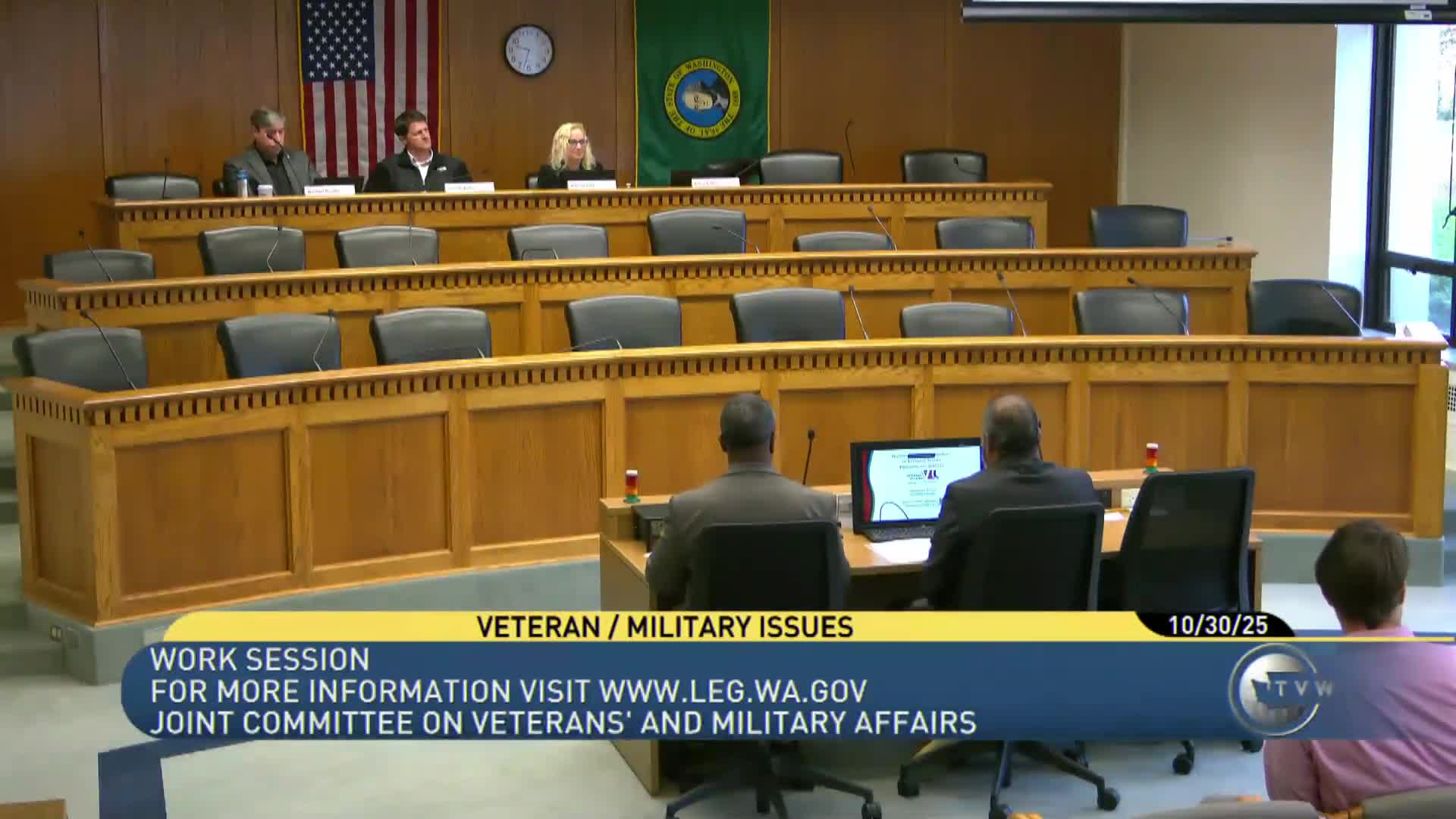
David Puente, director of the Washington State Department of Veterans Affairs (WDVA), briefed the Joint Committee on Military and Veterans Affairs on three agency priorities: a proposed Tri‑Cities state veterans cemetery, a Spokane Veterans Home replacement, and recent budget reductions that have reduced some veteran services.
"Once we get the keys to the location in the cemetery, typically the VA will reimburse the additional 10%," Puente said, describing the federal arrangement that will fund most start‑up costs if the state provides an initial 10 percent match for a new cemetery. Federal VA analysis identified a 75‑mile radius in the Tri‑Cities area that would serve roughly 46,000 veterans and an estimated 400 interments per year.
WDVA has identified two candidate parcels near Richland and West Richland and received $500,000 in capital funding for a predesign study due in early 2026; the predesign will evaluate access, utilities, geotechnical and archaeological constraints and recommend the preferred site. Puente said Pierce County’s armed forces license‑plate fund currently supports the existing Spokane cemetery but that fund alone cannot support a second state cemetery; he said the agency expects to request general‑fund support for ongoing operation and maintenance once a second cemetery is built.
On the Spokane Veterans Home replacement, Puente said site negotiations were nearing completion and the agency is working to close a land purchase. The proposed replacement follows the VA’s small‑house model: multiple 20‑bed households clustered around a central hub with shared dining and medical support. The preferred parcel totals about 42 acres, and the proposed new home would provide roughly 120 beds in private, home‑like rooms and additional memory‑care capacity the agency currently lacks in Eastern Washington.
Puente told the committee WDVA submitted a capital request and a grant application for the estimated $162 million construction cost; the federal VA will cover about 65% of eligible construction costs if the state secures its matching share. He said WDVA currently operates 517 beds statewide but VA data indicate a need for roughly 1,200 beds in Washington.
The agency also reported a set of budget reductions that are already affecting service delivery. WDVA said it absorbed roughly $3.2 million in reductions and is holding 17 positions vacant. The reductions have disproportionately affected veteran services and outreach: the agency reduced travel and in‑person outreach, lowered partner grants to veteran service organizations by about 6%, and cut roughly $861,000 from the veteran services and counseling program. Puente said counseling and emergency financial assistance programs each face about $100,000 in reduced funding.
Committee members pressed for details on timing for capital requests and on whether federal staffing and grant changes were affecting suicide‑prevention or hotline services; Puente said WDVA retained a Staff Sergeant Fox grant that funds suicide‑prevention work and is monitoring VA staffing and partner capacity. He asked members to consider state funding to cover operations and maintenance for a second cemetery and noted WDVA will return with additional details as predesign and land purchase progress.
Solomon Gilbert, deputy director, attended the briefing and joined Puente in answering questions about siting, community partnerships and possible future uses for the current Spokane facility if the home moves to a new site (transitional housing or adult day health care were identified as options).