Get Full Government Meeting Transcripts, Videos, & Alerts Forever!
Get email alerts on the Youth Services Access topic
No spam. Unsubscribe anytime.
Youth advocates say family contact, mental‑health and education access lag in juvenile facilities
Summary
Youth advocates and legal services for incarcerated young people told the committee that family contact, access to mental‑health care and educational opportunity remain inconsistent across secure facilities and can prolong harm.
Youth advocates and legal services for incarcerated young people told the committee that family contact, access to mental‑health care and educational opportunity remain inconsistent across secure facilities and can prolong harm.
“My name is Gisela Gonzales… I spent time at the in county juvenile justice center, and that time really did damage me,” Gisela Gonzales, a youth with system experience, told the committee. She described limited counseling during her stay and said educational offerings at Echo Glen were insufficient. “When I came out of Echo Glen, I was not only very under where, I was very undereducated,” she said.
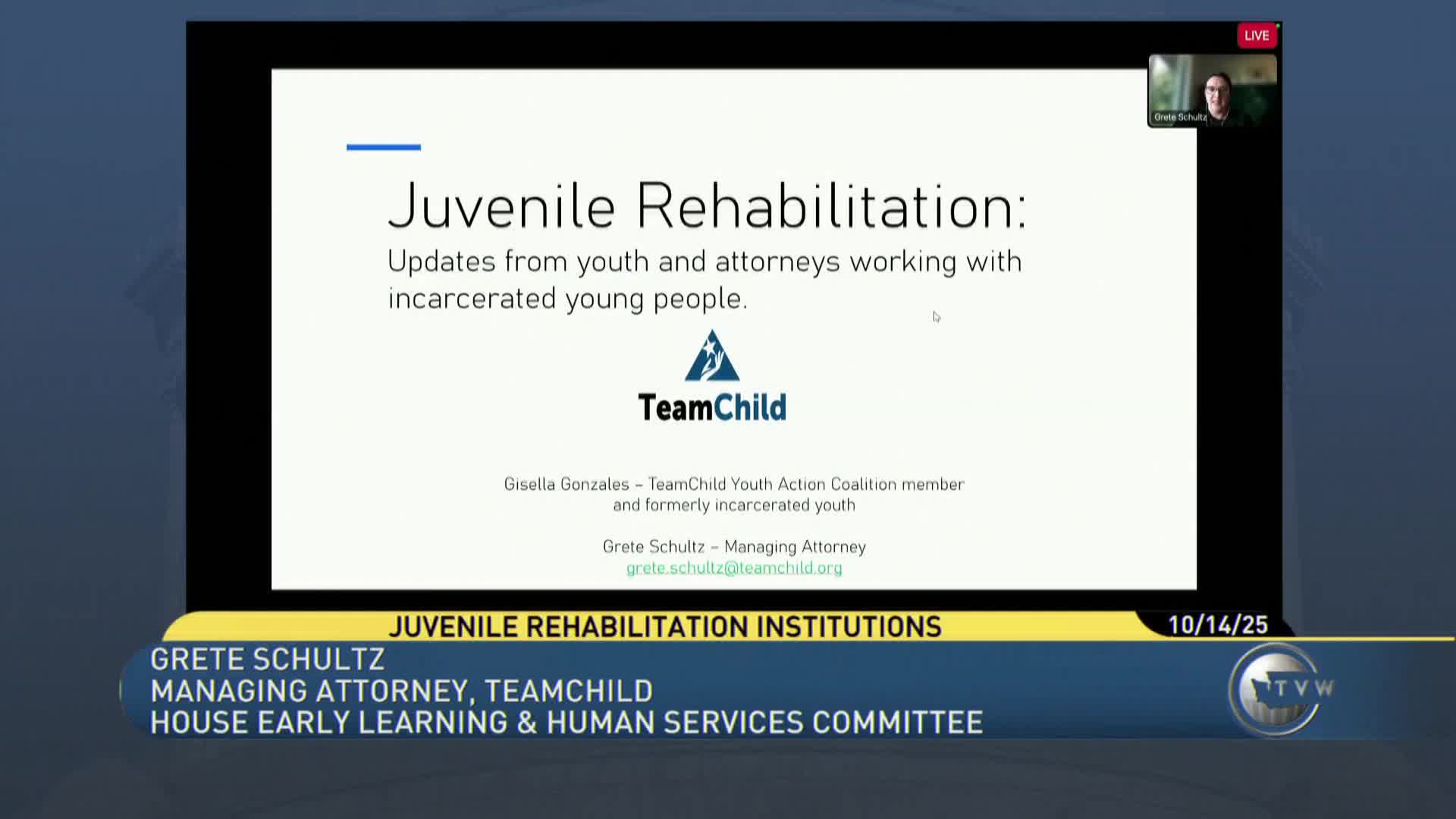
Greta Schultz, managing attorney with TeamChild, presented findings from TeamChild’s annual report and relayed young people’s recommendations. Schultz told the committee that youth define success broadly: not only diplomas and vocational certificates, but mental‑health stability, safety from violence, respectful treatment by staff and reliable family connection.
Schultz and advocates urged faster diagnosis and support for youths with developmental or acquired disabilities. They said assessments and school‑based services exist but can be delayed, and that JR’s practice of extending sentences for disciplinary reasons can increase length of stay without clear rehabilitative benefit.
Advocates also criticized several facility practices that limit family contact. TeamChild reported instances where phone access appeared controlled by case managers, with some youths allowed only monthly calls, and instances in which whole living units were shifted to no‑contact visits as a punitive response to group incidents. "Youth will have to wait a month, months, just a very long time in order to have, you know, the deep behavioral health support that they need," Schultz said.
On education, advocates flagged a gender disparity: Green Hill offers on‑campus college instruction for older males but Echo Glen’s female population has struggled to secure equivalent higher‑education access. Advocates said JR staff told them efforts are underway to secure online or on‑site college for Echo Glen, but that access has been a long‑standing gap.
TeamChild and the Youth Action Coalition urged fuller and faster use of Community Transition Services (CTS) and community facilities to move youth back to family and community supports when clinically appropriate. They said CTS appears underused in some cases and recommended expedited assessments and community staffing to increase placements.
Provenance: Topic introduced with TeamChild remarks: "This is the QR code to our annual report..." (transcript block block_218; tc 00:36:10). Youth remarks: "My name is Gisela Gonzales, and I am an HMO high school student..." (transcript block block_311; tc 00:52:37).