JBLM sentinel landscape briefing urges voluntary land conservation, seed production to ease training encroachment
Loading...
Summary
The Joint Base Lewis–McChord Sentinel Landscape Partnership said voluntary conservation and targeted funding can reduce encroachment that constrains military training at JBLM.
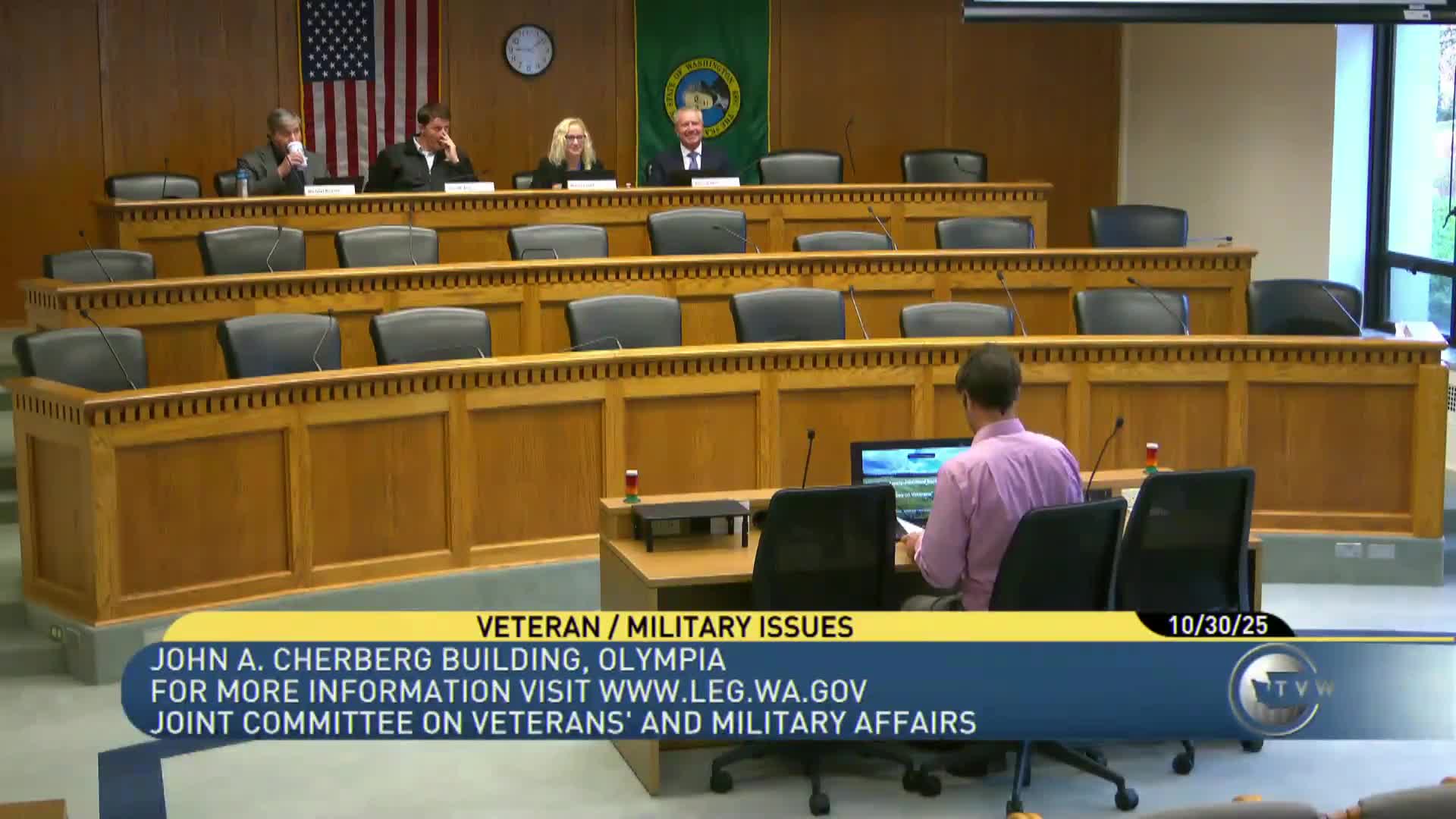
The Joint Base Lewis–McChord (JBLM) Sentinel Landscape Partnership told the Joint Committee on Military and Veterans Affairs that voluntary conservation around the installation can reduce the regulatory and development encroachment that limits military training.
"We rely on voluntary, non‑regulatory cooperation with private landowners," said Dr. Dan Calvert, program coordinator for the JBLM Sentinel Landscape Partnership. He told the committee the program supports natural‑resource management and working lands to safeguard training flexibility at JBLM.
Calvert summarized the program’s scope and tools. There are currently 19 Sentinel Landscapes in 17 states and one territory covering 60 installations and ranges. JBLM’s Sentinel landscape protects roughly 90% of remaining prairie habitat in Western Washington and thus is a stronghold for multiple species listed under the Endangered Species Act; the presence of listed species can create timing and location restrictions on training.
The partnership uses several funding avenues and project types. Calvert described the Readiness and Environmental Protection Integration (REPI) program as a flexible federal tool that can fund off‑base land protection, management and certain capacity activities; he said nearly $14 million in REPI funds supported regional projects in the last four years. Locally, the partnership secured $3 million to protect about 10 acres of prairie at Pacific Lutheran University through a conservation easement, with Pierce County holding the easement; Calvert noted that the funding does not cover ongoing management such as prescribed burning.
Calvert reviewed other projects and capacity investments funded through REPI Challenge awards and partner grants: a seed‑coordinator role to expand local prairie seed production; a shared restoration crew serving multiple properties; travel funding to support tribal and reservation restoration work; captive‑rearing of ESA‑listed species through the Sustainability in Prisons program; and landowner outreach funded to WSU Extension and Thurston Conservation District.
Calvert also described recent grant attempts that were not funded: an NRCS Regional Conservation Partnership Program (RCPP) proposal for a roughly 100‑acre farm abutting JBLM and a larger, roughly 484‑acre proposal. He said those proposals remain "ripe and ready to go" but face high land values, smaller parcel sizes compared with other regions, and administrative complexity as barriers to success.
On policy, Calvert asked the committee to consider several state‑level supports that could improve partners’ ability to leverage federal dollars: codified state Sentinel Landscape designation to coordinate state agencies; a dedicated state matching fund to support conservation easements and management endowments; authority for more local organizations to hold perpetual management endowments; limited flexibility in statewide burn bans to allow prescribed fire for habitat management and wildfire mitigation; and greater flexibility for water‑right transfers to enable conservation actions.
Committee members asked technical follow‑ups. When asked whether seed supply was wild‑collected or nursery‑grown, Calvert replied that most supply comes from local growers and nurseries but that availability is insufficient and he is working to diversify producers. On whether federal REPI staff and funding reductions were affecting local work, he said he had heard anecdotal reports of staff losses and would follow up with specifics.
Calvert concluded by urging ongoing engagement between the partnership and state officials to align conservation, agricultural and training‑readiness goals.