Get Full Government Meeting Transcripts, Videos, & Alerts Forever!
Get email alerts on the Medical School Pipeline topic
No spam. Unsubscribe anytime.
UND Medical School outlines 'North Dakota 85' recruiting push and student‑support plans to retain more in‑state physicians
Summary
The UND Medical School said it received 1,855 MD applications in the most recent cycle but only 109 listed North Dakota as a permanent address; the school outlined recruitment, bridge programs and an embedded student‑support model designed to raise in‑state matriculant shares and retention.
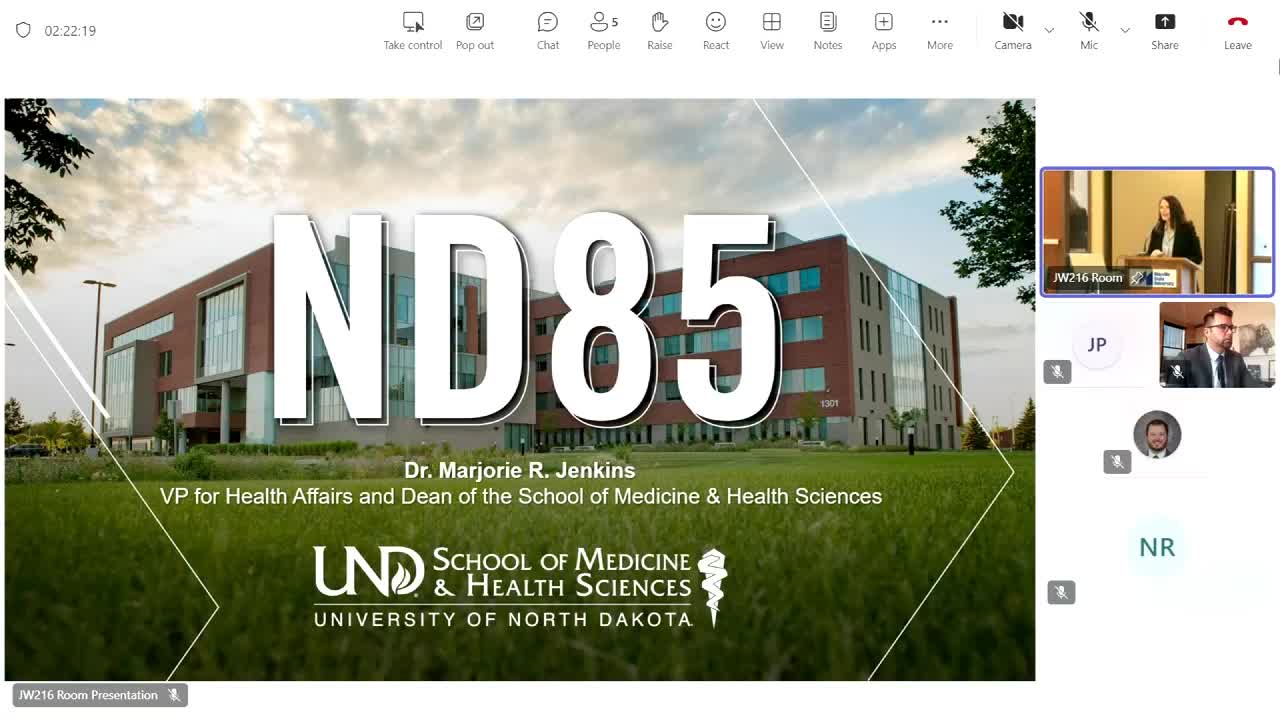
Dean Jenkins of the University of North Dakota Medical School updated the committee on the school’s "North Dakota 85" initiative, a statutory goal (Senate Bill 2003, Sec. 44) to increase the share of in‑state residents among MD and PA matriculants to 85% by 2030.
Jenkins said UND’s most recent admissions cycle included 1,855 MD applicants of whom only 109 listed North Dakota addresses. ND applicants who apply are often competitive on GPA but less often meet the MCAT thresholds program screens on; the result is fewer ND applicants reach and complete the interview pipeline. Jenkins said the school has begun prioritizing North Dakota applicants in admissions and has added a weekend interview day dedicated to applicants with strong ND ties.
Underscoring the retention problem, Jenkins warned that current cost of attendance is near $80,000 per year and a four‑year program’s totals (roughly $320,000) combined with recent federal proposals on loan limits could make financing medical education more difficult for some students. The school is seeking to reduce financial risk for prospective ND students as part of the retention strategy.
UND outlined a four‑part plan: (1) stepped‑up recruitment (two regional recruiters, scrubs camps, high‑school outreach); (2) advising and bridge programs (partnerships with ND undergraduates; a one‑year non‑thesis master’s program that can guarantee a medical‑school interview if criteria are met); (3) MCAT preparation and admissions coaching; and (4) in‑school student supports — a "Team Success" model that embeds a faculty lead, a learning strategist and a psychologist to identify students at risk and provide early support to preserve on‑time graduation rates.
The Medical School also announced a planned primary‑care accelerated track to begin accepting students for 2028. Under that program, students would complete an accelerated (three‑year) MD with placement into an in‑state family or internal‑medicine residency and would receive full tuition and fee scholarships in exchange for a five‑year in‑state service commitment.
Why it matters: UND’s pipeline and retention problems directly affect rural health workforce capacity in North Dakota. Jenkins’ recruitment and support measures seek to increase the share of North Dakota residents in training and thereby raise the likelihood they practice in‑state after residency. The committee asked for continued reporting on outcomes, admissions changes and retention.