Get Full Government Meeting Transcripts, Videos, & Alerts Forever!
Get email alerts on the Infrastructure Sewers topic
No spam. Unsubscribe anytime.
Gardiner council accepts 2025 CSO master plan, directs DEP schedule negotiations tied to funding
Summary
The Gardiner City Council unanimously accepted the 2025 Combined Sewer Overflow master plan and directed staff to negotiate the DEP schedule for required projects based on funding availability.
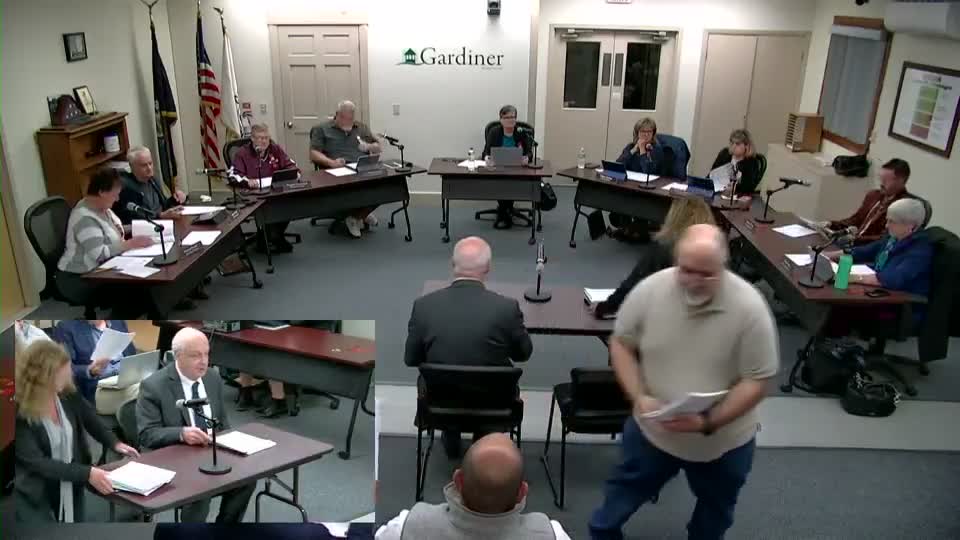
Gardiner — The Gardiner City Council on a unanimous vote accepted the city’s 2025 Combined Sewer Overflow (CSO) master plan and then voted to amend that acceptance so staff may negotiate the implementation schedule with the Maine Department of Environmental Protection (DEP) to reflect funding realities.
The plan, presented by Bill Oliver of Oliver Associates, documents the city’s sewer system, models storm-driven peaks and identifies the worst upstream source areas that drive overflows at the Main Avenue pump station. Oliver said the system includes about 18 miles of sewer piping, two major pump stations and a treatment plant with a permitted capacity of about 9.7 million gallons per day (MGD). During a modeled 25‑year storm (about 5.4 inches in 24 hours) the system could produce roughly 13.22 MGD — about 3.5 MGD above treatment capacity, the presentation stated.
Oliver named three high‑priority source areas for remediation: Spring Street (measured ~406,000 gallons per day per inch of rain in parts), Ash Street/West Hill near the high school (~400,000 gpd/inch) and Central Street downtown between Pine and Green (~320,000 gpd/inch). He recommended targeted television (TV) pipe inspection of those lines to determine whether pipe relining or open‑cut replacement is required. Cost estimates in the master plan (open‑cut basis) included Spring Street ~$3.6 million, Ash/West Hill ~$2.1 million and Central Street ~$1.3 million, for a near‑term total of about $7.2 million.
Oliver described the city’s 410,000‑gallon storage tank at the Main Avenue pump station and said that, since the plant upgrade in 2006 (from 4.5 MGD to 9.7 MGD) and the tank installed in 2016, overflows dropped from dozens of events per year to an average of roughly three per year. He said the CSO license is a legal mechanism that allows managed discharges but obliges municipalities to produce and update a master plan every five years.
Councilors pressed the presenters on affordability and grant prospects. An unidentified funding advisor and Oliver told the council that DEP’s State Revolving Fund (SRF) programs and other grant programs take community income and unemployment into account when assessing forgiveness and eligibility. Oliver said a $7.2 million package financed over 20 years at 2.5% interest would add about $462,000 a year in debt service and about $310 a year to the average sewer bill — pushing the typical household sewer burden to about $1,400 annually unless grant funding reduces the local share.
After the presentation, Councilor Gaye Grant moved to accept the master plan. The council recorded a unanimous vote to accept the plan. Grant later asked that the council add language to make clear acceptance was subject to negotiation with DEP on the schedule and to reflect funding constraints; the council approved that amendment unanimously.
"We've met the requirement by doing the plan," Oliver told the council, but he underscored that the DEP must accept the schedule and that the schedule can be adjusted if funding cannot be secured.
Next steps recorded in the presentation and during council discussion include: conducting TV inspection work in 2026 to refine design scope, pursuing SRF and other grant and loan programs (including a DEP grant that can reimburse 50% of TV inspection costs), scheduling a funding meeting with DEP and funders, and prioritizing Spring Street, Ash/West Hill and Central Street for design and construction phases in 2027–2029 if funding is obtained.
The council’s amended acceptance directs the city manager and staff to pursue meetings with DEP to negotiate a realistic schedule tied to the city’s funding and affordability constraints. The town’s acceptance of the plan satisfies the master-plan requirement but does not make the schedule legally binding until DEP incorporates it into the discharge license.