Get Full Government Meeting Transcripts, Videos, & Alerts Forever!
Get email alerts on the Student Health topic
No spam. Unsubscribe anytime.
Twin Valley board discusses adding Wi‑Fi access for students with diabetes monitoring devices
Summary
Board members debated adding language to policy 209.2 to permit students with medically approved glucose monitors or insulin pumps to connect to district Wi‑Fi 'when possible' so monitoring data can be transmitted; staff said individual medical plans and administrative regulations would govern implementation.
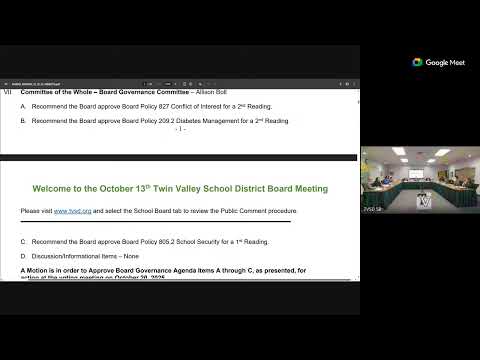
Twin Valley School District board members discussed proposed language to board policy 209.2 (diabetes) to make clear that students with medically approved glucose monitoring devices and insulin pumps should be permitted to access district Wi‑Fi resources when necessary for health monitoring.
A board member (Speaker 2) urged adding policy language after describing cases in the district where getting approval and technical connectivity took "several weeks, if not months," and warned, "However, this is a life to death type scenario." Staff (Speaker 4) said nurses had reviewed procedures and that accommodations are typically documented in a student's medical plan or 504 plan; administrators (Speaker 3) said administrative regulations could spell out technical measures (MAC filtering, a dedicated SSID or priority traffic) while preserving a statement that the district cannot guarantee flawless connectivity.
Why it matters: Diabetes care increasingly depends on continuous glucose monitors and phone‑linked pumps that transmit real‑time data to parents and school nurses. Trustees said adding guiding language to policy would clarify expectations and speed local administrative approvals while limiting the district's liability by noting that connectivity may not be perfect.
Details: The administration recommended the policy be written so that students "approved for possession and use of monitoring equipment shall be permitted to connect to the district's Wi‑Fi resources" with qualifying language such as "when available," "practical," or "as feasible" to avoid implying an absolute guarantee. Staff explained current local practice includes use of public Wi‑Fi, MAC filtering, and ad‑hoc priority measures for medically necessary devices. The board and staff agreed to draft proposed policy language and assign specifics to administrative regulation for review at the next committee meeting.
What happens next: Trustees directed administration to prepare revised policy/regulation language for the next review cycle so board members can examine a written proposal before the next formal reading.