Get Full Government Meeting Transcripts, Videos, & Alerts Forever!
Get email alerts on the Pilot Cost Controls And Rate Design topic
No spam. Unsubscribe anytime.
People's Counsel urges $30M-per-utility cap and strict cost controls for geothermal pilots; staff lays out data and reporting needs
Summary
The Office of People's Counsel urged the Public Service Commission to limit ratepayer exposure on Maryland’s network geothermal pilots to about $30 million per utility and to require close reporting and prior authorizations for cost overruns.
The Office of People's Counsel told the Public Service Commission that Maryland’s proposed network geothermal pilots carry unusually large costs and should be constrained by clear budget controls and reporting requirements.
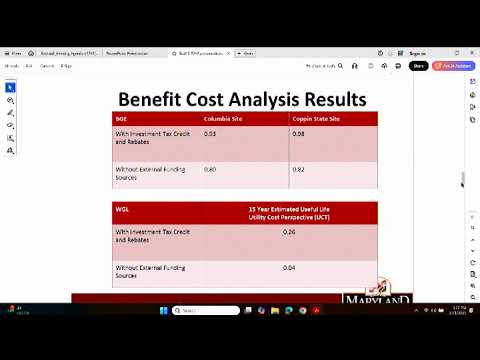
Assistant People's Counsel Diamond Hawkins introduced the OPC position and said OPC supports network geothermal learning but "cautions that innovation must be balanced with fairness," including limits on ratepayer exposure. Consultant Theodore Love presented cost and per‑ton comparisons that OPC argued show Maryland pilots are expensive relative to other projects: he cited combined pilot budgets of roughly $123 million (and up to $190 million if outside funding does not materialize), and revenue-requirement scenarios ranging from approximately $261 million to $353 million in 2025 dollars.
Love told commissioners that median and average per‑ton costs in U.S. network geothermal projects are about $58,000–$65,000 per ton but that Washington Gas and BGE pilots showed substantially higher per‑ton figures (OPC cited roughly $134,000 per ton for WGL and up to $223,000 per ton for BGE in materials shown to the commission). "These budgets are beyond the pilot level here," Love warned, and OPC recommended several controls to limit ratepayer risk.
OPC’s recommendations included: capping recoverable pilot spending to $30 million per utility after accounting for outside funding; limiting allowable cost overruns to no more than 10% without prior Commission authorization; rejecting BGE’s proposal to capitalize non‑capital pilot costs and rejecting Washington Gas’s request for accelerated depreciation plus a 100‑basis‑point adder to its authorized return on equity.
Senior Assistant People's Counsel Mark Scheibust further argued the statute (cited in the hearing as section 7‑1102) places primary responsibility on gas companies and that allocating large portions of these pilot costs to electric customers raises statutory and fairness concerns.
PSC technical staff joined the discussion and recommended staged approvals, stronger data reporting and a work‑group model to define "apples‑to‑apples" metrics: semiannual reports, clear categorization of front‑of‑meter vs. behind‑the‑meter costs, and verification of any transmission and distribution savings before allocating those savings to electric ratepayers. Staff also suggested approving one pilot per utility with explicit conditions on reporting and external review where appropriate.
Commissioners expressed concern about both large costs and the risk that strict upfront caps could stall viable pilots; they asked staff how prior‑approval protocols or semiannual reporting might provide timely oversight without unduly delaying construction. OPC and staff indicated they would be open to a process that combines budget limits with early notification and Commission approval triggers for overruns.
The hearing record now moves to deliberations over whether to approve one or more pilots and, if approved, what specific cost‑control, reporting and customer‑protection conditions should be imposed.