Get Full Government Meeting Transcripts, Videos, & Alerts Forever!
Get email alerts on the Code Changes Public Comments topic
No spam. Unsubscribe anytime.
Work group flags small-business costs, embodied carbon concerns ahead of CR-102 filing
Summary
Members and public commenters told the Building Code Council work group that proposed energy- and building-code changes could impose significant costs on small businesses and tenants, and urged staff to supply quantitative cost–benefit analysis before the council’s CR-102 filing.
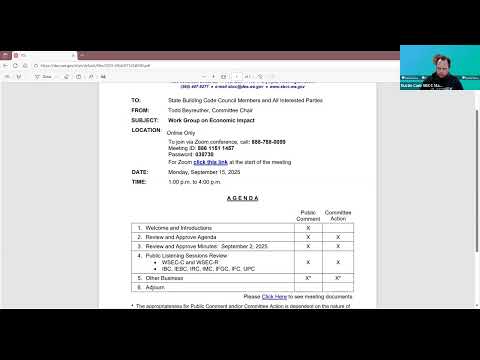
Members of the Building Code Council work group on economic impact met Monday and reviewed public comments received during recent listening sessions, focusing on potential cost impacts of proposed building- and energy-code changes and gaps in the available cost–benefit analysis.
The work group, which met virtually Sept. 15, heard that opposition to the embodied-carbon proposal remains, and that at least two comments on the commercial energy code argued kitchen-electrification requirements would place “significant and prohibitive” costs on tenants and small businesses, potentially requiring infrastructure upgrades the tenant cannot complete. Dustin, staff to the work group, summarized the comments and confirmed the list of issues the group had already flagged.
Patrick Hanks of the Building Industry Association of Washington said he had reviewed the commercial proposals after the listening sessions and raised several concerns about how the proposals could affect mid- and high-rise multifamily buildings. He singled out a proposal to incorporate the clean building performance standard and an electrification package, and warned that a 20% vertical-fenestration requirement could produce unintended design and cost consequences. “I think it’s really important to get quantitative analysis, even if it’s just a preliminary review,” Hanks said, adding that the public and the council need numbers they can review before final adoption.
Work group staff confirmed a separate procedural problem: the 2021 preliminary cost–benefit analysis referenced in prior cycles is currently unreachable online. Hanks said the missing link prevented straightforward comparison with the residential analysis, and called for restoring the record so the public can scrutinize cost assumptions. Dustin responded, “I want to track down that broken link… I’ll make sure to get that back online.”
The staff summary also noted a comment that changes to the CMU-block installation requirements could discourage use of CMU (concrete masonry unit) blocks to meet energy requirements, and a general comment urging the council to adopt less-cost-restrictive measures to avoid upward pressure on rents.
The work group agreed its immediate tasks are to ensure draft CR-102 documents include flagged public-comment items and to get any missing background materials (including the 2021 analysis) back online before the Building Code Council’s Sept. 26 meeting. If additional substantive public input arrives after staff distributes the written comments, the work group said it may reconvene to consider changes ahead of the formal CR-102 filing.