Get Full Government Meeting Transcripts, Videos, & Alerts Forever!
Get email alerts on the Stormwater topic
No spam. Unsubscribe anytime.
Kankakee committee backs mirroring neighboring stormwater detention rules; urges quick council review
Summary
After public comment from a local small‑business owner who said detention requirements make a small parking lot cost‑prohibitive, the Kankakee planning/ordinance committee voted unanimously to send a proposed stormwater ordinance amendment to the full city council with the planner’s and engineer’s approval.
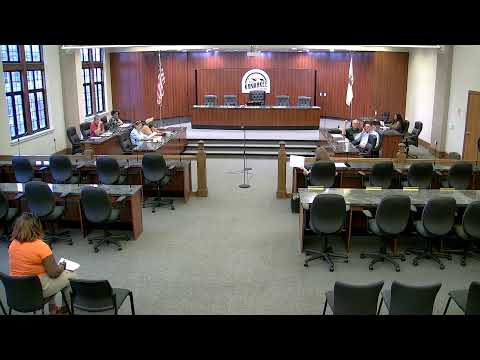
The Kankakee City planning/ordinance committee voted unanimously to forward a proposed amendment to the city’s stormwater detention rules to the full City Council, after hearing public comment from a nearby business owner who said the current rules impose steep costs on very small parking projects.
Joe Thomas, who identified himself as an owner of Legacy Bank Wall and Little Light of My childcare, told the committee his proposed 14‑space parking lot behind his building at 1060 East Birch Avenue would cost about $56,000 to construct. ‘‘That’s with the drainage,’’ he said, and added that ‘‘just for the drainage and the pipe installation is $10,000.’’ Thomas asked the city to consider changing its code so very small lots would not trigger expensive detention requirements that neighboring communities apply only above a clear square‑foot threshold.
City planner presentation and recommendation City planner staff briefed the committee on a code review that compared Kankakee’s language to neighboring jurisdictions (Bradley, Bourbonnais and Kankakee County). Staff said many neighboring ordinances set a higher threshold (commonly 10,000 square feet) before full engineering and detention ponds are required, while Kankakee’s current language can require detention for much smaller projects. The planner recommended mirroring the neighboring jurisdictions’ approach — establishing a two‑tier permit structure (a lighter class 1 submittal for smaller projects and a full class 2 engineering set with detention requirements for larger projects) — while keeping a provision that allows the city engineer to require detention calculations in site‑specific problem areas.
Committee action and next steps Councilmember Moa Marshall moved to send the ordinance change to City Council with the approval of the planner and city engineer; Kelly Johnson seconded. The committee recorded unanimous ‘‘aye’’ votes and directed staff to prepare redlined ordinance language to present to the council. The planner said the relevant section of the ordinance is relatively short and she would try to get a draft to the engineer quickly so the item could appear on the next council agenda.
Timing concerns Committee members and the public noted a timing concern: contractors typically stop asphalt work after temperatures fall, which could make this season the only window for completing pavement projects. Thomas said he had been granted an extension until December and urged a quick turnaround so his project could proceed this season.
What this means If the council adopts the change recommended by committee staff, small nonresidential additions or compact parking projects would typically face a lighter review and would not automatically trigger full detention design unless the city engineer determines site‑specific detention is required. The planner said the change intends to align Kankakee’s requirements with nearby municipalities while preserving local discretion in known problem areas.
The committee vote sends the ordinance amendment to the full City Council; staff will prepare the redlined ordinance for council packet review.