Get Full Government Meeting Transcripts, Videos, & Alerts Forever!
Get email alerts on the Workforce Grants topic
No spam. Unsubscribe anytime.
NDUS awards $10 million in Workforce Education Innovation Fund to 20 projects; three requests denied
Summary
The North Dakota University System awarded $10 million from the Workforce Education Innovation Fund (WEAF) to 20 campus projects emphasizing rapid workforce impact; three applications were declined and several awards were reduced. Campuses must report progress and ROI in 2026–2027.
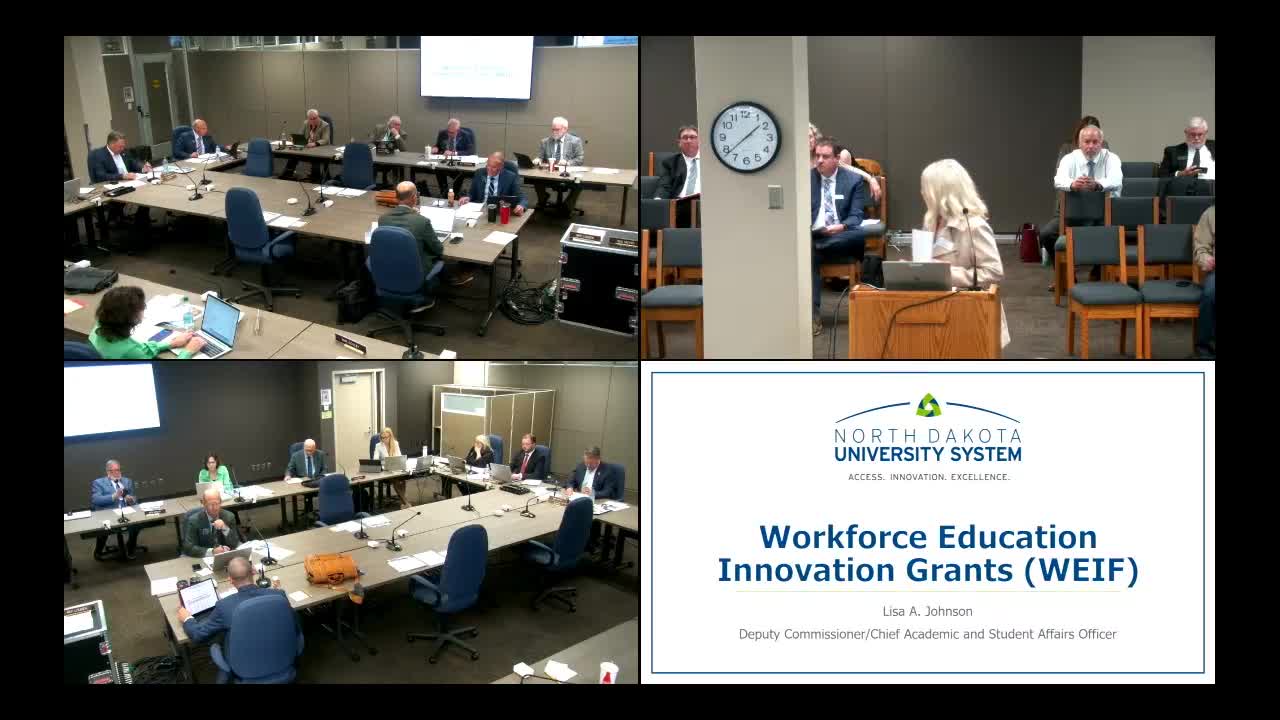
Lisa Johnson, deputy commissioner and chief academic and student affairs officer for the North Dakota University System, told the House E & E higher education subcommittee that the Workforce Education Innovation Fund was designed to help campuses ‘‘create and bolster educational programs to help sustain and grow the state’s workforce.’’ The fund was appropriated $10,000,000 by the legislature and grants were distributed on August 1, Johnson said.
Johnson said the WEAF review committee — chaired by the State Board vice chair D.J. Campbell and including representatives from state agencies and industry — scored applications on efficiency, sustainability and alignment with regional workforce needs. Twenty applications received awards; some awards were reduced in amount while three proposals were not funded: a Bismarck State College dental hygiene proposal, a Mayville State request for a master’s in leadership, and an NDSCS food-truck entrepreneurship request. ‘‘Some just received reduced funding, but not all projects were funded,’’ Johnson said.
Committee members pressed for accountability. Representative Swantek asked whether the system will provide a written ROI for each project; Johnson said she will require campuses to include an ROI section in their reports and that presentations to the board and final campus reports are scheduled in June and November 2026, with legislative report-outs in January 2027. Representative Richter asked how soon students and coursework could appear; Johnson said the committee concentrated funds on projects that could show impact within the first year, potentially leading to courses or programs this academic year.
Johnson described eligible uses — curriculum development, equipment, facility modifications, instructor hiring and program promotion — and said awardees include a mix of health-care, cybersecurity and technical programs aligned with employer needs. Committee members requested clearer breakdowns by funding source and by new versus continued programs; Johnson agreed to provide further detail on request and to include ROI metrics in required reporting.
Next steps: campuses will submit interim reports and the system office will present preliminary outcomes to the State Board of Higher Education in mid-2026, followed by final campus reports in late 2026 and legislative reporting in January 2027.