Get Full Government Meeting Transcripts, Videos, & Alerts Forever!
Get email alerts on the Climate Action topic
No spam. Unsubscribe anytime.
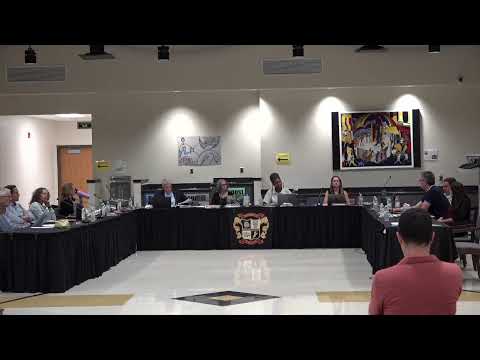
Hopewell Valley Climate Action Committee outlines plan for decarbonization, grants and student engagement
Summary
The Climate Action Committee presented its year-long work to the board, detailing education initiatives, transportation goals (including a push toward zero-emission buses), waste-reduction and resilience efforts and announced a $30,000 New Jersey Department of Education climate resilience grant for rain-garden installations and curriculum.
Co-chairs Scott Bertell, principal of Hopewell Elementary School, and Callum McGrath, an art teacher and co-chair, presented the Climate Action Committee's annual report, highlighting student-led education, transportation surveys and grant-supported resilience work.
Bertell said the committee's work is organized into subcommittees for Education, Transportation, Food and Waste, Resilience and Facilities and noted student programs such as Green Week, school gardens and an ecology elective at the high school. "Our yes Club has been instrumental" in outreach and student engagement, presenters said during the report.
The presenters highlighted small external funding the committee secured, including a $1,000 STEM mini-grant for professional development and, more substantively, a climate resilience grant from the New Jersey Department of Education for roughly $30,000 to support additional or new rain gardens at each school and hands-on stormwater management curriculum that began in June.
On transportation, the committee reported survey results showing substantial parent pickup activity and discussed steps toward zero-emission buses, improved traffic flow and electric-vehicle charging; staff noted that district electrical service upgrades would be required before large-scale charger installation and that previous bus-grant applications had been denied due to service limitations and typical rural mileage profiles.
The committee also described food and waste actions — waste audits, composting pilots, plant-based meal options and moves to reduce single-use plastic — and resilience measures including classroom resources for extreme-weather response and coordination with external partners, such as the Watershed Institute and Mercer County Planning for a stormwater review of campuses.
Ending: the board thanked committee members and asked the administration to continue pursuing grants and coordination with facilities and finance to align resilience and decarbonization steps with capital planning (including possible integration with referendum projects).