Get Full Government Meeting Transcripts, Videos, & Alerts Forever!
Get email alerts on the Canine Care topic
No spam. Unsubscribe anytime.
Mass. committee hears bills to fund retired police dogs and expand canine emergency care
Summary
State lawmakers heard emotional testimony Tuesday in favor of two bills intended to improve medical and retirement care for police canines.
State lawmakers heard emotional testimony Tuesday in favor of two bills intended to improve medical and retirement care for police canines.
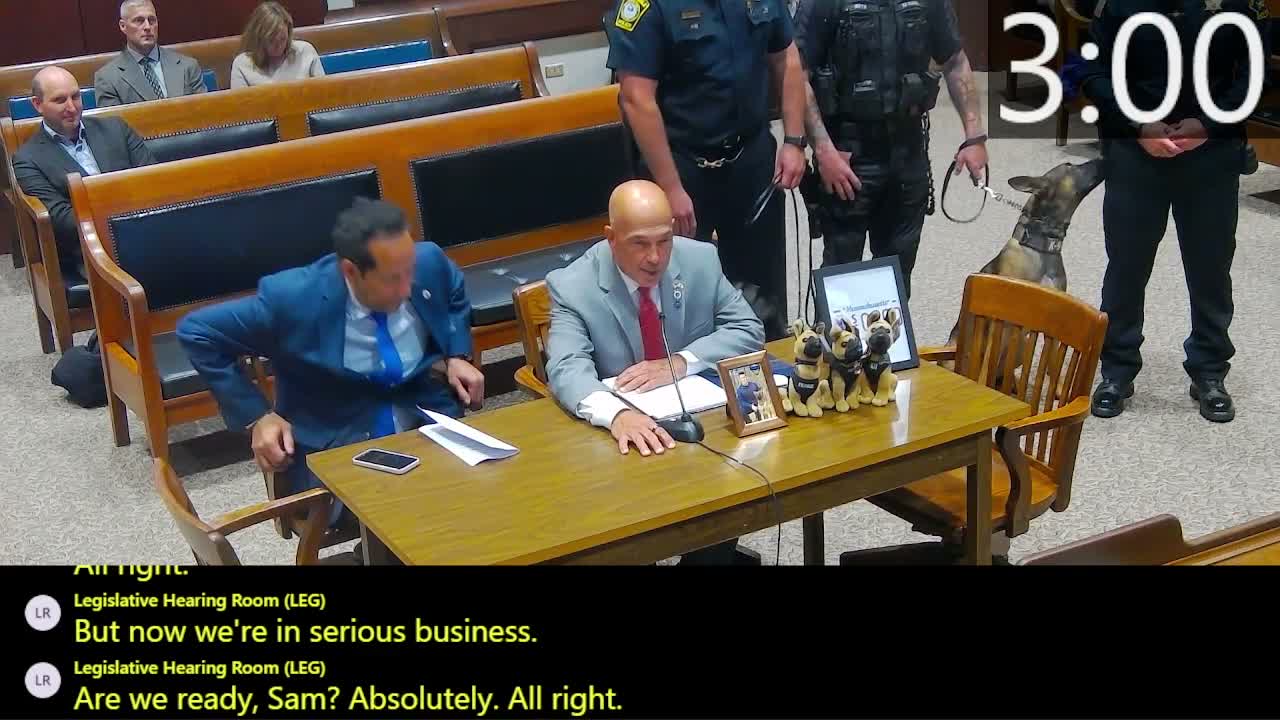
Representative Steven Exaros, who introduced H 2735 and H 2738 to the Joint Committee on Public Safety and Homeland Security, brought three service dogs to the hearing and called them “partners” in policing, urging a favorable report on both measures. H 2735 — called Dakota’s Law — would establish a fund, backed by a specialty license plate, to cover medical and retirement costs for retired police dogs. H 2738 — referred to in testimony as Nero’s Law — would permit and fund advanced life‑support training so first responders could provide greater emergency care to injured canines in the field.
The bills’ supporters said retired and injured canines now often rely entirely on handlers or nonprofits to pay for expensive care. Eric Ramsden, a retired state trooper who spent decades as a K‑9 handler and trainer, described an $18,300 surgery bill for a retired partner and urged state help: “When a canine retires, they leave with nothing. Dakota’s Law assures that these heroes are not discarded in service.” James Lamonte, who runs a facility that shelters retired police and military dogs, told the committee his center currently cares for 13 canines and said without donor support some dogs would face euthanasia.
Proponents said a specialty license plate would be a reliable, dedicated funding source. Lamonte told the committee the plate release was among the fastest in Massachusetts Department of Transportation history, and Representative Carlos Gonzales said such a funding stream would make it easier to support statutory commitments for retired animals.
No vote was taken; witnesses asked the committee to issue favorable reports so the bills can move to the floor. The hearing included questions about the bills’ scope and the interaction with existing municipal and nonprofit care programs. The committee adjourned at the end of the session.