Get Full Government Meeting Transcripts, Videos, & Alerts Forever!
Get email alerts on the Sb571 Sb12 Implementation topic
No spam. Unsubscribe anytime.
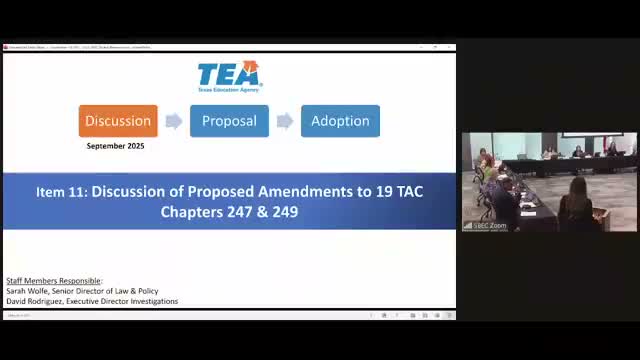
SBEC begins rulemaking to implement SB 571 and SB 12, debating definitions and new temporary-suspension authority
Summary
The State Board for Educator Certification opened rulemaking work to implement SB 571 and SB 12, debating whether to adopt statutory language directly into the educator code of ethics and how to operationalize the boards new temporary suspension authority.
The State Board for Educator Certification on Wednesday began detailed work to translate two 2025 laws into enforceable board rules, focusing on what school districts must report to the Texas Education Agency and how the board will use its new temporary suspension authority.
TEA staff told the board that SB 571 expands mandatory reporting by district leaders and narrows some reporting timelines, and that SB 12 creates statutory definitions (for terms such as diversity, equity and inclusion and social transitioning) that the staff recommends adopting “whole cloth” into the educator code of ethics rather than rewording in board rules. "We went from a triggering event like separation to evidence that one of these things has occurred, and we went from 7 days to 48 hours," a staff presenter said while explaining the timeline changes for district reporting to TEA. (Transcript: staff presentation at SEG 998SEG 1006.)
Why it matters: The changes affect when and how superintendents and principals must report allegations involving certified and noncertified employees and service providers, including "inappropriate communications" and failures to maintain appropriate boundaries. Board members said the text must be clear so superintendents know when to escalate reports to TEA.
What the board discussed
- Definitions vs. pointers to statute: Several members said they prefer pointing to statute to avoid repetitive maintenance when the legislature changes definitions; others urged including definitions in rule text so HR staff and educators have clear, readily accessible language. (See debate at SEG 755SEG 825 and SEG 791SEG 823.)
- Mandatory reporting specifics: Staff said SB 571 requires reporting of mistreatment regardless of injury, inappropriate communications and boundary violations, and shortens some timelines; board members pressed staff to clarify how district-specific communication platforms, parental consent processes, and special education contexts intersect with the reporting rules. (Discussion at SEG 990SEG 1130.)
- Temporary suspension authority: Staff reviewed two buckets for suspension: (1) arrests that trigger suspension under statute and (2) "imminent threat to public welfare," a concept the statute leaves undefined. For imminent-threat orders the agency will present probable-cause arguments to the State Office of Administrative Hearings within 17 days and will follow up with a merits hearing within a statutory window; for arrest-based orders staff said temporary suspension orders typically remain until 61 days after final disposition. The board debated whether to adopt general principles, list specific misconduct types that would trigger imminent-threat orders (abuse, solicitation, romantic relationships with a student), or do both. (See staff chart and discussion at SEG 1569SEG 1660 and SEG 1604SEG 1610.)
Board direction and next steps
Board members asked staff to: (1) return draft rule text for stakeholder feedback rather than adopt minimum sanctions immediately; (2) circulate plain-language guidance for districts and universities; and (3) include parents, special education stakeholders and district HR representatives in outreach. Staff said it would begin broad stakeholder engagement and aims to return proposals for consideration in December. (See staff statement at SEG 2160SEG 2224.)
Quotes
- "SB 12 took effect on September 1 and the vague wording of the law has led to lots of confusion across the state," said Dr. Elizabeth Rogers of the Texas Counseling Association, describing how counseling and classroom guidance were paused in some districts while districts awaited clarification. (Public comment: SEG 367SEG 374.)
- "We went from 7 days to 48 hours," staff said summarizing the revised superintendent-reporting timeline under SB 571. (Staff presentation: SEG 999SEG 1006.)
What remains unresolved
The board did not adopt any new sanctions or final rule text at the meeting. Key open questions for rule drafting include how narrowly to define "inappropriate communications" and "boundaries," what examples should be listed in rule text, how to handle special-education contexts where boundaries differ, and what precise criteria will trigger an imminent-threat temporary suspension. Staff will solicit stakeholder input and return draft rule text.
The board recessed for lunch and continued later in the day with an extended discussion of educator-preparation rulemaking related to House Bill 2.