Get Full Government Meeting Transcripts, Videos, & Alerts Forever!
Get email alerts on the Prep Allotment topic
No spam. Unsubscribe anytime.
SBEC debates how to implement HB2: mandated Reading and Math Academies, HQIM skills, and approvals for prep‑funded pathways
Summary
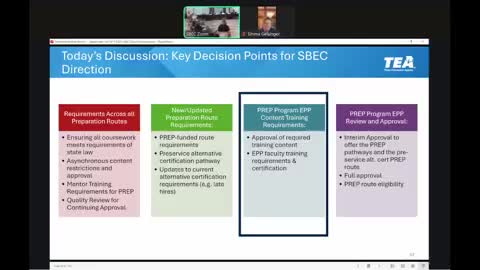
The State Board for Educator Certification continued a multi‑day discussion of how to put House Bill 2 into practice for educator preparation, focusing on required Reading and Math Academies for prep‑funded routes, whether to require high‑quality instructional‑materials skills and classroom‑management training for EPP faculty, and a phased approval process for programs to participate in the prep allotment.
The State Board for Educator Certification met to continue deliberations on how to implement House Bill 2 changes for educator preparation programs, focusing on which course content must be required for prep‑funded pathways and how programs and districts will share responsibility for delivering that content.
Melissa, the agency presenter, told the board the agency will ensure “these materials are research based” and aligned to the board’s educator standards and the science of teaching reading. She said the reading and math academies for early elementary candidates are required in statute, and that the commissioner can develop additional course content which the board may then review for approval.
Board members pressed staff on several practical points: whether high‑quality instructional materials (HQIM) skills and classroom discipline management should be separate requirements or embedded into the Reading and Math Academies; whether approved reading content developed by the agency (for example, Bluebonnet as an example set) would unfairly bind programs to one product; and how the statutory hours (currently 60 hours for reading academies, 18 hours for math) could be streamlined for educator preparation programs (EPPs) without reducing rigor.
Associate Commissioner Linda noted that Reading and Math Academies are statutory requirements for EC‑3 and EC‑6 prep routes and said the agency is developing an EPP‑specific pathway that would allow a candidate to complete the statutory requirement within an EPP so districts would not have to reteach the same modules once the candidate becomes a teacher of record.
Several university and EPP representatives asked for clarity about hours and integration. Dr. Rodriguez and other higher‑education speakers urged clear lists of the specific skills and the performance expectations that candidates must reach so programs can plan curriculum changes and avoid simply adding hours on top of existing requirements. One board member recalled that a three‑hour university course is commonly treated as 45 contact hours, an example offered as a possible way to reconcile differing hour conventions.
Staff proposed a two‑stage approval process for prep routes: an interim desk review (application and artifacts) and a full approval conducted within the redesigned continuing‑approval on‑site review. Residency programs were described as eligible to draw down the prep allotment beginning in 2026‑27; statute provides a limited carve‑out so residency programs can receive funding before fully implementing new content requirements.
Next steps and timing: staff said the prep allotment application will launch in the 2025‑26 year so residency, grow‑your‑own and mentorship programs may apply to implement in 2026‑27. Content development and training for EPP faculty are planned for 2026‑27, with broader program approvals and statewide implementation of new EPP requirements expected in 2027‑28 as rulemaking and training conclude.
The board asked staff to return with more detailed drafts — especially concrete definitions of the HQIM‑skill set, proposed hour allocations for EPP pathways, and proposed certification requirements for faculty who will deliver the materials — and to continue stakeholder engagement with higher education, alternative‑certification providers, and districts.
The board took no binding vote on rules during this session; staff said rulemaking and additional stakeholder input would follow the timeline presented.