Get Full Government Meeting Transcripts, Videos, & Alerts Forever!
Get email alerts on the Water Supply topic
No spam. Unsubscribe anytime.
Cedar City Council directs $2 million toward water-well exploration as leaders weigh aquifer risks and faster pipeline options
Summary
Cedar City leaders voted to move $2,000,000 into a well‑exploration fund and asked staff to proceed with test‑well bids after a lengthy debate about drilling near existing Enoch wells versus farther‑out valley options.
Cedar City leaders voted to move $2,000,000 into the water fund for new well exploration after a multi‑hour discussion about where to drill and how quickly new supplies could reach the city system. Council directed staff to obtain bids and more geologic data for a short list of candidate sites while continuing concurrent work on longer‑term valley options.
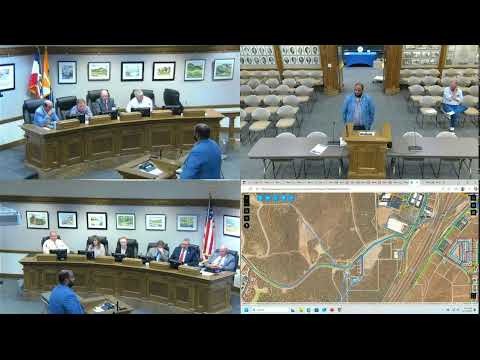
The council’s decision followed presentations from city engineering staff and hydrogeologist recommendations to adjust previously selected test locations. City engineer Jonathan Stath told the council that consultant Mervyn Cox recommended moving one site (2.4) slightly north, de‑prioritizing another (2.6), and adding two possible sites near Enoch Well No. 3 for testing. “We wanted to present that information to the council and see if there were possible changes to the recommended locations,” Stath said.
Why it matters: Cedar City has an immediate need to add reliable municipal water sources. Council members and residents described frequent shortages and infrastructure limits and debated the environmental and operational risks of drilling close to existing wells. Spencer Jones, who raised concerns about historical spring declines in the Enoch area, warned that past groundwater publications indicate flow patterns that could be affected by nearby pumping. “There’s been publication by UGS/USGS that this water historically comes down through here,” Jones said, urging caution before adding extraction near documented decline areas.
Council discussion focused on three tradeoffs: (1) drilling near existing Enoch wells offers faster, cheaper pipeline connections but raises the risk of local interference with springs or neighboring wells; (2) drilling in the valley or Rush Lake area could yield higher flow rates but would require expensive conveyance to Cedar City; and (3) retrofitting agricultural wells or reusing existing infrastructure could be an intermediate option. Several council members emphasized the need for additional data before committing to a final site list.
What the council directed: By consensus the council asked staff to collect well logs and other short‑term data already promised by Paul Munro and others, to proceed with requests for proposals for test drilling at the near‑term candidate sites (2.1, the new 2.4 location and 2.5 as discussed), and to hold back on adding certain marginal sites until additional data arrives. The council also agreed the city could use some of the $2,000,000 allocation to pursue up to five test wells, as Mayor and several council members supported a mixed approach that includes both near‑term and longer‑term exploration.
Funding and next steps: Staff confirmed meters and pump projects are being funded through reallocated budget lines and ARPA/state pass‑throughs; the council voted to move the $2,000,000 into the water fund to make the test‑well program immediately available. Jonathan Stath and the water committee will return with firm cost estimates, a bid package for drilling, and updated well‑yield data; councilmembers asked for that information within weeks so the city can decide which test holes to bid and where to concentrate short‑term effort.
Statements from residents and experts: During the meeting residents and technical advisers emphasized both urgency and caution. Public commenter Logan Sisom (Buena Vista) urged the council to protect neighborhoods from industrial encroachment while supporting the landowner’s right to sell. Spencer Jones, citing recent UGS/USGS work and historical spring declines, urged detailed analysis before committing to drilling in hydrologically sensitive areas.
What remains unresolved: The council did not finalize exact drilling locations or a construction schedule; it agreed to gather and present additional geological and well‑log data, finalize a short list of sites to bid, and return with cost estimates for pipeline or wet‑well work necessary to connect successful wells to the municipal system. The water exploration item was moved to action to permit contracting and budgeting steps to proceed.