
County staff outline debt and cash options for proposed $50M highway shop; committee asks for a financing plan
Get AI-powered insights, summaries, and transcripts
Subscribe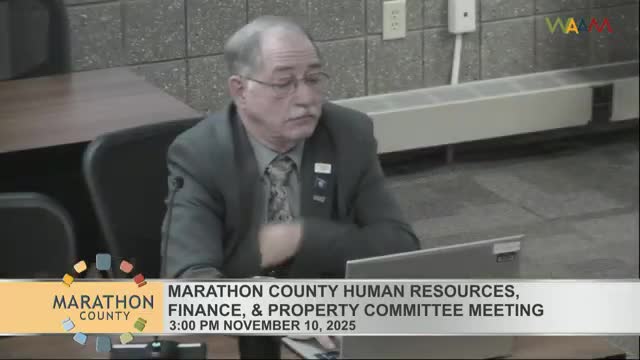
Summary
Marathon County’s administrator and financial adviser presented two scenarios to finance a hypothetical $50 million highway shop — issuing roughly $20.33 million in new debt or using annual North Central Healthcare payments — and the committee asked staff to develop a detailed plan, schedule of values and cash-flow analysis.
Marathon County officials on Nov. 1 discussed how to finance a potential $50 million highway shop but took no action, asking staff to return with a plan that balances tax impact and project timing.
Administrator Leonard and Kristen Hansen of PFM presented two high-level scenarios. In the first, the county would issue roughly $20.33 million of general obligation promissory notes (staff used an illustrative 5% interest-rate assumption), producing annual principal-and-interest payments of about $1.6 million and total interest costs in the range of $9 million to $11 million over 20 years. Hansen noted borrowing yields an immediate lower near-term tax impact but higher cumulative interest and issuance costs.
In the second scenario staff modelled using North Central Healthcare (NCHC) annual payments — roughly $3 million as presented — to pay down the project over a shorter period (about five years in staff scenarios). That approach avoids long-term interest but requires phasing and would not provide a $20 million lump sum up front; staff noted it could give the county capacity to address other deferred capital needs.
Sam in finance illustrated homeowner impacts under the assumptions used: a cash-based approach versus borrowing produced an illustrative difference of about $175.58 to the average homeowner over the modeled period. Staff also presented the county’s outstanding debt profile, legal debt limit and equalized-value history to frame borrowing capacity.
Committee members asked for concrete next steps, including a "schedule of values," project cash-flow projections, options for short-term borrowing to meet construction cash flow if needed, and a multi-year levy ramp (e.g., five- or seven-year options) to avoid a single-year levy spike. Administrator Leonard said staff will prepare a hybrid plan and circulate the slides and underlying assumptions to the committee for further review.
What’s next: Staff will provide a schedule of values and cash-flow analysis and return with financing options before broader budget decisions for 2027.