Get Full Government Meeting Transcripts, Videos, & Alerts Forever!
Get email alerts on the Stormwater Regulations topic
No spam. Unsubscribe anytime.
Uxbridge panel updates stormwater checklist, plans public hearing on LID and regulations
Summary
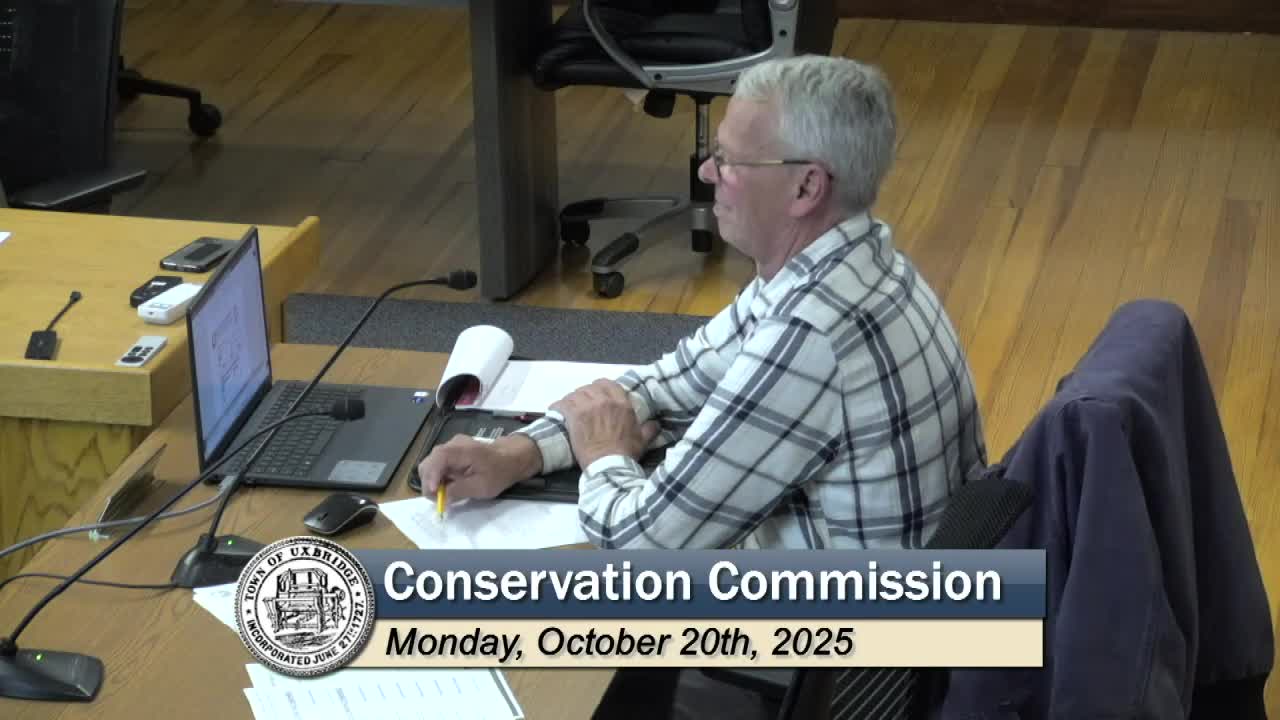
The Uxbridge Conservation Commission reviewed a revised stormwater checklist that adds low‑impact development (LID) questions and discussed posting and revising stormwater regulations under Chapter 2‑90; commissioners agreed to bring redlines and changes to a public hearing scheduled for early November.
The Uxbridge Conservation Commission on Oct. 20 reviewed a revised stormwater checklist that adds a new Low‑Impact Development (LID) section and agreed to take revisions to a public hearing to update the town’s stormwater rules and regulations. The commission’s chair said the checklist adds Section B to ensure applications address LID options such as reducing impervious surface, preserving trees and considering green‑roof or blue‑roof options.
Commissioners emphasized they want developers to document LID considerations in permit materials rather than skip over them. "The part that's new is Section B, which is Low Impact Development," said Speaker 1, the commission chair, explaining the checklist is intended to prompt clearer responses in applications. Commissioner Speaker 4 and others said applicants often "gloss over" LID elements and that a concise checklist would help clarify expectations.
Members debated whether the document on the town website is the bylaw itself or the implementing regulations (General Bylaws Chapter 2‑90). Speaker 6 noted the town’s stormwater document bears the bylaw header and cautioned that changes to the bylaw could require town‑meeting approval, while other commissioners said the planning board previously adopted regulations under authority granted by the bylaw. "We need to make sure that what we change is properly separated between bylaw and regulations," Speaker 6 said.
The commission confirmed a public hearing is scheduled (referred to during the meeting as "the fourth") where the full set of edits — presented in a Word draft and converted to a working PDF for public posting — will be discussed. Commissioners agreed to redline the Word draft, bring suggested edits to the public hearing and avoid editing collaboratively outside an open meeting, citing open‑meeting law concerns.
Staff and members also discussed operational items to include in the checklist: tree preservation, green space, long‑term operation and maintenance, and bonding/insurance for stormwater features until responsibility shifts to the town or a homeowners association. The commission asked staff to make the draft accessible as a PDF on the commission page before the hearing and encouraged members to prepare redlines in advance.
Next steps: the commission will finalize redlines to the draft, post a public PDF with the proposed changes, and take the item up at the scheduled hearing where the body can accept public comment and adopt revisions consistent with the scope of the bylaw and regulatory authority.