Get Full Government Meeting Transcripts, Videos, & Alerts Forever!
Get email alerts on the Energy Storage topic
No spam. Unsubscribe anytime.
Uxbridge planning board closes hearing on 404 Blackstone battery storage project after technical updates and resident objections
Summary
The Town of Uxbridge Planning Board closed the public hearing on a proposed battery storage facility at 404 Blackstone Street after the applicant presented updated technical materials and nearby residents raised safety and noise concerns.
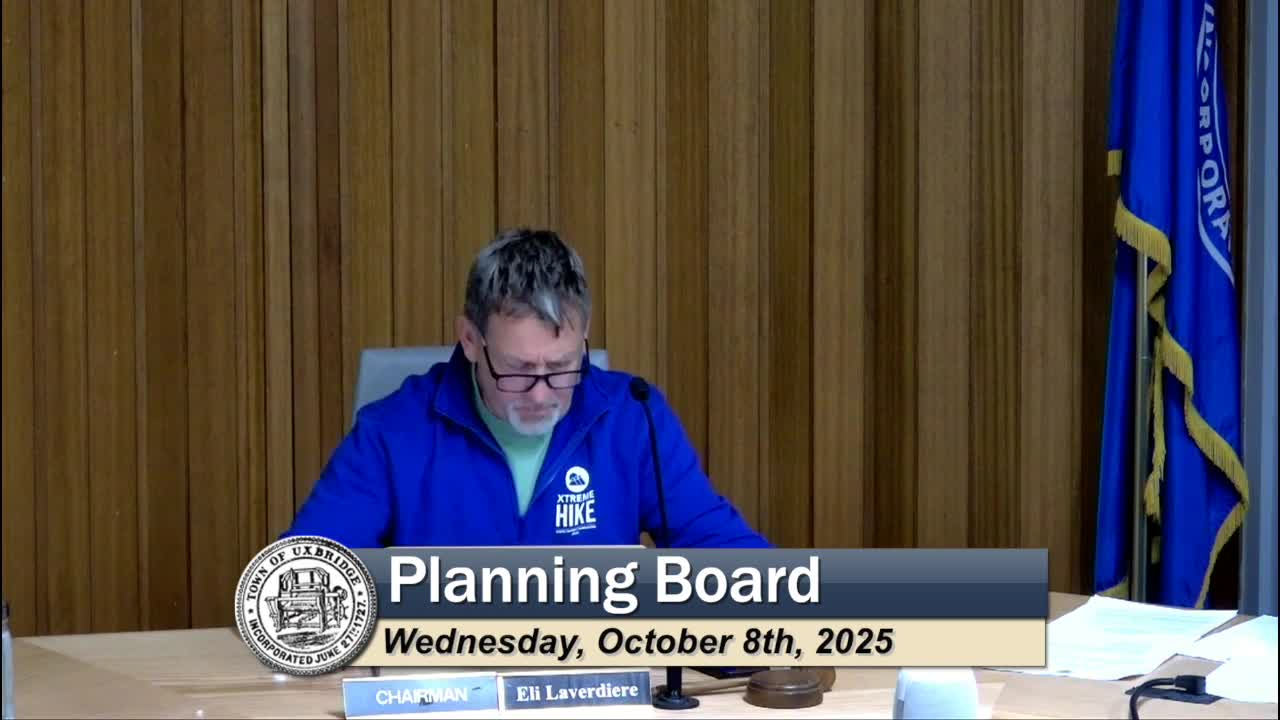
Planning Board chair opened a continued public hearing on a special permit for a battery storage facility at 404 Blackstone Street. Tom Corbett of ZP Battery and Development Co., representing the applicant, told the board he had supplied additional materials addressing charge/discharge operations, how the system interacts with the grid, sound mitigation measures and coordination with the fire department. Corbett said preliminary plans are submitted and definitive plans will be filed soon and asked the board to close the hearing to meet project timelines.
A resident, Bev Gudnowski of 41 East Street, spoke in opposition and submitted a letter and supporting documents, saying public‑health and safety guidance recommends caution. Gudnowski cited a Massachusetts Association of Boards of Health memo urging a moratorium on battery installations, raised concerns about noise and fumes, and questioned equipment sourcing, saying: “It is wrong headed, and it is stupid.”
Board members and the applicant discussed technical constraints that determine when batteries may charge. Corbett referenced the Clean Peak Energy Standard and the interconnection service agreement with National Grid, and said state reporting and incentive rules (the CPECs program described during the hearing) require projects to follow specified charging schedules. “They’ll shut us down immediately if they find non‑compliance,” Corbett said, describing enforcement risk tied to incentives and interconnection rules.
On sound and nuisance mitigation, the board reiterated conditions that require a follow‑up peer‑reviewed sound study conducted after the facility reaches full operation. The board said if a later study shows a higher noise level that cannot be mitigated, the town’s enforcement process could require remediation up to a shutdown or other enforcement by the building inspector or the Board of Health.
Board members noted a separate procedural issue: an attorney general review of a related bylaw remains pending and one member suggested considering that ruling before issuing a final decision. The board nonetheless agreed to close the public hearing so it could begin its decision period under Chapter 40A; members noted Chapter 40A’s 90‑day decision clock applies unless an extension is agreed.
The hearing was closed by voice vote; no final permit decision was made. The board will receive the applicant’s definitive plans and will consider any additional material required by the planning office and town departments before final action.