Get Full Government Meeting Transcripts, Videos, & Alerts Forever!
Get email alerts on the Stormwater Regulations topic
No spam. Unsubscribe anytime.
Uxbridge Conservation Commission continues hearing on updated stormwater rules tied to EPA MS4 permit
Summary
The Uxbridge Conservation Commission on Nov. 3 advanced work on a draft of the town’s stormwater regulations designed to meet obligations under the federal MS4 permit.
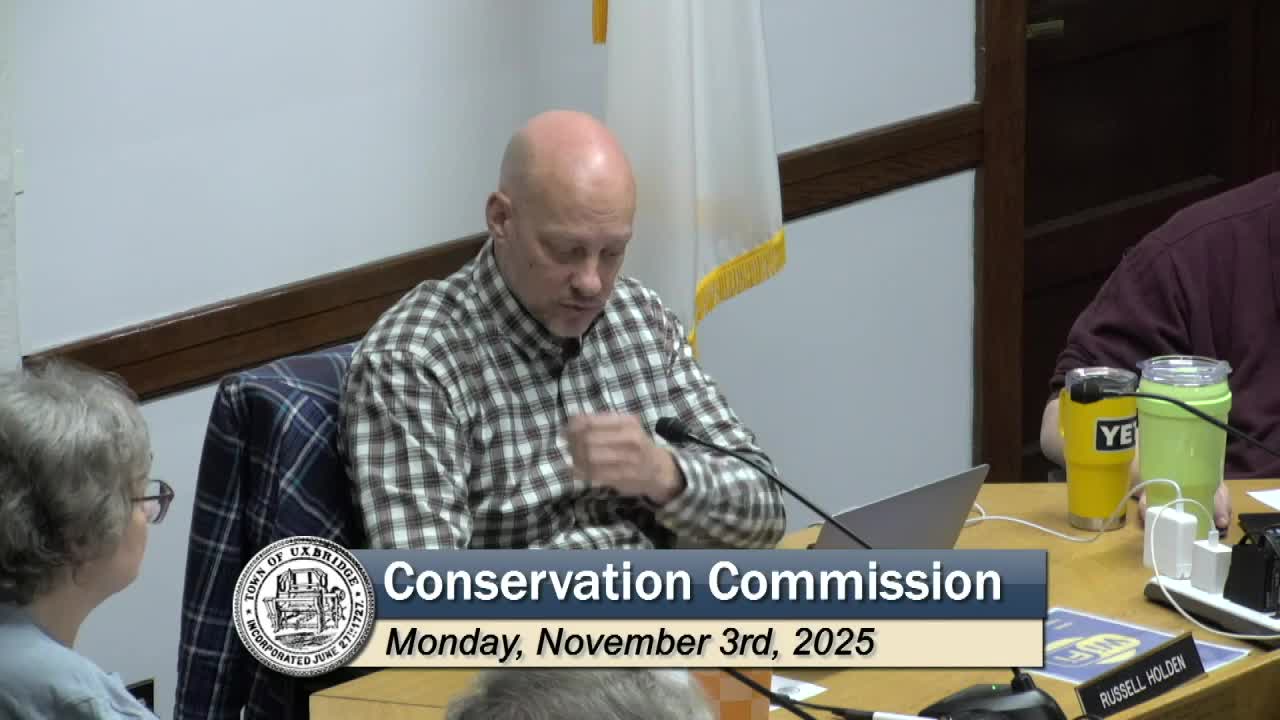
The Uxbridge Conservation Commission on Nov. 3 advanced work on a draft of the town’s stormwater regulations that staff say are needed to align local rules with the federal Municipal Separate Storm Sewer System (MS4) permit. Paul Huttnack, assistant director of public works and the town’s MS4 manager, told the commission the changes are intended to bring the town “into compliance” after the EPA flagged issues in the annual report.
Huttnack said the town hired a consultant through the Central Mass Regional Stormwater Coalition to review and update existing bylaws and regulations. “They sent an email saying that we're not in compliance with this,” Huttnack said, describing the EPA review that prompted the current revisions. He reviewed technical proposals in the draft, including more stringent pollutant-removal and runoff-retention standards for new development and redevelopment.
Key technical proposals in the draft include retaining runoff equivalent to 1.0 inch of rainfall over post-construction impervious area for new development, and meeting a 90% average annual removal of total suspended solids (TSS) and 60% removal of total phosphorus; redevelopment standards in the draft would target roughly 0.8 inch runoff retention, 80% TSS removal and 50% phosphorus removal. Huttnack told commissioners the change “is more stringent” than the town’s current practice and may push designers toward engineered separators for phosphorus control where infiltration alone cannot meet the targets.
Commission members debated how strongly to require low-impact development (LID) measures such as swales, rain gardens, green roofs and other non-structural practices. Chair (Speaker 1) proposed inserting “strongly encouraged” language as an interim step while staff and counsel develop enforceable wording and a waiver process. “I think if you just put 'strongly encouraged' in there, then we've mentioned that we are serious about low-impact development,” the chair said.
Members emphasized the need for an objective waiver framework that would require applicants to document why LID is infeasible for a site (high groundwater, steep slopes or other extenuating circumstances). Commissioners also asked staff to coordinate the final language with town counsel and, where needed, the town council so enforcement mechanisms—such as a noncriminal disposition process to collect fines—are legally defensible.
After discussion, the commission voted to continue the public hearing and directed staff to merge the edits, including Huttnack’s MS4-driven changes and the commission’s suggested LID/waiver language, into a single draft for public review and the next meeting.
What’s next: Staff will circulate a consolidated draft for review, and the commission expects to resume the hearing at its next scheduled meeting; no final regulatory vote was taken at the Nov. 3 meeting.