Get Full Government Meeting Transcripts, Videos, & Alerts Forever!
Get email alerts on the Affordable Housing topic
No spam. Unsubscribe anytime.
Senate advances affordable-housing package tying local planning to $24 million in gap funding
Summary
Senator Andrick, sponsor of Senate Bill 34, described the measure as a planning-and-incentive package that ties municipal adoption of two recommended affordable-housing strategies to eligibility for Transportation Investment Fund prioritization and a $24 million infusion to the Olene Walker Fund.
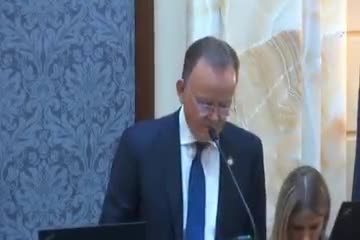
Senator Andrick, sponsor of second substitute Senate Bill 34, described the proposal as a planning and incentive package aimed at helping cities prepare for growth and enable affordable and lower-cost housing development. The bill compiles about 25 optional strategies that municipalities can “consider” and ties adoption of two or more of those strategies to eligibility for a TIF prioritization "kicker" while directing $24 million in gap funding to the Olene Walker Fund (about $4 million ongoing and $20 million one-time in the fiscal note). "This is not a silver bullet," Andrick said during floor remarks, "but I do think government has a role in this process." (Senator Andrick, SEG 1009–1016, SEG 1528–1536).
Why it matters: The bill attempts to nudge local planning toward long-term transit and growth corridors by offering financial incentives rather than imposing mandates. Sponsor and supporters said the change is designed to make cities eligible for additional state transportation prioritization and to help fill financing gaps that typically block affordable projects.
Key provisions and funding: The measure lists a menu of planning options (lines cited by sponsor) and conditions eligibility for the enhanced TIF prioritization on adopting at least two recommended strategies. The $24 million fiscal package in the bill’s fiscal note was described on the floor as $4 million of ongoing funding and $20 million of one-time capital to augment the Olene Walker Fund. The sponsor said the money is intended to be an infusion into that fund to support gap financing for projects; specifics on loan vs. grant terms were discussed as to remain subject to Olene Walker Fund rules.
Debate and concerns: Several senators praised the intent but raised detailed questions about implementation and equity. Senator Hilliard asked whether cities would actually implement the strategies and cautioned about potential downstream consequences for individuals and timelines. Senator Henderson questioned inclusion of measures such as mortgage-assistance for municipal employees and whether that would meaningfully address broad low-income needs. Senators also pressed on whether reductions in impact fees could be offset by municipalities elsewhere and whether DWS (Division of Workforce Services) would have authority to determine eligibility for the TIF prioritization—sponsor confirmed that DWS would review targeting under prior statutory language from last year’s House Bill 249.
Rural access and fund mechanics: Senator Vickers asked whether rural jurisdictions were considered; sponsor said rural representatives were on the commission and that definitions of transit/major corridors were broadened to include rural thoroughfares so those areas could qualify. Several senators sought clarity about whether the $24 million would be loans or grants and whether developers, including potential nontraditional projects, could use funds; sponsor indicated the money is structured as a loan fund in the Olene Walker program and pledged to verify specifics.
Vote and next steps: After extended discussion and substitutions earlier in the process, the Senate read the bill for a third time. The chair announced second substitute Senate Bill 34 received 18 yea votes, 10 nay votes, 1 absent and shall be read for a third time. The bill advances to the next step in the legislative process per Senate rules.
Context: Sponsor Andrick framed the bill as a conservative, incremental approach intended to align state financing and transportation priorities with local planning—while preserving cities’ authority to choose whether to adopt the recommended strategies. The bill also includes reporting requirements for cities to provide follow-up data on whether plans were adopted and how much housing was added.
What’s next: The bill moves forward after third reading; funding details and implementing rules (including any Olene Walker Fund guidelines and DWS determinations) will be resolved in later drafting, appropriation processes or administrative rules.