
Board debates public-comment time limits and meeting order; chair discretion and security language proposed
Get AI-powered insights, summaries, and transcripts
Subscribe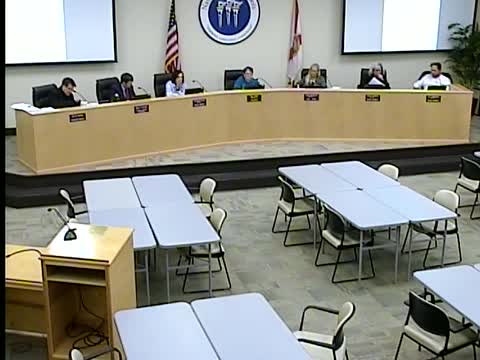
Summary
Board attorney Brett Steger presented clarifying language for speaker protocol and asked the board whether to allow three minutes per agenda item plus three for general comment or a single three-minute allotment; members split and asked for both drafts to be prepared for the next meeting.
Board attorney Brett Steger led a lengthy discussion of proposed speaker-protocol changes at the Nassau County School Board’s Nov. 10 meeting, asking members to choose whether public speakers should receive three minutes for each agenda item plus three minutes for general comment, or three minutes total to cover agenda and non-agenda matters.
Steger said the current draft (section 2b) is ambiguous about whether agenda-item comments and general public comment are separate categories. ‘‘Each speaker is allotted 3 minutes for comments,’’ he said while pointing to proposed clarifying language. He presented two drafting alternatives and asked the board which path to advertise and bring back for final action.
Opinions split. Some board members favored permitting speakers to address multiple items (three minutes per item plus general comment) because the board meets only once a month and the public may need more time. Other members warned such a rule could be exploited by repeat speakers and lengthen meetings; one noted the State Board of Education’s much shorter limits as a point of comparison.
The board discussed practical enforcement: whether public comments should be moved to the beginning of meetings so speakers state concerns before votes are taken, who tracks the time, whether the chair may grant or deny extra time, and if presentations by district staff or contractors should be exempt from the public-comment restrictions. Steger proposed language allowing ‘‘the board chair or his or her designee, in conjunction with the board attorney’’ to conclude speaker privileges for violations and to engage in limited clarifying dialogue with speakers.
The board directed staff to prepare both drafting options for the next board meeting so members can see how each version would read in the advertised materials. No vote was held on Nov. 10.
Action items and next steps Staff will prepare and advertise two versions of the speaker-protocol language (one that treats agenda items as separate 3-minute allotments and one that treats comment time as aggregated) and supply sample agenda order language that places public comment before action items. The board also asked the attorney to narrow language so it explicitly exempts district-staff presentations needed for votes.