Get Full Government Meeting Transcripts, Videos, & Alerts Forever!
Get email alerts on the Ww2 Disability Homefront topic
No spam. Unsubscribe anytime.
University of Utah historian highlights overlooked disability history of the World War II home front
Summary
At a Hinckley Institute Veterans Day forum, University of Utah associate professor Matt Basso argued that wartime injuries and policies made disability central to the home front, citing national rehabilitation laws, factory injuries (including at Geneva Steel), and large-scale VA and military hospital expansions such as Bushnell in Brigham City.
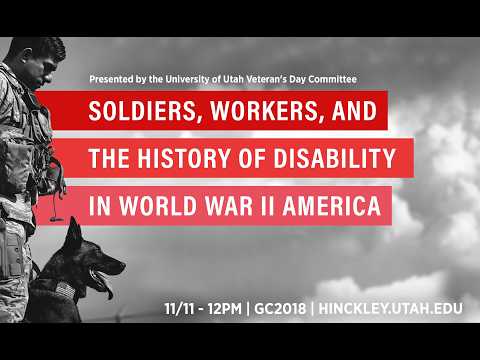
SALT LAKE CITY — University of Utah associate professor Matt Basso told a Hinckley Institute audience on Veterans Day that disability was a defining, and too often overlooked, part of the World War II American home front.
Basso opened by noting the 80th anniversary of the war’s end and said the scale of wartime injury demands a reassessment of home-front history. "More than 10,000,000 Americans became temporarily or permanently disabled during World War II," he said, calling the figure "an astonishing statistic" that reframes ordinary accounts of the era.
The historian framed his talk around three site types: the White House/Warm Springs, wartime factories, and military hospitals. Using Franklin D. Roosevelt’s Warm Springs as an example, Basso said the president’s public accommodations and specialized equipment made him a visible disabled statesman but also that Warm Springs represented an elite, exclusionary form of access: "This was a community where disabled Americans were able to come together, but not all were invited," he said, noting Black Americans were largely welcome only as staff until late in the war.
Basso described legislative and administrative responses to wartime disability. He identified two 1943 measures central to his theme — which he referenced as "Public Law 16" (March 1943) for veterans’ rehabilitation and the Vocational Rehabilitation Act (July 1943) for civilians — and said the laws reflected a split between Veterans Administration priorities and civilian disabled-people organizations that pushed for inclusive services. He said Roosevelt asked federal administrators in late 1941 to create programs to move disabled civilians and veterans into wartime employment.
Factories and workplace safety comprised the second element of Basso’s talk. Using Geneva Steel—situated on Utah Lake—as a local example of wartime production, he said injuries rose in 1942–43 as inexperienced workers entered dangerous jobs and training and safety lagged. Basso cited newspaper and archival accounts of local casualties and argued unions and organized labor became primary advocates for rehabilitation and stronger workplace safety.
Basso offered numeric context: government agencies placed about 28,000 disabled individuals in jobs in 1940 and roughly 300,000 in 1945; the New York Times estimated roughly 3 million disabled people were working in 1942. He also pointed out how race and gender shaped opportunity: white men were more likely to win factory jobs, deaf and hard-of-hearing women found clerical and production roles in specific plants, and disabled Japanese Americans often received poor government support while incarcerated in removal camps yet sometimes found meaningful work within camps.
The lecture concluded with hospitals and psychiatric care. Basso described Bushnell General Military Hospital in Brigham City as a sprawling wartime facility—built rapidly in 1942 with capacity for thousands of patients—and said the Veterans Administration later carried out a major postwar hospital-building program. He emphasized that neuropsychiatric illness was widespread among combat veterans, that Life magazine’s 1946 "Bedlam" exposé and other reporting exposed horrific conditions in some mental hospitals, and that public attention to veterans’ psychiatric needs has historically come in waves tied to subsequent conflicts.
During a question-and-answer period, Basso addressed whether advances that saved lives on the battlefield also increased the number of people living with disabilities, saying medical progress created new social obligations to treat and integrate disabled people. When asked about selective-service screening and LGBTQ people, he said neuropsychiatric exams often flagged queer people and that wartime inclusion could give way to scrutiny as demobilization proceeded. On questions about rehabilitation’s gendered dimension and the lack of a "care ethic," Basso described historical examples of community-based approaches (including the Rome plan) while noting most wartime programs emphasized reintegrating men into paid labor.
Basso said the World War II project he described grew out of a five-year collaboration with the National Park Service and student researchers and produced place-based histories intended to support nominations to the National Register and National Historic Landmark program. He urged continued attention to the subject: "We have to keep our attention on this," he said.
The forum was sponsored by the Hinckley Institute of Politics as part of University of Utah Veterans Day programming. After remarks and questions the host thanked the speaker and reminded attendees refreshments were available.