Get Full Government Meeting Transcripts, Videos, & Alerts Forever!
Get email alerts on the Local Transportation topic
No spam. Unsubscribe anytime.
Fountain Valley council weighs $100,000 traffic study for Euclid/Edinger; council asks staff to explore faster delivery methods
Summary
Council members expressed safety concerns about parallel parking and RV parking on Euclid Avenue and questioned spending about $100,000 on a traffic study; staff said developer data can be used as a reference and will explore on-call consultants and alternative delivery methods to accelerate or reduce the study scope.
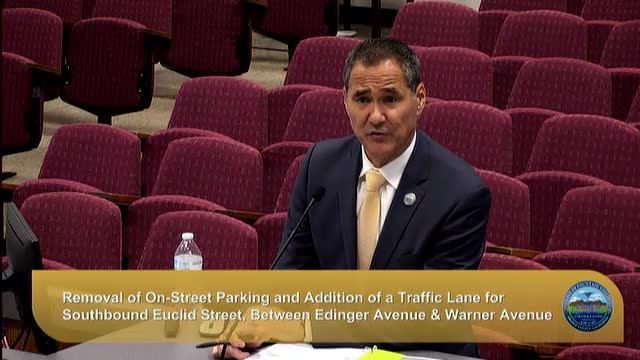
City Public Works Director Scott Smith presented Level of Service (LOS) examples and described options for Euclid/Edinger improvements, including whether to add a third lane to address congestion at peak hours.
Councilmember Grandes said parallel parking and RV parking on Euclid make the corridor dangerous and questioned paying roughly $100,000 for a traffic study; he urged staff to consider simply painting striping as a lower‑cost fix (Councilmember Grandes). Vice Mayor Kuneen asked whether the city could use traffic data the developer had already collected; Smith said developer studies can be used only as a reference because a third‑party traffic engineer must stamp and certify data for the city to rely on it.
Councilmembers discussed alternative delivery methods—on‑call consultants, progressive design‑build, or streamlined procurements—to shorten timelines and reduce duplication. Staff committed to returning with memos outlining whether the study can be reduced, whether on‑call consultants can be used, and any risk tradeoffs. Council gave direction to pursue options that could accelerate the work while ensuring appropriate legal and liability protections.
What comes next: Staff will solicit quotes, evaluate on‑call consultant options, and report back to council with recommended procurement and scope adjustments.