Get Full Government Meeting Transcripts, Videos, & Alerts Forever!
Get email alerts on the Mobile Food Ordinance topic
No spam. Unsubscribe anytime.
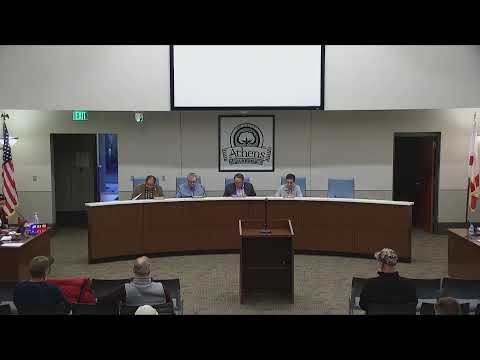
Athens adopts new food-truck rules, expands where mobile vendors may operate starting Jan. 1, 2026
Summary
The Athens City Council voted unanimously to adopt a new mobile food-unit ordinance that expands where food trucks may operate in the city while imposing licensing, safety inspections and time limits; the ordinance takes effect Jan. 1, 2026.
The Athens City Council voted 4–0 to adopt an ordinance that expands and regulates mobile food vending in the city while preserving limits on permanence and public-safety concerns.
Shane, who presented the ordinance to the council, said the measure ‘‘takes what the city has currently been doing through the mayor’s executive order and puts it on the books’’ by establishing a licensing and permitting framework and formalizing safety inspections. Shane said the ordinance requires a city business license and a fire-safety inspection sticker, in addition to complying with Alabama Department of Public Health rules, and includes operational restrictions such as where and how long a truck may remain at a location.
The ordinance allows mobile food units in more commercial districts than under current rules, but retains boundaries intended to prevent trucks from operating permanently on private property. ‘‘The idea is still that a food truck . . . would be temporary,’’ Shane said, adding the ordinance sets limits on hours, duration at a particular property and prohibits placement on public rights-of-way except during permitted special events.
Council members emphasized the measure balances business opportunity with safety and neighborhood impacts. Councilmember Seibert noted tweaks could return to the council after administration by the city clerk’s office. The council recorded a roll-call vote of 4 yeas, 0 nays to adopt the ordinance; the measure is scheduled to go into effect Jan. 1, 2026.
The ordinance also specifies operational standards to avoid obstructing fire hydrants, requires trucks to be on a firm surface and to manage litter and waste. Enforcement and permitting will be administered by the city clerk’s office with inspections handled by the fire marshal’s office.
Council members said the ordinance formalizes practices that had been done under an executive order and provides predictability for operators and neighborhoods. No public opposition or comment on the ordinance was recorded during the meeting. The city said it will monitor the ordinance’s administration and return with any suggested tweaks.