Get Full Government Meeting Transcripts, Videos, & Alerts Forever!
Get email alerts on the Elections Redistricting topic
No spam. Unsubscribe anytime.
Laguna Hills holds first public hearing on switch to by‑district elections
Summary
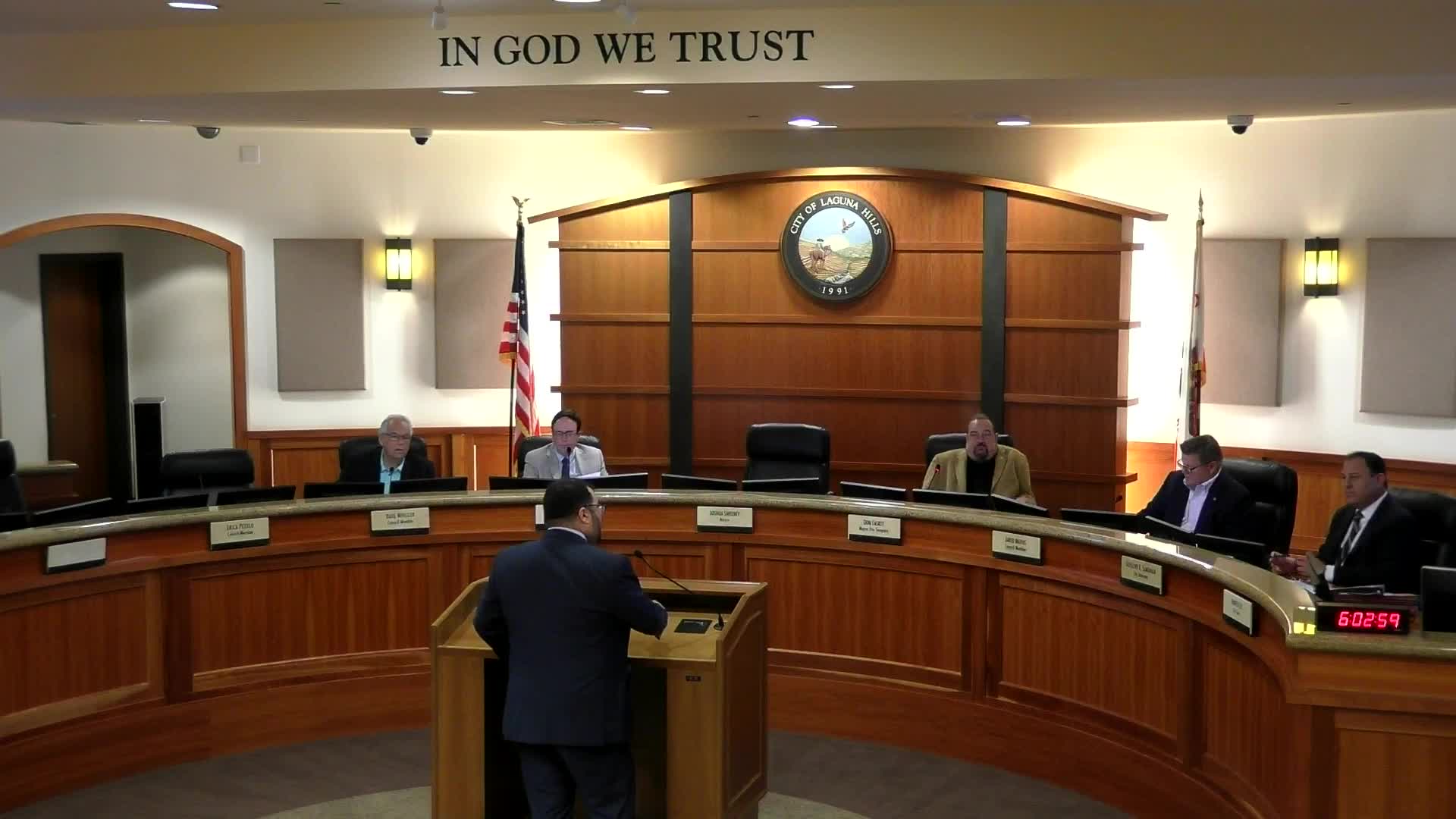
Laguna Hills held its first public hearing on Oct. 7 required to begin a transition from at‑large to by‑district city council elections. Mayor Pro Tem Kaskey opened the special meeting and the city clerk reported a quorum; Justin Levitt, vice president of National Demographics Corporation (NDC), presented the consultant's overview of legal standards, demographic data and a schedule for map drafting.
Laguna Hills held its first public hearing on Oct. 7 required to begin a transition from at‑large to by‑district city council elections. Mayor Pro Tem Kaskey opened the special meeting and the city clerk reported a quorum; Justin Levitt, vice president of National Demographics Corporation (NDC), presented the consultant's overview of legal standards, demographic data and a schedule for map drafting.
"This is really because of a law called the California Voting Rights Act," Levitt said, explaining that the law has made by‑district transitions common across California and has produced litigation that often ends in large settlements. He told the council the city must hold two pre‑map hearings before any maps are drawn, then additional workshops and public comment before a December adoption target, with the first district elections scheduled for November 2026.
Levitt reviewed mapping criteria derived from federal and state law: equal population using 2020 census total population counts (the state‑required baseline), Section 2 of the federal Voting Rights Act, and state Fair Maps Act priorities (contiguity; preserving communities of interest; identifiable boundaries; compactness). He explained legal limits on drawing districts so that race or ethnicity may be considered as one factor but not the sole or predominant factor.
On numbers, Levitt said Laguna Hills' 2020 census total population is 31,399, producing an ideal district population of about 6,280 for five districts. He summarized racial/ethnic totals (about 54% non‑Hispanic white, 24% Latino, 19% Asian) and citizen‑voting‑age population (CVAP) figures used in voting‑rights analyses (roughly 62% white, 17% Hispanic, 17% Asian). He noted some localized anomalies in the 2020 census counts — including units in commercial or hotel areas and effects from the census' differential privacy methods — and said the consultant will flag such anomalies during map review.
Levitt also demonstrated the public participation tools (the consultant's interactive web map at drawlh.org), described how the consultant will accept and post public map submissions, and explained that similar maps are grouped for presentation rather than repeating identical submissions. He gave a schedule: the second pre‑map hearing Oct. 14 (regular council meeting), a community workshop Oct. 15, an internal deadline for draft maps Oct. 17, initial map postings Oct. 21, first draft map presentation Oct. 28, a community revision period with a post by Nov. 11 for the Nov. 18 hearing, and a targeted adoption on Dec. 9.
Council members questioned technical and policy points. "Why would [the census] include noncitizens if they're not eligible to vote?" Councilman Dave Wheeler asked; Levitt responded that California law requires use of total 2020 census population for equal‑population districting and that a 2020 citizen‑only census dataset does not exist. Council members also asked about whether small, nonresidential census blocks could appear to show high concentrations of a demographic group; Levitt explained those can reflect counting anomalies and will be analyzed and explained in map materials.
Staff noted the owner of the former El Toro mall property, Merlone Geier Partners, currently has vested entitlements for up to 1,500 apartment units under a development agreement, a factor the council may consider when weighing maps that account for likely future growth (within legal deviation limits).
The council opened the public hearing and the city clerk reported no electronic or in‑person public comments on the item. With no testimony, the council closed the hearing, thanked Levitt for the presentation and by consensus directed staff to return for the second pre‑map public hearing scheduled Oct. 14. The meeting was adjourned.
Next steps: the consultant will post materials and accept public maps online, present grouped and consultant‑drawn draft maps to the council beginning Oct. 28, hold community workshops and revision windows through November, and seek final adoption at the Dec. 9 hearing; district elections would begin with the staggered cycle starting Nov. 2026.