Get Full Government Meeting Transcripts, Videos, & Alerts Forever!
Get email alerts on the Elections topic
No spam. Unsubscribe anytime.
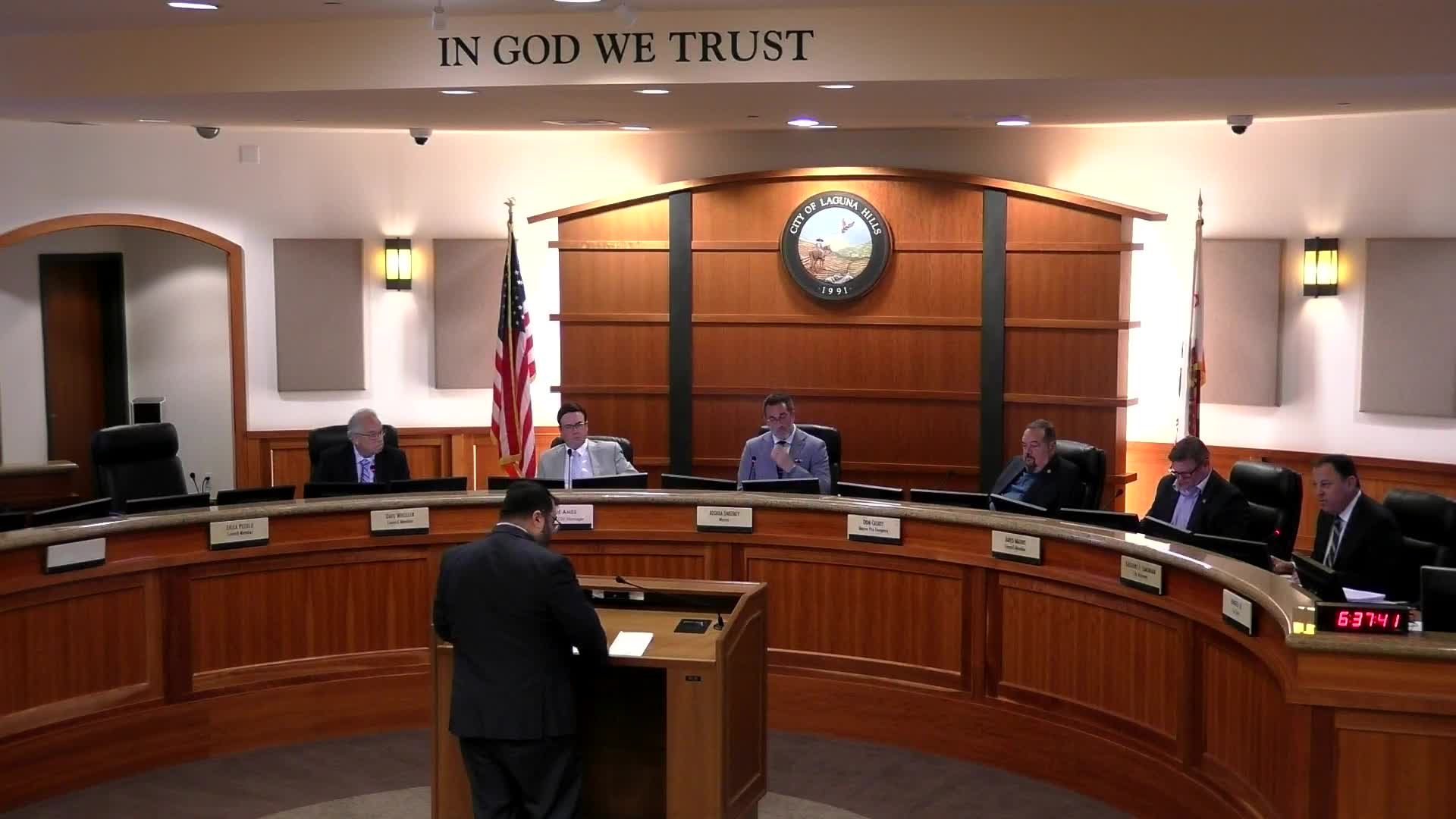
Laguna Hills begins public process to move to by‑district elections; council advances next hearings
Summary
City demographer Justin Levitt outlined the districting criteria and schedule under the California Voting Rights Act; council received the presentation and voted 3–1 to continue the public hearing process, with one member recused on conflict grounds.
The Laguna Hills City Council advanced the city’s transition to by‑district elections after a public presentation by Dr. Justin Levitt of National Demographics Corporation (NDC).
Levitt told the council the California Voting Rights Act has driven many California cities to adopt district elections by lowering the legal threshold for a plaintiff to challenge at‑large elections. He summarized the criteria the city must consider—equal population, contiguity, communities of interest, easily identifiable boundaries and compactness—and described the legal and procedural timeline for public hearings and map posting.
Key details Levitt provided: the city’s 2020 population is 31,399, producing an approximate target district population of 6,280 for a five‑district plan; maps and community submissions must be posted seven days before the hearing that will consider them; the city’s public workshop was scheduled for Oct. 15 in the Heritage Room and the city’s draft maps will be posted by Oct. 21 so the Oct. 28 hearing can consider them.
Levitt also explained technical matters such as use of the statewide adjusted 2020 database, how NDC divides large census blocks when necessary (by allocating block population proportionally to housing units/units within city records), and the statutory priority order for map‑drawing criteria. He invited residents to use the public tools at maplh.org and submit community maps.
Council discussion touched on data sources (census blocks vs. block groups), how split blocks are justified and calculated, how communities of interest are defined in practice, outreach and advertising methods, and legal uncertainties such as potential future changes from higher courts. Council Member Wheeler voted no on the motion to receive and file the presentation; one council member had recused herself earlier because of a potential conflict with counsel filing materials.
What’s next: NDC will post draft maps and the city will hold additional hearings and workshops this fall; the council expects to adopt a final map by December for use starting with the 2026 election cycle.