
Sahuarita council adopts three-part economic development incentive program to attract businesses
Get AI-powered insights, summaries, and transcripts
Subscribe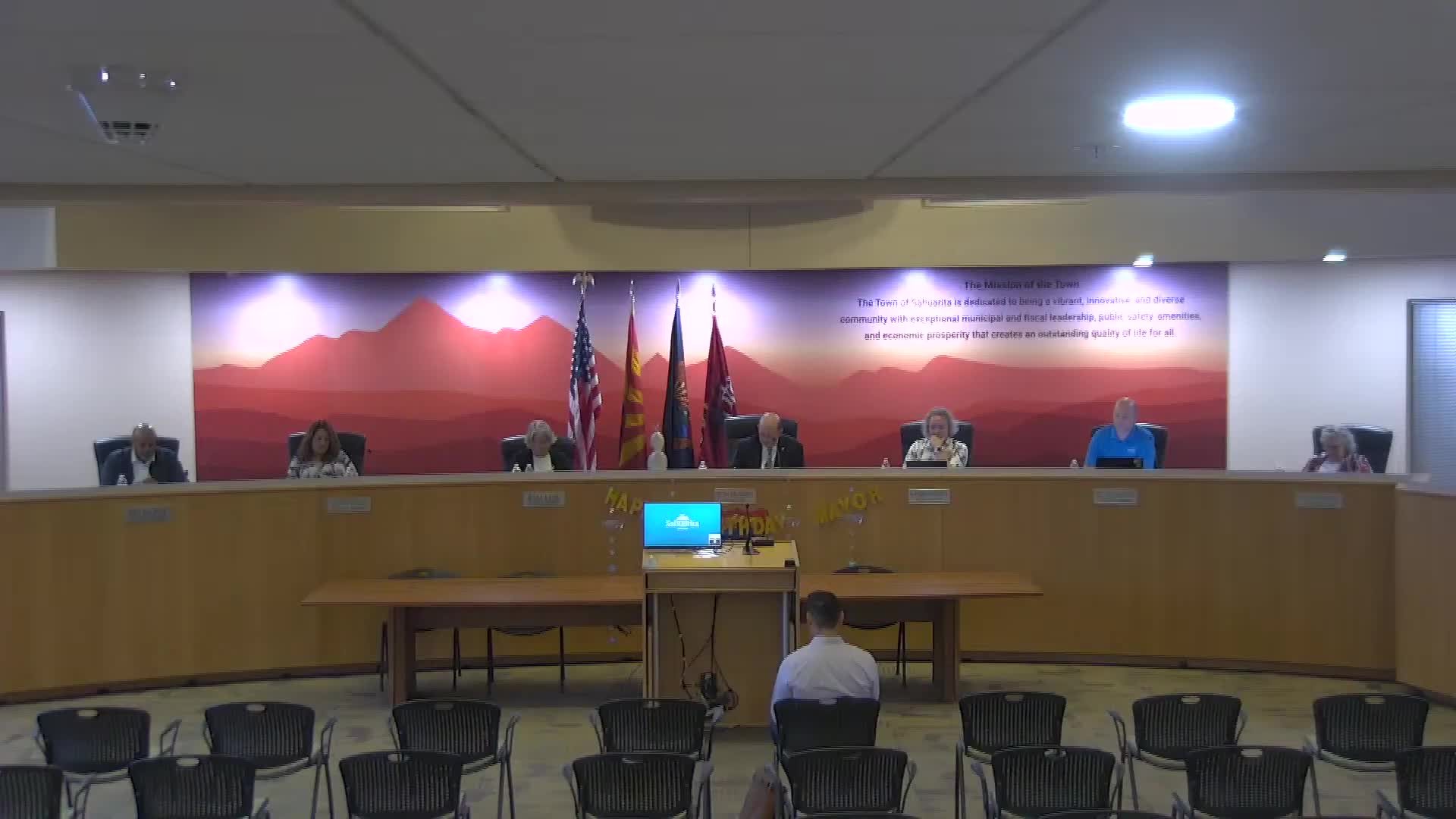
Summary
The Town of Sahuarita adopted a three-part Economic Development Incentive Program offering construction sales‑tax reimbursement, building fee credits and façade grants for qualifying projects that meet eligibility criteria and performance requirements, including clawback provisions for nonperformance.
The Town of Sahuarita council voted to adopt a three-part Economic Development Incentive Program aimed at attracting commercial and industrial development, diversifying the local economy and creating jobs.
Economic Development Director Victor Gonzalez presented the program framework: a business-attraction reimbursement that can return up to 100% of qualifying construction sales tax (illustrated with a $1 million example producing roughly $26,000 in incentive allowance), a building‑fee credit that offsets plan-review and permit costs for qualifying projects, and a façade-grant program that matches up to 50% of eligible exterior improvement costs to rehabilitate older vacant properties.
Gonzalez said projects must meet eligibility criteria to qualify—most importantly the project must be located inside the Town of Sahuarita, be properly zoned, generate at least $1 million in construction hard costs, create jobs and pay at-or-above the Pima County median wage for the industry. Projects must begin construction within 12 months and reach a certificate of occupancy within 36 months; staff emphasized that reimbursement occurs only after eligible work is completed and that agreements will include clawback provisions to recapture awards of up to 100% if projects fail to perform.
Town Manager Shane Dilley highlighted trade-offs for town funds, reminding the council that reimbursing construction taxes reduces the pool available for the town’s capital-improvement program and that staff will review each deal's ROI and protect the CIP where possible. Several council members voiced support for the program as a tool to reduce retail tax leakage and encourage reuse of vacant buildings.
Following presentation and discussion, the council approved the program by voice vote. Gonzalez said each prospective project will return to the council for an individual Economic Development Incentive Agreement that specifies the award, required public improvements and any clawback terms.