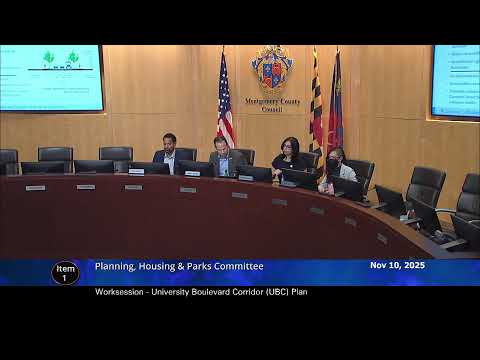
Committee backs University Boulevard Corridor plan with narrower rezoning for abutting lots; members press stronger anti-displacement measures
Loading...
Summary
The Montgomery County Planning, Housing and Parks Committee voted 2–1 to refer the amended University Boulevard Corridor master plan to the full County Council after agreeing to housing‑affordability targets and a compromise rezoning approach.
The Montgomery County Planning, Housing and Parks Committee voted 2–1 to refer the amended University Boulevard Corridor master plan to the full County Council after adopting a package of edits to housing, zoning and implementation language.
The committee left in housing recommendations that call for 15% Moderately Priced Dwelling Units (MPDUs) in new development and for public properties redeveloping with residential components to target a minimum of 30% MPDUs (15% at the standard MPDU level and 15% affordable to households at or below 50% of area median income). "The plan aims to balance the preservation of existing market‑rate affordable housing with the production of new housing that can create additional moderate units along the corridor," planning staff said during the presentation (Ms. Dunn, Planning staff).
Committee members pressed staff on language intended to prevent displacement. One member asked to replace "strive for no net loss" language with mandatory no‑net‑loss wording; planning staff and the planning director explained the tradeoffs, noting that strict no‑net‑loss requirements can force very high MPDU percentages or require much greater density to be financially feasible. Lisa Gavoni, planning supervisor, and Jason Sartore, Planning Director, said prior projects used rental agreements and negotiated approaches with the Department of Housing and Community Affairs (DHCA) to retain units in some cases.
After extensive debate about single‑family conversions, duplex/triplex yields and the risk that zoning changes could increase tax assessments for nearby properties, the committee adopted a compromise on rezoning. The committee voted to recommend to full council that properties that abut University Boulevard be rezoned to the CRN zone with a 45‑foot height cap, while retaining existing residential zoning for non‑abutting parcels. Planning staff said the abutting‑only option would affect roughly 165 parcels (about 9% of the R‑16/R‑90 parcels in the plan area), while a broader planning board scenario had identified about 512 parcels for rezoning.
Planning staff and outside analyses presented a conversion‑yield estimate tied to market assumptions: if many single‑family lots converted to duplexes, staff estimated roughly one additional residential unit per converted parcel and projected up to about 700 additional units over 20 years under the planning‑board scenario, though staff emphasized this is a market‑sensitive estimate and depends on property owners electing to redevelop.
Several council members sought more concrete anti‑displacement strategies and asked planning to return with baseline metrics and monitoring. Planning staff proposed establishing baseline data at plan adoption, creating a public dashboard with metrics (for example, shares of BIPOC residents, homeownership rates, poverty and tax delinquency indicators) and scheduled 5‑year milestone reviews to assess outcomes and consider adjustments.
Action and next steps: the committee referred the plan and the committee's recommendations to the full County Council by a 2–1 committee vote. Staff will update the packet for the full council with the committee’s preferred option, a consolidated explanation of the alternatives that were considered and the monitoring/implementation language the committee requested.
Quotes: "The plan aims to balance the preservation of existing market‑rate affordable housing with the production of new housing that can create additional moderate units along the corridor," Ms. Dunn, planning staff, said during the briefing.
"We will come back with baseline data and milestones so we can define benchmarks for housing access, service access and representation," planning staff said when describing the proposed equity dashboard.
Ending: The committee’s referral sends the plan, with these committee amendments and the request for further monitoring language, to the full County Council for consideration.